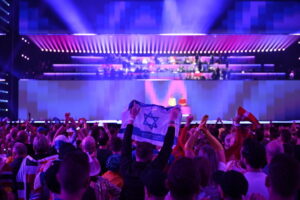
Following announcements from Ireland, Slovenia, the Netherlands, and Iceland, Spain on Wednesday became the first country from the “Big Five“, the five largest sponsors of the Eurovision Song Contest, to formally announce its decision to boycott the next edition in Vienna (12-16 May 2026) if Israel’s entry is not cancelled. The “Big Five” includes Spain, Germany, the United Kingdom, France, and Italy.
The withdrawal was approved by the board of the Spanish public broadcaster RTVE by 10 votes in favour, 4 against, and 1 abstention. The vote followed a statement last week by Spain’s culture minister, Hernest Urtsun, that Spain should withdraw from the event if Israel remains on the list of participating countries.
Dutch public broadcaster AVROTROS also said it could “no longer justify Israel’s participation, given the ongoing humanitarian disaster in Gaza.”
A decision on whether Israel will participate in the song contest is expected in December.
Why is Israel participating in Eurovision?
Israel made its Eurovision debut in 1973. And it’s not the only non-European country to participate: Armenia and Azerbaijan also take part in the event, and since 2015, Australia has been the most “exotic” competing country.
From now on, Australia will be the most exotic country.
With four firsts in its history, Israel is considered one of the most “successful” participating countries. But the Israeli-Palestinian conflict has affected the competition several times over the past five decades.
Security for Israeli contestants
In 1973, Ilanit was the first Eurovision contestant from Israel. A few months earlier, Palestinian terrorists had killed 11 Israeli athletes at the Olympic Village in Munich. It is said that Ilanit wore a bulletproof vest, and the audience had to remain seated throughout her performance.
The 2024 contestant, Israeli Eden Golan, also had special protection. Several countries had called for Israel to be excluded. The organization considered it, but not because of the Gaza war itself: there was a fear that the original title of the song, “October Rai,” was a clear reference to the event that triggered the war: the Hamas terrorist attack on Israel on 7 October 2023. Since the song’s lyrics were changed, Golan was allowed to participate in Eurovision. As in Malmo in 2024, spectators in Basel this year strongly protested against the Israeli entry, whistling and booing Golan.
Ask me anything
Explore related questions