





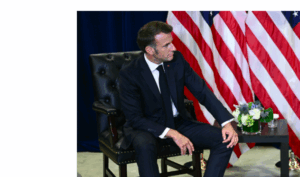
The relationship that the 47th US President, Donald Trump, has built with his French counterpart, Emanuel Macron, over the past nearly 10 years, as each of the two top leaders has maintained his or her own personal view of the international system and the liberal world order, sharpening the divide between the old and “new worlds.”
With… Atlanti,c separating them by underlining their clear ideological and political differences at every opportunity, the difference of opinion between them was once again reiterated yesterday, again against the backdrop of the recognition of Palestine. Firmly in a leadership role, the French President throughout the past period has undertaken a series of diplomatic initiatives calling for a Palestinian state, adding another issue to his agenda of long-standing disagreements with the occupant of the White House, between climate change and NATO.
On the Anglo-Saxon axis
In particular, France has joined the continuum of states such as those of the “Anglo-Saxon axis” (Canada, Great Britain, Australia) that have moved to recognize the state of Palestine in the last twenty-four hours, a choice interpreted as a highly symbolic move, sharply intensifying the pressure on Israel and the situation in Gaza. It is not only the internal public opinion of the EU member states that, to a certain extent, condones such a decision due to the humanitarian crisis, but also the reluctance to find a solution in Ukraine. In a treaty that the French President is projecting himself as the “voice of Europe”, setting a distinctive pace and laying down mortgages for a transnational career after the end of his second term in 2027.
On the other hand, Donald Trump would also like to end his presidential career with a Nobel Prize, having not hesitated to take sometimes critical and sometimes scathing positions, already in the days of his first term, towards the French President, Emmanuel Macron, on specific issues.
The common denominator, moreover, for both presidents is their celebrity, if not their promotion to another institutional office, as both can be re-elected. Yet Palestine vividly illustrates the different view between France and the US, and between the two statesmen personally, as was evident at the end of yesterday.
Speaking from the floor of the UN General Assembly, the French president advocated for recognition of Palestine a day after a summit held to that end, and challenged Donald Trump to end the war in Gaza against the backdrop of a Nobel Peace Prize. He had said he was “completely wrong” to read it as a gift to Hamas, saying in his U.N. testimony that “I see a president of the United States who is proactive, who wants peace… who wants the Nobel Peace Prize. But the Nobel Peace Prize is only possible if you stop this war.” For his part, President Trump reiterated from the same podium his claim that he had “ended seven endless wars” and described the domino effect of Palestine’s recognition as “reward for these horrible atrocities, including October 7.”
Indicative of their different perspectives was the atmosphere at their private meeting in New York, where he appeared optimistic that “we will find a solution” in the Middle East, in contrast to President Macron, who stressed that for two years the war has had no effect. The Israelis “killed the key leaders of Hamas. An impressive achievement, but you have the same leaders as on day one. So this cannot bring down Hamas,” Macron concluded.
Scenes of crisis
A key area of divergence between the two, however, has been European security, with President Macron championing its autonomy, while they have openly clashed over support for Ukraine and the North Atlantic Alliance’s next day on the increased share of member states’ budget contributions, with the French president describing NATO as “brain dead.”
Security-driven, Macron and Trump are not short of times when they have also disagreed in front of TV cameras, when, for example, on the sidelines of the 2020 NATO summit, President Trump challenged his French counterpart to “give back ISIS fighters” who were imprisoned and came from Europe, with President Macron insisting they still pose a threat. But very recently, the Elysee tenant has also reacted strongly to the US President’s policy of tariffs, calling it an “aberration” for NATO members to wage a “trade war” with each other.
Putin in the middle
The escalation, however, between Macron and Trump has a name and it is none other than the Russian President, Vladimir Putin, as the US President’s stance on the Ukraine front has several times brought European leaders to the brink. Being against the Russian President for his expansionist policies from the very beginning, President Macron has been blatantly supportive of his Ukrainian counterpart, Volodymyr Zelensky, even as the latter was on the verge of exploding while visiting Donald Trump at the White House.
The French president has advocated for Ukraine’s autonomy, maintaining its territorial status, but also for its continued arming to counter Russian aggression, leaving sharp edges to Donald Trump’s ambivalent stance. “Putin does not want peace” was a constant refrain from the French president, who resisted the transformation of the Ukrainian issue into a bilateral issue between the US and Russia as far as ending the war is concerned, calling for Ukraine’s active participation in all ways. In this direction, the US President appeared yesterday to be disappointed in the Russian President, remarking that ‘my relationship with him meant nothing’. According to Donald Trump, the Ukrainians “can fight,” while “let [i.e., Volodymyr Zelensky] get their land back [i.e., from Russia], let’s see how that goes,” he concluded.
Ask me anything
Explore related questions




