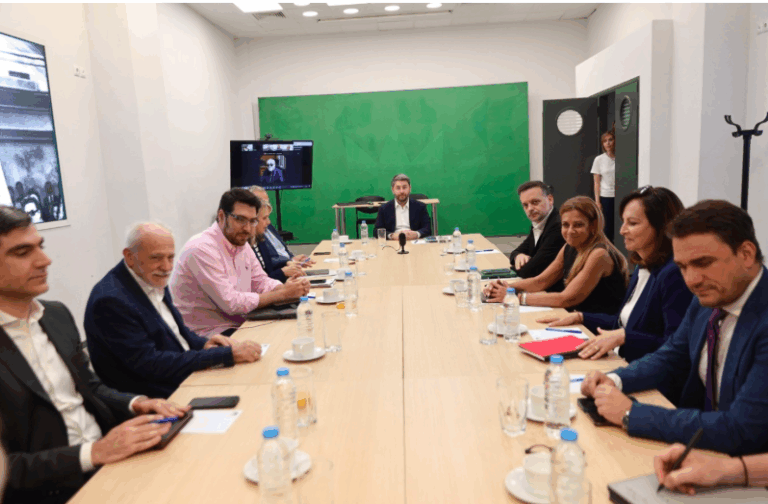
PASOK is mired in near-daily infighting, with senior figures trading barbs and sending pointed messages to leader Nikos Androulakis. At the heart of the tension lies the party’s failure to establish itself as a strong alternative governing pole against the ruling New Democracy — a weakness fueling discontent and sharpening rivalries.
Competing Lines, Open Rifts
Former minister Anna Diamantopoulou recently warned against PASOK drifting into “populism” or becoming a party in the mold of Maria Karystianou or Zoe Konstantopoulou. Her comments came after Athens mayor Haris Doukas openly rejected any post-election cooperation with New Democracy, calling instead for a party-wide congress to settle strategy.
Diamantopoulou’s intervention, sparked by the leadership’s support for hunger-striking activist Panos Routsis (father of a victim of the Tempi rail disaster), underscored her view that PASOK must avoid “waving the flag of populism.”
Pavlos Geroulanos and veteran MP Haris Kastanidis countered sharply, arguing that showing empathy for victims’ families is not populism. “Fighting populism requires first understanding what populism is,” Kastanidis said in Parliament, citing theorist Ernesto Laclau.
Androulakis Holds Back
For his part, Androulakis has chosen not to engage directly with critics. Aides say he considers the questions already answered, but observers note that the party leadership is falling back on rhetoric about “programmatic battles” without clarifying its next steps.
Meanwhile, internal unease grows as polls consistently place PASOK some 15 points behind New Democracy. Talk of Alexis Tsipras’s possible return or even a new center-left vehicle under Karystianou adds to the uncertainty.
Echoes of the Past, Stakes for the Future
Party veterans recall Costas Laliotis once joking that “PASOK has seven lives.” Today, figures like Doukas and Diamantopoulou frame the struggle as a contest over the party’s very identity: whether to embrace progressive alliances, as Geroulanos advocates, or to defend political “calm” and resist Syriza-style tactics, as Diamantopoulou insists.
“The responsibility we carry is not to become another Karystianou or Konstantopoulou,” Diamantopoulou said in a recent speech in Kilkis, warning against street politics and rally-driven momentum. Instead, she argued, PASOK must act through institutions and uphold stability: “We lived through the fists, the broken glass, the anger with Syriza. We will not repeat that.”
Yet critics fear that this line risks alienating segments of society that mobilized after the Tempi disaster and remain receptive to anti-establishment appeals. With elections approaching, the challenge for Androulakis is stark: to bridge these divides and stop the party’s gradual slide from the 20% highs of late 2024 toward fragmentation and voter drift.
Ask me anything
Explore related questions