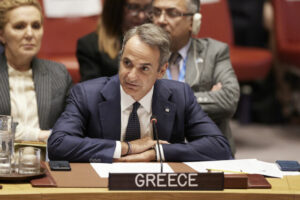
Prime Minister Kyriakos Mitsotakis spoke at a high-level event of the UN Security Council, organized by the Korean presidency, on the theme “Artificial Intelligence and International Peace and Security.”
Speaking in New York during the High-Level Week of the 80th General Assembly, he underlined both the opportunities and the risks of artificial intelligence (AI), insisting that global governance must ensure that technology “serves peace, human dignity, and the highest aspirations of humanity.”
Mr. Mitsotakis began by congratulating South Korea for organizing the session, linking it to previous initiatives. “Today’s discussion builds on the informal Arria-formula meeting that Greece co-hosted last April with France and the Republic of Korea,” he said.
He also noted that the recent summits in The Hague and Seoul, the U.S. Political Declaration on the Responsible Military Use of AI, and the Paris AI Action Summit “contributed to the development of rules, regulations, and guidelines for the responsible development and use of artificial intelligence, including in the highly sensitive military field.”
The Prime Minister emphasized that AI is not “just another tool,” but a general-purpose capability that can either strengthen peace or destabilize. “In the right hands, it can enhance peacekeeping, improve early warning systems, accelerate humanitarian assistance… In the wrong hands, it can fuel disinformation, intensify cyberattacks, and lower the threshold for escalation and conflict,” he said.
By its nature, he added, AI is “a dual-use technology, which means that our collective security increasingly depends on the choices we make.”
Mr. Mitsotakis connected the issue to historical examples of regulation, arguing that just as institutions were created in the past to regulate nuclear energy and arms control, “we must now develop new mechanisms to ensure that innovation in artificial intelligence enhances not only peace and security but also human dignity.” This, he stressed, requires “international cooperation, transparency, and a renewed commitment to the principles of the UN Charter.”
Acknowledging today’s security realities, he warned that malicious actors are advancing quickly: “If we want to protect our citizens, maintain our deterrent power, and ensure stability, we must also invest responsibly in AI applications for defense and security — always in accordance with international law and with a firm commitment to human oversight.”
He stressed that this “is not a call for a new arms race, but recognition of the fact that peace is hard to achieve, harder to safeguard, and hardest of all to sustain.”
The Prime Minister described the present moment as decisive. “We are at a turning point. The choices we make about AI will not only redefine the balance of power, but also determine whether technology becomes a force for human progress or a lever of threat,” he noted.
He urged the Security Council to rise to the occasion, as it did in the nuclear era. “The Council must now respond to manage the age of artificial intelligence,” he said.
“Greece believes that the United Nations has the historic responsibility to chart a course where innovation strengthens peace, responsibility tempers power, and technology serves humanity’s highest aspirations.”
He warned that AI must not be allowed to become “a source of rivalry and division,” but rather “a cornerstone for a safer, fairer, and more peaceful world.”
Ask me anything
Explore related questions