





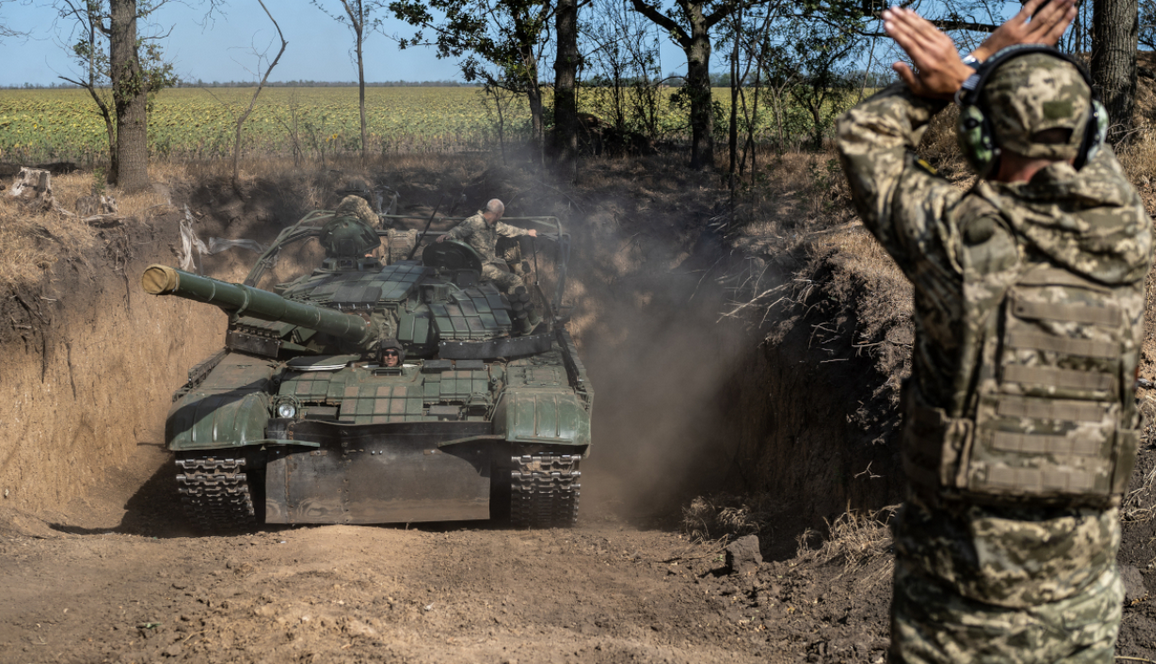
The recent shift in tone by U.S. President Donald Trump, regarding the possibility that Ukraine could reclaim its lost territories in the war with Russia, with the help of NATO and the European Union, has revived the question of how realistic this actually is.
Sky News, in an extensive analysis, records the facts on the ground and, with the help of maps, attempts to visualize the situation.
Which territories does Russia control?
Russia currently occupies about 19% of Ukraine, including Crimea, which it annexed in 2014. Moscow has focused on the regions of Luhansk, Donetsk, Zaporizhzhia, and Kherson, though it has not managed to fully seize them. In Luhansk, it controls almost the entire region, but in Donetsk, Zaporizhzhia, and Kherson, around 30% remains under Ukrainian control.
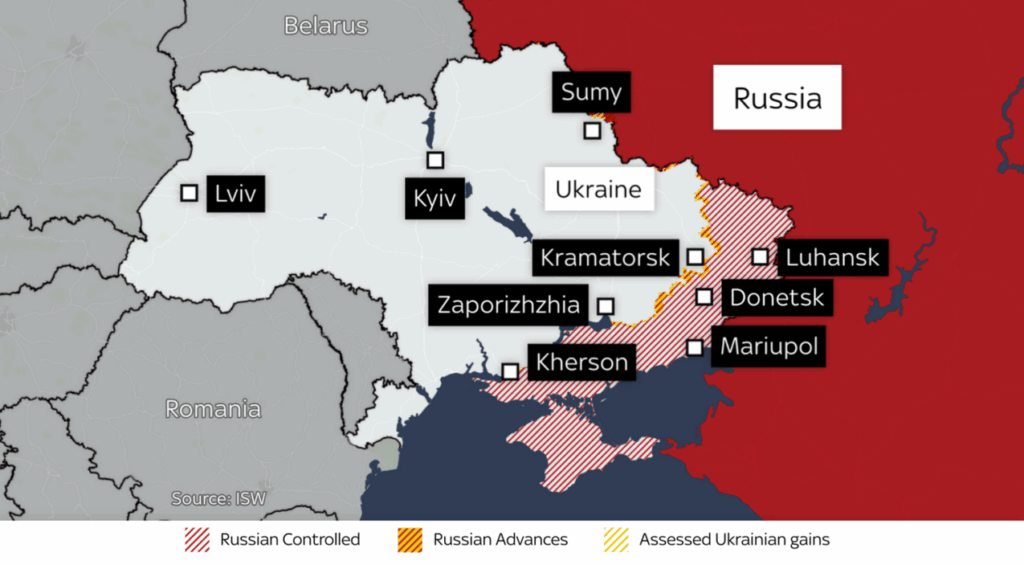
Russian forces have achieved territorial gains at a slow pace and with significant losses. Despite constant attacks, major cities of the Donbas have been resisting for years, and Moscow’s advance has not managed to deliver a decisive strategic blow.
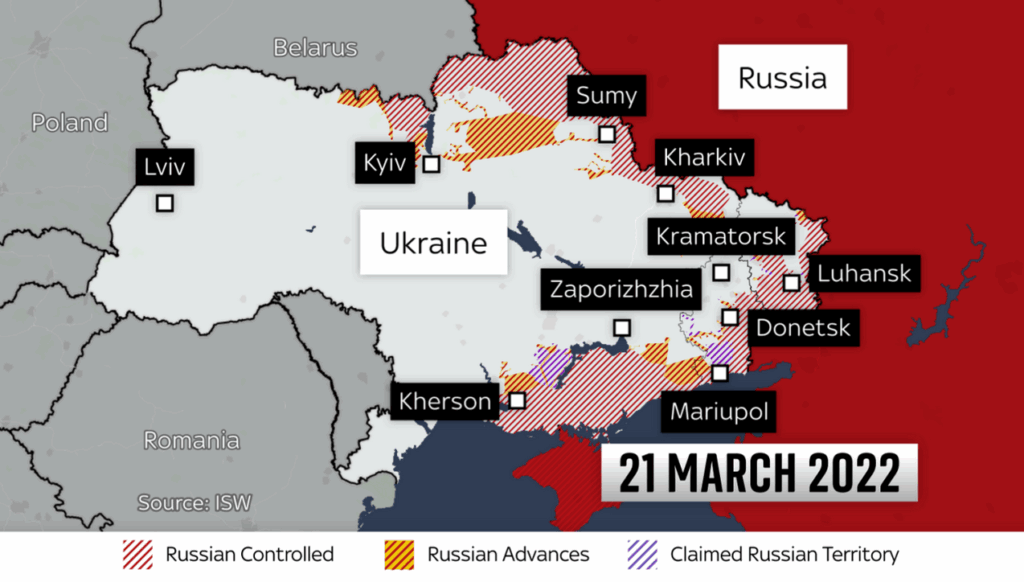
Can Ukraine turn the tide?
The fiercest battles are unfolding in the Donbas region, particularly around Pokrovsk, an industrial city – a hub of rail and road networks – that had a pre-war population of about 60,000.
The city is under severe pressure, with Russian forces attempting to encircle the defenders and cut off supply lines. For weeks, there was a sense that its fall was only a matter of time, but Ukrainian counterattacks have created new conditions.
“Our warriors are advancing,” declared Armed Forces commander Oleksandr Syrskyi, while Zelensky spoke of the destruction of Russian forces in the area and the recapture of 160 square kilometers. At the same time, the “wall” of four cities – Kramatorsk, Sloviansk, and two others – remains under Ukrainian control, blocking Russia’s advance into eastern Ukraine.
The shortage of troops, supplies, and the chaotic management make it increasingly difficult to withstand Russia’s relentless pressure. However, Kremlin forces have yet to make significant progress toward any of the cities.
Colonel Pavlo Yurchuk, whose forces are defending a small town on the northern edge of the fortified zone, stated that he is certain Russia’s latest attempt to advance there will fail. “From a military point of view it looks right – on the map it looks neat – but after nearly three and a half years of war, we all know that such maneuvers and such broad flanking operations are not Russia’s strong suit,” he told the Associated Press.
Battles in the Northeast
On the northeastern front, near Kupiansk, Russian forces have made advances. Kupiansk, a key rail junction and supply hub, is considered of strategic importance.
The Russian Ministry of Defense claimed it had partially encircled Ukrainian forces in the area, though this has been disputed by the Institute for the Study of War, which stressed there is no confirmed evidence. Moscow has announced plans for offensives in multiple directions, including the cities of Chuhuiv, Izium, and Vovchansk in the Kharkiv region.
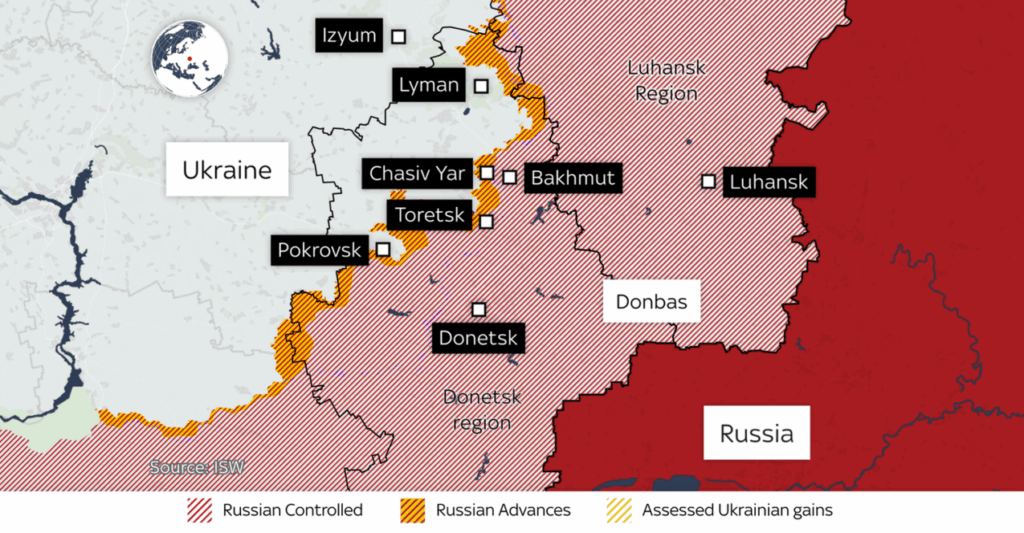
This development signals an expansion of Russian objectives beyond the four regions that Russia declared it was annexing in 2022.
Nuclear facilities in Zaporizhzhia and Crimea
In the south, Ukraine has set as a strategic goal the recapture of the Zaporizhzhia nuclear power plant, which has been under Russian control since March 2022. Its recovery would be crucial for the country’s energy security.
Beyond that, Mariupol and Melitopol remain in Russian hands, while Crimea continues to be Kyiv’s top strategic objective. The peninsula, connected to Russia by the Kerch Bridge, remains both a symbol and a critical supply hub for the Russian military.
The city of Kherson, which was liberated in 2022, remains under Ukrainian control on the west bank of the Dnipro River. On the opposite bank, despite ongoing Russian attacks, Ukraine maintains a small but steady bridgehead, demonstrating its ability to hold ground even under adverse conditions.
Trump’s statement on Ukraine’s capabilities serves as political and psychological encouragement. On the ground, however, the situation remains complex. Russia continues to hold critical territories, while Kyiv relies on Western support to sustain resistance and counteroffensives.
The question remains whether Ukraine can actually realize the U.S. president’s optimistic assessment, or whether the conflict will drag on with uncertain outcomes.
Ask me anything
Explore related questions




