PASOK: Scrambling to Hold Second Place After Tsipras’ Surprise Move
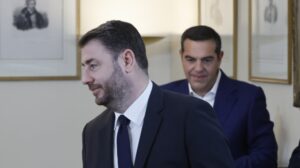
PASOK has entered an uphill battle to defend its claim to second place in the polls, rushing to revamp its image and strategy after Alexis Tsipras’ unexpected political comeback. The party now realizes it lacks even the two-month window that Pavlos Geroulanos had warned was needed to mount an effective counterattack.
The former prime minister’s decision to reassert himself as a central figure in the center-left — by resigning from his parliamentary seat — has not only unsettled PASOK but also forced its leadership on Charilaou Trikoupis Street to look for a political “lifeline.” The move comes as fears grow of losing ground in the polls ahead of the next elections, with Tsipras’ new initiative threatening to draw voters away.
For months, PASOK had been focused solely on competing with New Democracy, maintaining its stated goal of “winning even by one vote.” Now, however, the party finds itself fighting on two fronts — against both the ruling conservatives and Tsipras’ new formation — without the cushion of any recent polling boost. Despite New Democracy showing signs of fatigue after more than six years in government, early readings suggest Tsipras’ new party could debut with numbers rivaling PASOK’s.
Warnings Ignored
Until recently, PASOK officials had downplayed the prospect of Tsipras’ return. Despite internal calls for more collective decision-making, the leadership postponed crucial initiatives — such as more frequent meetings of elected bodies and setting a date for a party congress to clarify strategy before the elections.
Pavlos Geroulanos had been one of the few to sound the alarm. Pointing to PASOK’s “stuck needle” in the polls, he warned that “we must move within two months, because things will be much more difficult later.” His statement, now seen as prophetic, sparked internal debate over the risk of stagnation or even decline as the election approached. Several PASOK MPs are now urging a more aggressive communications push, warning that the political landscape will only grow more competitive.
Androulakis Strikes Back
In the wake of Tsipras’ announcement, Nikos Androulakis moved swiftly to counterattack, seeking to regain momentum and set the tone for the coming battle.
“Today’s development confirms that from the moment the former prime minister resigned as SYRIZA leader, he was already plotting his next move — effectively orchestrating his party’s dissolution behind the scenes,” Androulakis told ERT News. “Now, he’s trying to return to the spotlight outside the framework of SYRIZA.”
Positioning himself as the main alternative to both Tsipras and Prime Minister Mitsotakis, Androulakis argued that “only PASOK can form a credible and strong opponent to New Democracy and deliver political change.” He added, in a pointed jab at Tsipras, that “such efforts cannot be built on reckless behavior or backroom maneuvering.”
Responding to Tsipras’ remarks about egos among center-left leaders, Androulakis fired back: “Some have already been judged — and others will be judged soon.” He continued, “New Democracy’s 41% victory was a result of how Tsipras handled his role as opposition leader. He has been in Parliament for two years and remained silent on key issues — from the Tempi tragedy to the OPEKEPE scandal. Who is truly self-serving? The one who fights in Parliament every day, or the one who disappeared from the debate?”
Doukas Draws a Line
Former Athens mayoral candidate Charis Doukas also took a firm stance, telling Protothema.gr and Antonis Sroiter that he would never consider cooperating with Tsipras, insisting his loyalty lies solely with PASOK.
Doukas acknowledged that party members sent him a clear message during internal elections — that he cannot combine the roles of mayor and party leader — but emphasized that he remains active in national politics. He argued that PASOK’s goal should be to finish first in the elections, saying that “second place would be a failure.” While admitting that current polling numbers are disappointing, he warned that Androulakis “cannot operate under constant time pressure” and called for a party congress to establish clear positions — especially the commitment to no post-election cooperation with New Democracy.
Diamantopoulou’s Critique
Anna Diamantopoulou, head of PASOK’s political planning, also weighed in after Tsipras’ announcement, predicting new turbulence within SYRIZA.
“Alexis Tsipras’ resignation from Parliament marks the seventh split within SYRIZA,” she wrote. “He now calls on the leaders of the Left and Center-Left to ‘set aside their egos and end the fragmentation.’”
Diamantopoulou, who has repeatedly criticized Tsipras’ leadership style in the past, once again dismissed any possibility of cooperation with him — reinforcing PASOK’s effort to draw a clear line between the two camps.
Ask me anything
Explore related questions