

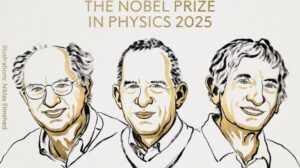
Professors John Clarke, Michel Devoret, and John Martinis have been awarded the 2025 Nobel Prize in Physics “for the discovery of macroscopic quantum tunneling and energy quantization in an electrical circuit,” the Royal Swedish Academy of Sciences announced.
The 2025 Physics Prize recognizes groundbreaking experiments that demonstrated how quantum tunneling can be observed on a macroscopic scale, involving vast numbers of particles rather than just a few.
One of the great questions in modern physics concerns the largest possible size of a system that can still display quantum mechanical behavior. The three laureates conducted experiments using a superconducting electrical circuit, where they observed both quantum tunneling and quantized energy levels in a system large enough to fit in the palm of a hand.
Transistors in computer microchips are already an example of quantum technology in everyday life. The 2025 Nobel Prize in Physics paves the way for the next generation of quantum technologies—from quantum cryptography and quantum computing to ultra-sensitive quantum sensors.
The experiment designed by Clarke, Devoret, and Martinis used a superconducting circuit on a chip about one centimeter in size. Previously, such quantum phenomena had been observed only in systems with a few particles. This time, the effects appeared in a quantum system containing billions of Cooper pairs spread throughout the superconducting material—bridging the gap between the microscopic and macroscopic worlds.
Imagine throwing a ball at a wall. You would expect it to bounce back, not to magically appear on the other side. Yet in quantum mechanics, this seemingly impossible behavior—known as tunneling—can occur.
Through their pioneering experiments, the three laureates showed that the strange laws of the quantum world can manifest in tangible systems we can hold in our hands. Their superconducting circuit could “tunnel” between states as if passing through a wall and could absorb and emit energy in discrete packets—just as quantum mechanics predicts.
Ask me anything
Explore related questions