





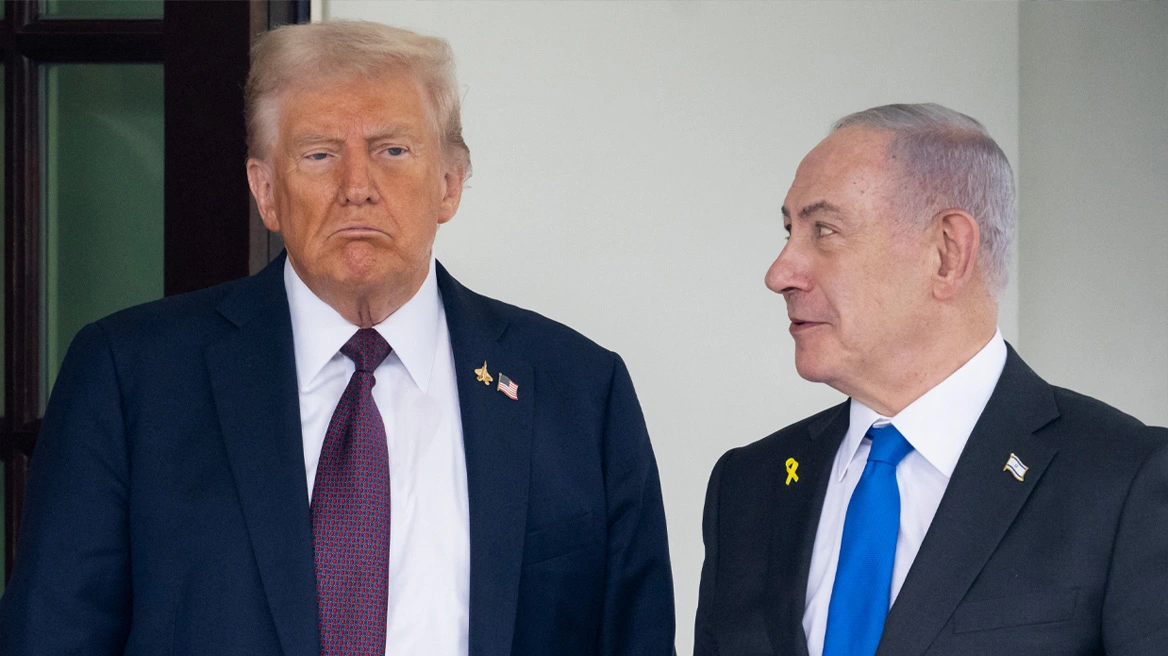
The decision of the United States and Israel to once again “plunge” into a new war with Iran creates an extremely dangerous moment with unpredictable consequences. Israel used the word “preemptive” to justify its attack.
The evidence shows that this is not a response to an imminent threat—something the concept of preemptive action would require. Instead, it is a war of choice. Israel and the United States have calculated that the Islamic regime in Iran is vulnerable—facing an acute economic crisis, the political cost of violently suppressing protesters earlier in the year, and defenses that remain seriously weakened by last summer’s war. Their conclusion appears to have been that this was an opportunity not to be missed.
Iran as a danger to the US and Israel
It is also another blow to an already shaken system of international law. In their statements, both President Donald Trump and Prime Minister Benjamin Netanyahu said that Iran poses a danger to their countries—Trump said it poses a global danger. The Islamic regime is indeed their greatest enemy. But it is hard to see how the legal justification of self-defense can be applied, given the enormous imbalance of power between the US and Israel on one side and Iran on the other.
War is a political act. Armed conflict, by its nature, is difficult to control once it begins. Leaders need clear objectives.
Benjamin Netanyahu has viewed Iran as Israel’s most dangerous enemy for decades. For him, this is an opportunity to inflict as much damage as possible on Tehran’s regime and Iran’s military capability. Netanyahu is also facing general elections later this year. Evidence from two years of war with Hamas shows that he believes his political position strengthens when Israel is at war.
Trump shifts his goals
Donald Trump’s objectives have drifted and changed, as is characteristic. Back in January, he told protesters in Iran that help was on the way. Much of the US Navy was then engaged in the removal of Venezuela’s leader, so Trump did not have many military options.
As the US deployed two aircraft-carrier strike groups to the region, along with significant ground firepower, Trump spoke extensively about the dangers of Iran’s nuclear ambitions—even though, after last summer’s war, he had said the Iranian nuclear program had been “eliminated.”
The Iranian regime has always denied seeking a nuclear weapon, but it has enriched uranium to a level that has no civilian use in a nuclear energy program. At the very least, it appears to want to keep the option of building a bomb. So far, Israel and the US have published no evidence that this was about to happen imminently.
In his video, Trump told Iranians that “the hour of freedom” is approaching. Netanyahu sent a similar message—that the war would give Iran’s people the opportunity to overthrow the regime. That is far from certain.
The examples of Iraq and Libya
There is no precedent for regime change brought about solely by air strikes. Saddam Hussein in Iraq was overthrown in 2003 by a massive US-led invasion force. Muammar Gaddafi in Libya was overthrown in 2011 by rebel forces that effectively acquired an air force through NATO and certain Arab states. In both cases, the result was state collapse, civil war, and thousands of killings. Libya remains a failed state. Iraq continues to face the consequences of the invasion and the bloodshed that followed.
Even if this becomes the first case in which air power alone topples a regime, the Islamic regime will not be replaced by a liberal democracy that respects human rights. There is no credible alternative government in exile waiting “in the wings.”
For nearly half a century, the Iranian regime has built a complex political system based on a mix of ideology, corruption, and—when required—ruthless use of violence. Tehran’s regime showed in January that it was willing to kill protesters. It has security forces that obey orders to shoot and kill thousands of fellow citizens when they challenge the system in the streets and demand freedom.
Assassinating Khamenei as a strategy
Perhaps the US and Israel are trying to kill the supreme leader, Ayatollah Ali Khamenei. Israel believes in the power of assassination as a strategy. Over the past two years it has killed the leaders of Hamas in Gaza and Hezbollah in Lebanon, as well as many of their deputies.
The Islamic regime in Iran, however, is a different matter. It governs a state, not an armed movement. It is not the affair of one man. If the supreme leader were killed, he would be replaced—most likely by another cleric, with support from the Islamic Revolutionary Guard Corps (IRGC), which exists alongside the conventional armed forces with the explicit mission of defending the regime from internal and external threats.
Trump offered them immunity if they laid down their arms—or certain death. The IRGC is unlikely to be tempted by this offer. Martyrdom is a constant motif in the ideology of the Islamic Republic and in Shiite Islam. Trump believes that the primary driving force in politics and in life is transaction—as he puts it in his book The Art of the Deal. But dealing with Iran requires taking into account the power of ideology and faith.
That is far harder to measure. As this crisis has built since the turn of the year and America assembled its armada, there were increasing signs that Tehran’s leadership saw war as inevitable. They engaged in talks, aware that last summer as well, while talks were underway, Israel attacked and the US joined it.
They trust neither the US nor the Israelis
In his first term, Trump withdrew from the Iran nuclear deal, the JCPOA, which limited Iran’s nuclear program and was the signature foreign-policy achievement of the administration of Barack Obama.
There were indications that Iran might have been willing to accept a “JCPOA 2.0”-type agreement, at least to buy time. But the US appeared also to demand tough restrictions on its missile program and on its support for regional allies opposed to Israel and the US.
That was unacceptable for Tehran—it amounted to capitulation. Abandoning missiles and allies could, in the leadership’s mind, make it far more vulnerable to regime change from the threat—and now the reality—of an attack.
Instability deepens in the region
Iran’s leaders will now be calculating how to withstand the war, how to survive, and how to manage its consequences. Their neighbors, led by Saudi Arabia, will be dismayed by the great uncertainty and the potential consequences of today’s events.
Given the Middle East’s capacity to “export” problems, the outbreak of a renewed and intensified war deepens the instability of a region—and a wider world—that is already turbulent, violent, and dangerous.
Ask me anything
Explore related questions




