





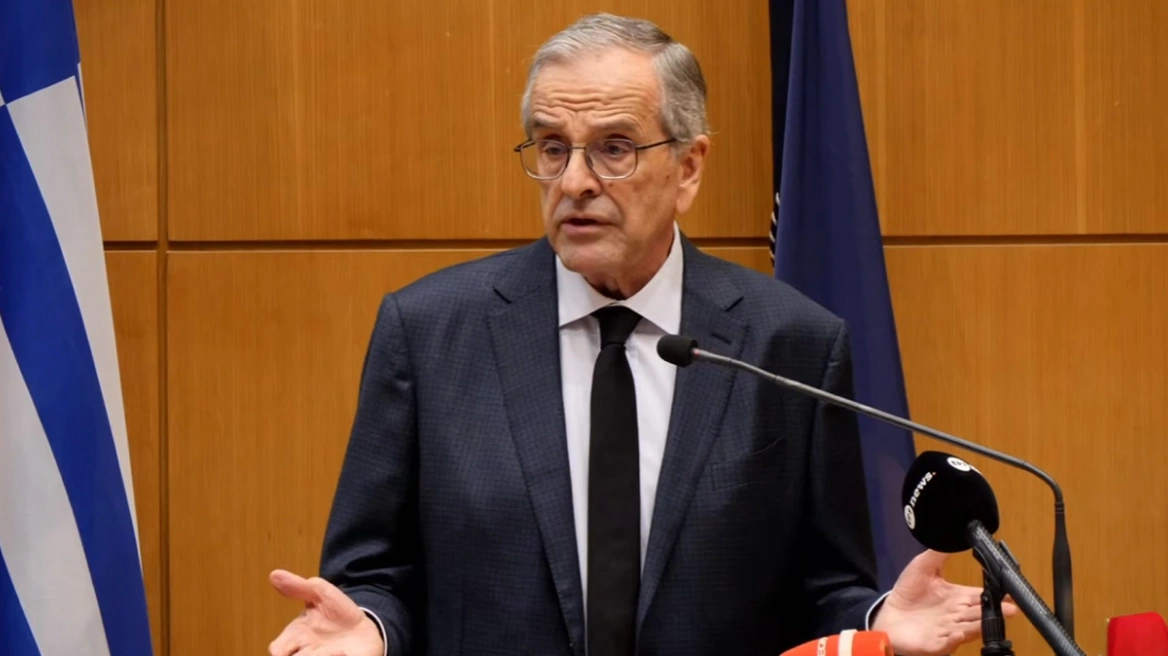
Antonis Samaras kept his cards close to his chest regarding scenarios suggesting he is considering the creation of a new political party, during an event held by the think tank “The Meaning – Crete” at the Heraklion Chamber of Commerce.
The former prime minister avoided giving a direct answer about his next political moves, but his remarks left open the possibility of future initiatives.
“I respond clearly: struggles for the country are not a profession, and in the struggle for the homeland there is no retirement. The contract with the homeland does not expire at some point,” he said, adding that this is the message he wants to pass on to young people. “To follow the straight path, not backward steps; struggle, not surrender,” he said.
He went on to argue that his presence in public life is driven by concern over the country’s direction.
“I would not be here if I did not believe my country is in danger and that there is another Greece that is not being heard. Not only from centre-right citizens, but from patriots and democrats who are tired of confrontations. These citizens constitute the ‘other Greece,’” he stressed.
Samaras also expressed optimism about the future, saying that “everything can change,” and referenced the poem “Gyríze” by Kostis Palamas, which he read to the audience.
In closing his speech, he emphasized that Greece still has the reserves needed for a new course.
“Within this blessed land, hope is always reborn. Politics, like nature and history, does not tolerate voids. The Greece of dignity, pride, and hope cannot remain resigned. And I, as I do not mince my words about today, do not lose my optimism about what can happen tomorrow,” he said.
Immediately afterward, when asked directly whether he intends to found a new party, he again avoided revealing his plans, while leaving clear hints of forthcoming announcements.
“I have gained great strength and wisdom by listening to the people. I have made my decisions and will announce them when and how appropriate,” he said, prompting warm applause.
Samaras’ speech contained strong criticism of government policy on the economy, demographic decline, migration, and national issues, as well as special reference to challenges facing Crete.
A central theme of his intervention was the need for a clear national strategy for Greece’s future, focusing on economic growth, the demographic crisis, and the country’s geopolitical positioning.
He argued that politics has been overtaken by communication, stating that “communication has replaced politics,” and stressed the need for substantive political discourse to return to public debate.
Referring to Crete, he highlighted issues affecting the island, such as migration, road safety on the Northern Road Axis of Crete (BOAK), and ExxonMobil’s withdrawal from energy plans in the region. He also acknowledged ongoing infrastructure projects but warned that Crete risks becoming an overburdened tourist destination.
“Crete risks losing its identity,” he said, stressing that development must be balanced with preserving the island’s character and identity.
On economic policy, he criticized the management of EU funds, arguing that a significant portion ends up benefiting only a small number of recipients. He said the government should have reduced waste and directed more resources toward addressing the demographic problem.
“There is wasted money everywhere and opacity is widespread,” he claimed, warning of risks, as he put it.
Within this framework, he presented two main economic proposals: reducing tax rates for small and medium-sized enterprises and abolishing advance tax payments, measures he believes would strengthen the real economy and entrepreneurship.
No policy of appeasement toward Turkey
He was particularly sharp on national issues and Greek–Turkish relations. He argued that Turkey continues to directly challenge Greek sovereign rights, making claims that extend to half the Aegean.
The former prime minister reiterated his proposal for an emergency EU summit on Turkish provocations, stressing that the European Union must understand that Greece needs to define its own geopolitical course and abandon the policy of appeasement toward Turkey.
“The policy toward Turkey must have a cost for it,” he said, arguing that Athens must use all available diplomatic tools.
He also noted that President Recep Tayyip Erdoğan “strikes from two directions,” referring to both the “Blue Homeland” doctrine and Turkish claims regarding two NATO headquarters. He said Greece should even consider exercising a veto if Ankara does not definitively abandon its claims.
He also referred to relations with Albania, warning that if Prime Minister Edi Rama continues not to respect the rights of the Greek national minority, Greece should block Albania’s EU accession path.
Samaras criticized the government’s strategy toward Turkey, arguing that the impression of calm is misleading due to the so-called “calm waters.” In his view, developments such as the “Blue Homeland,” the Kasos incident, and the Turkey–Libya memorandum intensified because Greece abandoned consistency in its positions and adopted a policy of appeasement.
“Now we must act before it is too late,” he concluded, stressing that the country needs a clear strategy both domestically and internationally.
“ND and SYRIZA are two sides of the same coin”
The former prime minister launched a dual personal attack on Tsipras and Mitsotakis, saying the two are very similar.
“Tsipras chose the name ELAS. It is a provocative staging. He instrumentalizes the most emotionally charged symbols, bringing gunpowder from the past to save the future of Greeks,” he said. Referring to Kyriakos Mitsotakis, he added that at the latest ND conference he presented a video featuring only the party’s founder and himself.
“Mitsotakis and Tsipras adopted the woke agenda. New Democracy and SYRIZA are two sides of the same coin,” he also said, adding that the broader centre-right space is now without representation.
He also referred to insults, mudslinging, and personal attacks from New Democracy officials against him, and reiterated that “the struggles for the country are not a profession and there is no retirement. These struggles follow you until your last breath.”
“I would not be here if I did not believe my country is in danger and that there is another Greece that is not being heard,” he said again, closing his speech without revealing whether he plans to found a new political party.
“The Greece of dignity, merit, competitiveness, pride, and hope — beyond and above parties — will not remain resigned and silent. It will claim its role and take its destiny into its own hands,” he said. “And I, as I do not mince my words about what is happening now, assure you that I do not lose my optimism about what can happen tomorrow.”
Ask me anything
Explore related questions




