





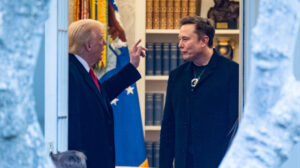
Donald Trump and Elon Musk appear, for now at least, to have set aside the “war” they waged via social media roughly a year ago, and have reopened their lines of communication. The reason for the shift looks fairly specific: November’s midterm elections, and what both men stand to lose or gain from them.
The rapprochement was sealed last May, when cabinet secretaries, business figures and members of the Trump family boarded Air Force One for the long flight to China. Among them was the ultra-wealthy businessman.
According to people who were on the plane, the mood between the two men was friendly. The head of Tesla and SpaceX, who at the time was close to becoming the world’s first trillionaire, spoke to the US president about plans to build new factories in America. Trump, for his part, brought up a rocket launch video he had watched shortly before and asked Musk about one of his young sons. Musk, together with White House advisers present, reminisced about his role in the 2024 presidential campaign.
It was then that Musk delivered the news Trump’s team had been waiting months to hear: he intended to help fund Republicans financially in the November midterms.
According to people familiar with the plans, cited by the Wall Street Journal, Musk intends to commit at least $100 million to a major voter mobilisation drive aimed at helping Republicans keep control of Congress.
From public falling-out to reconciliation
The scene aboard Air Force One was the culmination of an almost year-long effort to repair relations between the two men, following the collapse of one of the most unusual political alliances in recent American history.
The reconciliation effort involved behind-the-scenes phone calls, interventions by mutual friends, invitations to Mar-a-Lago and White House events.
A tragic event also played a catalytic role: the assassination of conservative activist Charlie Kirk, who in the months before his death had been trying to repair relations between Trump and Musk.
Despite the rapprochement, Trump reportedly admits privately that the relationship will never again be as close as it once was. Still, the two now speak roughly once a month, discussing artificial intelligence, China and international affairs.
The restored relationship suits both men. If Democrats win control of Congress, they are ready to launch a string of investigations into Trump and his family. Musk could also find himself in the crosshairs, given how heavily his companies rely on highly lucrative government contracts.
The ‘big bombshell’ Musk dropped
Trump and Musk built a close relationship during the 2024 election campaign. After Trump returned to the White House, Musk effectively moved into the presidential complex, even spending some nights there, to oversee the drive to drastically shrink the federal government.
His unorthodox conduct, however, generated a steady stream of negative headlines and resentment among Trump’s cabinet secretaries, who felt they should have had greater control over their own departments.
The situation spiralled out of control in June 2025, when tensions that had been simmering behind the scenes erupted into open warfare online.
“Time to drop the really big bomb,” Musk wrote to his 240 million followers on X, claiming that Trump’s name appeared in investigative files on Jeffrey Epstein and that this was “the real reason they haven’t been made public.”
Trump responded via Truth Social, threatening to cancel the government contracts held by Musk’s companies. He also accused the businessman of opposing the administration’s flagship tax and spending bill because it scrapped incentives for electric vehicles.
Musk had branded the bill a “disgusting abomination,” arguing it would send US debt soaring even higher. “Without me, Trump would have lost the election,” Musk wrote, having spent almost $300 million to help secure Trump’s re-election in 2024. “Such ingratitude.”
Vance and Wiles moved to put out the fire
Publicly, the White House tried to play down Musk’s attacks, dismissing them as an “unfortunate episode.” Behind the scenes, however, senior administration figures scrambled to mend the relationship.
Just a day after the public clash, Vice President JD Vance and White House Chief of Staff Susie Wiles quietly reached out to Musk in an effort to de-escalate things. The conversation went well, according to sources, and early the following week Musk himself phoned Trump. A social media post followed in which he expressed regret over some of his remarks, admitting he had “gone too far.”
It would still take several more months before the relationship was genuinely repaired. In September, Trump told a senior White House official that he was not yet ready to bring Musk back into his inner circle.
Vance played a central role throughout, keeping communication channels open with the Tesla boss and his associates.
A significant “peace offering” came when Musk dropped his plans to launch a new political party. According to people familiar with the discussions, one reason was his wish to maintain good relations with Vance, seen as a likely contender for the presidency in 2028.
Why the rift was dangerous for SpaceX
Vance considered Musk too important to ignore. A permanent rupture could have had serious consequences, given how significant SpaceX’s contracts are to US defence and national security.
The concern became especially acute when, at the height of his clash with Trump, Musk threatened to halt support for missions to the International Space Station.
A government review into SpaceX’s federal contracts, launched after the rift, found that most were critical to the Pentagon and NASA. Since then, the company has become even more deeply embedded in America’s defence apparatus.
The president’s eldest son, Donald Trump Jr, who kept up a friendly relationship with Musk, also helped the reconciliation along. The venture capital firm 1789 Capital, with which he is linked, has invested in xAI, SpaceX and Neuralink.
Charlie Kirk’s assassination and the meeting that ‘broke the ice’
Charlie Kirk’s contribution was also significant. He had been trying to reconcile the two men when their feud first broke out publicly.
Following his assassination in September, Trump and Musk found themselves together at his memorial service at an Arizona stadium. Musk approached Trump’s box and had a brief conversation with him. As he was leaving, the president touched him affectionately on the elbow.
That same evening, Musk posted a photo of the two of them talking, captioned with just two words: “For Charlie.”
The Trump moves Musk appreciated
Two significant personnel changes also helped the thaw.
Musk had repeatedly clashed at the White House with Trump’s longtime aide Sergio Gor. In August, Trump named Gor US ambassador to India, effectively easing him out of Washington.
In November, Trump made another striking about-turn, reinstating Musk ally Jared Isaacman at the helm of NASA, a decision the multi-billionaire particularly welcomed.
That same month, Musk returned to the White House for the dinner Trump hosted in honour of Saudi Crown Prince Mohammed bin Salman.
In recent months, Trump has again begun praising Musk publicly, and when the businessman became a trillionaire, the president sent him a message of congratulations.
At least $100m for the midterms
The clearest evidence of the reconciliation, however, is only now coming to light. Musk plans to fund America PAC, the political action committee he set up to back Trump in 2024, committing at least $100 million to voter mobilisation in key states ahead of the midterms.
America PAC will work alongside MAGA Inc, Trump’s main super PAC, which already has more than $400 million on hand.
This time, though, Musk has signalled that he does not intend to be as prominently in the spotlight as he was during the 2024 presidential race and his much-discussed stint running DOGE, the Department of Government Efficiency. “I think I got a little too involved in politics,” he said last month, adding: “I got carried away, to be honest.”
Ask me anything
Explore related questions




