
The pleasant surprise during Mr. Spyros Theodoropoulos’s speech at this year’s Open Assembly of the Hellenic Federation of Enterprises (SEV) was that the essence of his views—as president of SEV—and their broader significance for Greek society were fully conveyed to his audience, which included Prime Minister Kyriakos Mitsotakis. This is rather rare in such events, as the useful meaning of the SEV leader’s address often gets lost in lists of statistics and economic indicators.
By placing productivity at the core of his reflection on the present and future of the Greek economy, Mr. Theodoropoulos referred, among other things, to the reversal of the brain drain, which has indeed been taking place recently and is no longer a forever unattainable aspiration. Specifically, Mr. Theodoropoulos noted:
“Average annual productivity in Greece has remained almost stagnant over the last 30 years, and the gap between our country and the EU is widening. Nevertheless, within a few years, we managed to transform from Europe’s black sheep into a normal country. A normal country, in my view, is one that lives within its means and does not burden future generations. We have proven that we can improve in many areas when the state, society, and businesses work together.”
“Wages are rising. In the 2nd quarter of 2025, hourly labor costs increased by 10.7%, while in Europe the rise was 4.5%. In industry, the increase exceeded 11.2%. Unemployment has dropped drastically, and we now face major shortages in many specialties. In 2023, the net migration balance was positive by 15,000 Greek citizens—that is, more people returned than emigrated abroad. It is worth noting that for the previous 14 years, the net migration balance was negative by 250,000 Greek citizens.”
Economic migrants
On the same issue and in a similar tone—and coincidentally on the same day—Minister of Labor and Social Security Niki Kerameus announced before the Standing Committee on Social Affairs of Parliament that:
“We have a 64% reversal of the brain drain. We are making a great effort, which I consider a national endeavor that transcends parties and colors. We have visited four cities abroad and will soon head to the fifth, New York, on December 7, aiming to attract even more Greeks back home.”
In absolute numbers, this 64% reversal cited by the minister as evidence of the success of the Rebrain Greece initiative translates to 422,688 Greeks abroad who have recently returned after years of living overseas, mainly as economic migrants. According to Eurostat, during the period 2010–2022, due to the economic crisis, 659,547 citizens left Greece.
The total of 422,688 Greeks who have returned after the migration experience is impressive, despite the confusion surrounding the true scale of the Greek brain drain. For instance, examining Eurostat data reveals varying measurements and statistical studies—some estimating the “brain drain” at over 1 million people. Matters become even more complex and ambiguous when qualitative variables are added, such as age, gender, and education level of those who left and returned.
An interesting interpretative approach to the brain drain/brain regain ratio is offered by the Institute of Alternative Policies (ENA), which examines migration trends between 2010 and 2022 across three age groups: 15–24, 25–44, and 45–64 years old.
The first conclusion is that roughly 60% of Greek citizens who left due to the crisis belonged to the 25–44 age group—the most productive segment of the population.
According to ENA’s analysis, from 2010 to 2022, 1,079,992 people from Greece’s economically active population emigrated. Of these, 234,058 were aged 15–24, 633,680 were 25–44, and 212,254 were 45–64 years old.
Low Wages
However, the gloomy observation of ENA, always based on the Eurostat data it cites, concerns the continuation of the brain drain alongside the brain gain. This means that there is still a number of Greeks leaving the country — significantly smaller than before, yet still noteworthy — despite the fact that Greece has made great strides in progress and stability compared to the bleak economic conditions during the crisis years.
Thus, in reality, there exists a continuous, almost cyclical flow of Greeks emigrating and Greeks returning.
A year ago, in October 2024, the National Documentation and Electronic Content Centre (EKT) conducted a systematic survey, in the form of a poll, on the return of economic migrants to Greece. As EKT officials emphasize, one of the most important findings of the research concerns the benefit to the Greek economy arising from the return of specialized personnel.
Given that the majority (3 out of 4) state that their experience abroad made them more competitive—having acquired advanced know-how, improved skills, and other valuable qualifications—they now apply these assets in their new professional engagement in Greece.
For 44% of the 602 respondents in the EKT survey, their monthly income after returning to Greece is above €1,500 (27% earn between €1,501–€3,000 and 17% earn over €3,001).
67.6% of those who chose to return are married, and 52% are parents.
Interestingly, the tax incentives established precisely to encourage repatriation do not appear to act as a major motivation. 84% of those who followed the brain gain trend said that the tax benefits for returnees did not play an essential role in their decision to come back—possibly due to insufficient information, something that is improving as the Rebrain Greece platform gains more exposure through the international tour (roadshow) led by Minister Niki Kerameus.
The next stop is New York on December 7, the 5th stop in this initiative, following events in Amsterdam, Düsseldorf, London, and Stuttgart, which were attended by over 5,000 Greeks abroad seriously considering repatriation, along with more than 120 representatives of Greek companies from nearly every sector.
Indicatively, companies participating in the Rebrain Greece roadshow include Aegean Airlines, AKTOR, Alpha Bank, ANTENNA Group, Athens Medical Group, COSMOTE, PPC (Public Power Corporation), Hellenic Gold, Eurobank, LAMDA Development, Motor Oil, National Bank of Greece, and others.
Tax Measures
Specifically regarding tax incentives, for employees returning to Greece, Rebrain Greece provides for inclusion in a special taxation regime—that is, a 50% income tax exemption for seven fiscal years on income earned in Greece.
There is also a seven-year exemption from the annual objective living expenses as derived from the E9 property declaration (i.e., owned properties, primary and secondary residences, cars, etc.).
In practice, the main sectors of employment for those who have returned are construction (11%), education (10%), new technologies and IT (10%), consulting (7%), healthcare (7%), commerce (6%), and tourism (6%).
The majority — 46%, nearly half — are employed in Greek companies and organizations, while 21% work in self-owned businesses or as freelancers.
An additional 7% continue to provide services to foreign companies remotely, having now permanently settled in Greece.
The reversal of the brain drain has also created an area of activity for non-governmental organizations, such as the association “Hellenism in Action,” founded in 2010, which developed the BrainReGain initiative. Within this framework, the organization conducts studies—such as “After the Return”—to capture the reality of repatriates’ lives.
This particular study highlights the difference in attitudes between 2024 and 2025. The BrainReGain questionnaire includes four aspects of the return process, the first being the reasons that motivated respondents to come back to Greece.
49% answered: “My parents, who live in Greece.”
The next largest percentage, 39%, said: “Because Greece is my homeland, and I want to live there.”
However, this clear sense of patriotism is almost matched (38%) by the response: “I returned for the climate and the weather.”
Correspondingly, the biggest obstacle to making the return decision, for 33%, is the lower wages in the Greek labor market compared to abroad.
The Biggest Challenges
Regarding difficulties during the return process, the most significant are:
- Gathering the required documents (57%),
- Lack of information from state agencies (56%), and
- Finding housing (38%).
The main challenges after returning are bureaucracy (51%) and corporate culture in workplaces (49%).
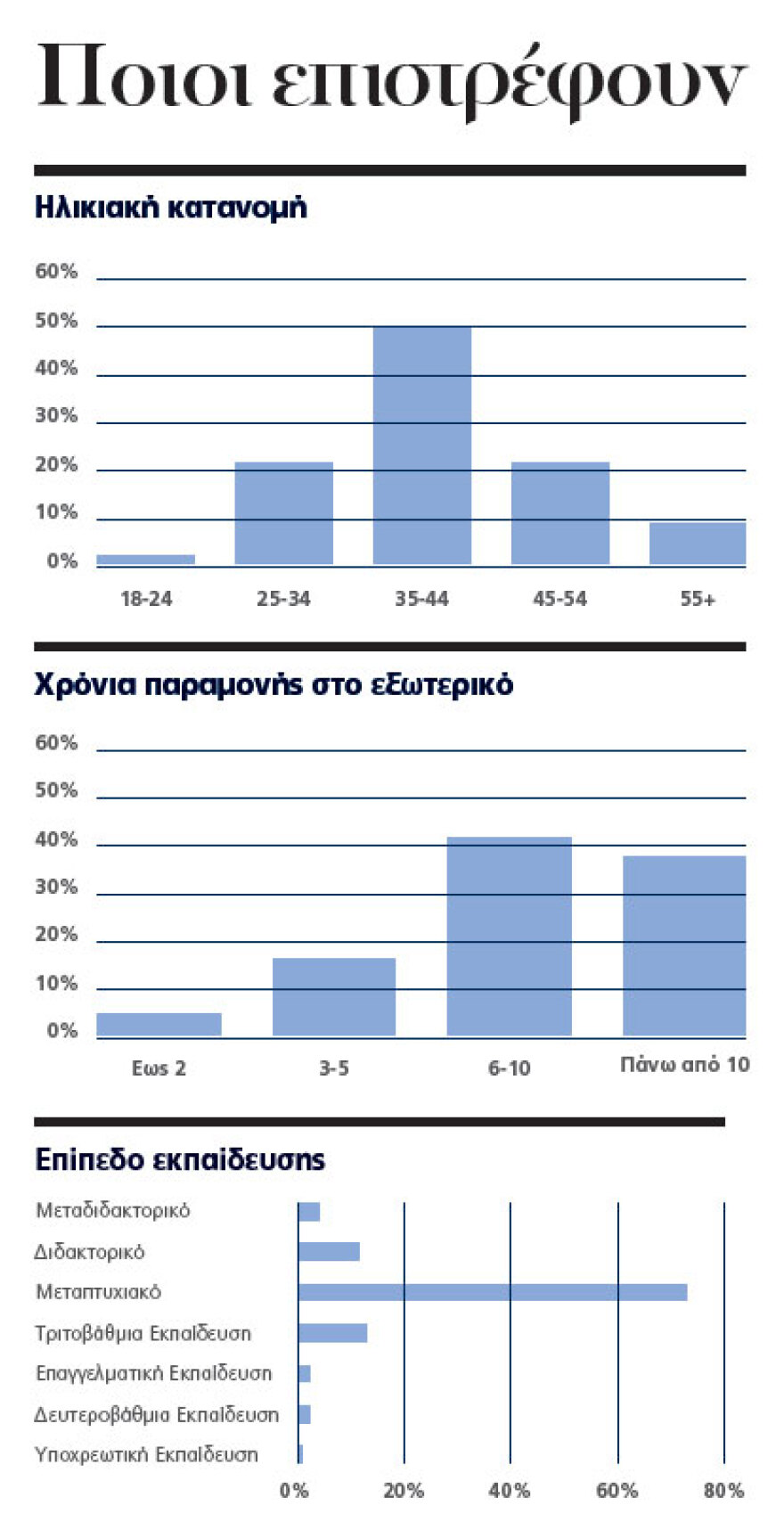
Consequently, according to the latest BrainReGain study, a typical profile of repatriated Greeks shows that they are aged 35–44, lived abroad for 6–10 years, and over 8 in 10 hold postgraduate degrees.
After returning, they assess their standard of living as moderate—as is their perception of the Greek education system, public healthcare, economy, and digital governance compared to their experience abroad. In short, almost everything is rated “average.”
At least, however, repatriation is rewarded by Greece’s climate and weather—understandably so, since most modern emigrants had left for Germany, the UK, and the Netherlands.
Above all tangible or intangible benefits—beyond any incentives—Greeks return home for their parents, as further confirmed by EKT’s research, which showed that 82% of returnees said they came back due to “the need to be close to family and friends.”
Something anachronistic, perhaps — but also deeply human.
Ask me anything
Explore related questions