In most countries around the world, the corresponding Tombs of the Unknown Soldier — created after World War I — are respected by citizens and visitors alike, while being strictly guarded under the responsibility of the Armed Forces or their elite units. This does not mean, however, that there are no exceptions.
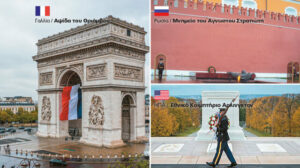
At the Arc de Triomphe, a top symbol of French national identity and certainly one of Paris’s most recognizable landmarks, lies the Tomb of the Unknown Soldier for French war casualties, visited by thousands of tourists every day. The monument was inaugurated on 11 November 1920, simultaneously with the equivalent in the United Kingdom.
At its center is the Eternal Flame, first lit on 11 November 1923 by André Maginot. The area is discreetly guarded, and a daily ceremony of flame rekindling is conducted by military personnel. Political gatherings around the site are strictly prohibited, and severe penalties apply for acts of desecration.
Nevertheless, in 2018, during the Yellow Vest protests, the Arc de Triomphe was vandalized, and last August there was an uproar when a man was arrested for lighting his cigarette from the Eternal Flame. He was a Moroccan legally residing in France on a temporary permit. After his arrest, the permit was revoked, and he was deported.

France / Arc de Triomphe
At the western end of the main nave of Westminster Abbey lies the Tomb of the Unknown Warrior in the United Kingdom. Since 1920, it has contained the body of a truly unknown member of the British Imperial Armed Forces who died on the Western Front during World War I. The monument is protected by the Abbey’s security, and the public is expected to behave with due respect.
In London, there is also the Cenotaph at Whitehall, inaugurated in 1920 as the UK’s national monument for the dead of Britain and the British Empire in World War I, and later, in 1946, it included those from World War II.

Although it is guarded by military and police forces, and despite the ban on gatherings in the area under the Public Order Act — which provides for severe penalties — it has often been the target of vandalism. This happened during demonstrations in 2000, when slogans were written on it, while in 2020 it was vandalized again and a protester attempted to set fire to one of its flags. Recently, in 2023, clashes occurred around the Cenotaph between far-right groups and left-wing demonstrators protesting the war in Gaza.
The Case of Canada
A special case is that of the National War Memorial in Canada. It is a tall granite arch with embedded bronze sculptures in Ottawa, erected in 1939 to honor Canadian soldiers who fell in World War I, while in 1982 and 2014 it came to include those killed from World War II onward. In 2000, the Tomb of the Unknown Soldier was added in front of the monument, symbolizing all Canadians who have sacrificed their lives for their country.
The monument, located just steps from Parliament Hill, began to have an honorary guard in 2006, after a man urinated on the Tomb of the Unknown Soldier during Canada Day celebrations. However, in 2014, a tragic incident occurred when a gunman attacked and killed Corporal Nathan Cirillo at the National Memorial and then stormed Parliament Hill, where he was shot dead in a gunfight.

Canada / National War Memorial
After these events, the Ottawa Police were called upon to guard both the monument and its guards — who, though armed, carry unloaded weapons. The oddity is that the police protection was provided for a fee.
Specifically, a contract worth 450,000 Canadian dollars was signed between the Ottawa Police Service and the Ministry of National Defence, stipulating that two off-duty police officers and one patrol vehicle would guard the monument and its unarmed guards from 9 a.m. to 5 p.m. daily.
Nevertheless, in the summer of 2022, the monument again fell victim to anti-government protests and acts of vandalism by truckers and COVID-19 vaccine deniers. These events sparked public outrage and reopened the debate about what measures should be taken to ensure its better protection.
Not Even a Mosquito Moves
On the other hand, there are countries where, around their monuments, not even a mosquito stirs.
For example, the Tomb of the Unknown Soldier is the most iconic monument of Arlington National Cemetery in the United States. The neoclassical white marble sarcophagus stands atop a hill overlooking Washington and, since 1921, has been the final resting place of unidentified soldiers who fell in World War I. Later, in 1958 and 1984, the list expanded to include those fallen in later wars.
Initially, the monument was guarded by personnel from nearby military units, but since 1948, the U.S. 3rd Infantry Regiment, known as The Old Guard, has been designated as the Army’s official ceremonial unit responsible for guarding the Tomb 24 hours a day, 7 days a week.

USA / Arlington National Cemetery
The guards are always armed with rifles and bayonets, as well as sidearms. During the changing of the guard, a strict ceremonial protocol is followed — as in Greece — according to Army regulations, while the commander informs attendees that they must remain silent and standing throughout the ceremony.
In some cases, the public is even asked not to use flash photography. Under federal law prescribing prison sentences, any protest gathering is strictly prohibited.
Even stricter protective measures apply to the Tomb of the Unknown Soldier in Russia, located by the Kremlin Wall in Moscow’s Alexander Garden. It is dedicated to Soviet soldiers who fell during World War II.
It contains the remains of truly unknown soldiers who were killed in the Battle of Moscow in 1941, originally buried in a mass grave in the city of Zelenograd and transferred to the Kremlin Wall in 1966. The dark red porphyry monument is decorated with a bronze sculpture of a laurel branch and a military helmet resting on a banner.

Russia / Tomb of the Unknown Soldier
At the center of the monument burns an eternal flame that never goes out. Its round-the-clock protection is handled by the Presidential Regiment, renowned for its strict discipline and operating under the Federal Protective Service (FSO), which is also responsible for the security of the Kremlin itself.
The changing of the guard takes place every hour following a precise ceremonial procedure. Visitors must remain silent as a sign of respect and must be appropriately dressed. Naturally, any gathering or protest is strictly prohibited, while acts of desecration or even interruptions of the changing ceremony are considered criminal offenses.
In Beijing
Strict security measures are also in place for the Monument to the People’s Heroes in China. It is a 38-meter obelisk erected in honor of the martyrs of the revolutionary struggle during the 19th and 20th centuries. It stands on the southern side of Tiananmen Square in Beijing, in front of the Mausoleum of Mao Zedong, who also inaugurated it.
Its construction lasted from August 1952 to May 1958. The monument, however, has played a crucial role in history, as major demonstrations and disturbances have taken place there — first, during the death of the “heretical” Prime Minister Zhou Enlai in 1976, and later during the Tiananmen Square student uprising in 1989, which was violently suppressed by the Chinese Army.
In Italy
The Tomb of the Unknown Soldier in Italy is located in Rome, beneath the Altar of the Fatherland, in front of the equestrian statue of King Victor Emmanuel II of Savoy. It is a war memorial dedicated to Italian soldiers who were killed or went missing during wartime.
The remains of the Italian Unknown Soldier were selected on October 28, 1921, and buried there on November 4 of the same year. The monument is guarded by military personnel from various branches of the Italian Armed Forces, with the guards rotating every ten years.

Italy / Tomb of the Unknown Soldier
In Serbia
Outside the city center and atop Mount Avala, southeast of Belgrade, stands the Monument to the Unknown Hero in Serbia. The first monument at the site was erected in 1922 by farmers from nearby villages on the grave of an unidentified fallen soldier. The current structure was built between 1934 and 1938, on the site of the medieval city of Zrnovo, and since then has served as a symbolic place of honor for all fallen warriors of the country. However, in Serbia too, there were strong disagreements regarding the choice of location.
The monument, made of black marble, takes the form of a simple classical sarcophagus on a pedestal, with the Tomb of the Unknown Soldier at its center. Its main facades are flanked by female figures symbolically representing the unity of all Yugoslav peoples. In 1987, it was declared a Monument of Culture of Exceptional Importance and has since been protected by units of the Serbian Armed Forces.
In Portugal
The Portuguese Tomb of the Unknown Soldier is located in the Sala do Capítulo of the Batalha Monastery. It contains the remains of two soldiers from World War I, buried there in April 1921. The monument is dominated by a statue of Christ and the so-called “Flame of the Fatherland.” Although relatively secluded, it is continuously guarded by an honorary watch.
In Spain
Similarly, the Monument to the Fallen in Spain (also known as the Monument to the Heroes of May 2nd), a 30-meter-tall structure located in Plaza de la Lealtad in Madrid, dates back to 1840 but was rededicated in 1985 by King Juan Carlos to honor all those who gave their lives for Spain, both within and beyond its borders. Since then, an eternal flame has burned on its façade. The monument is surrounded by a metal fence, and access is strictly controlled.
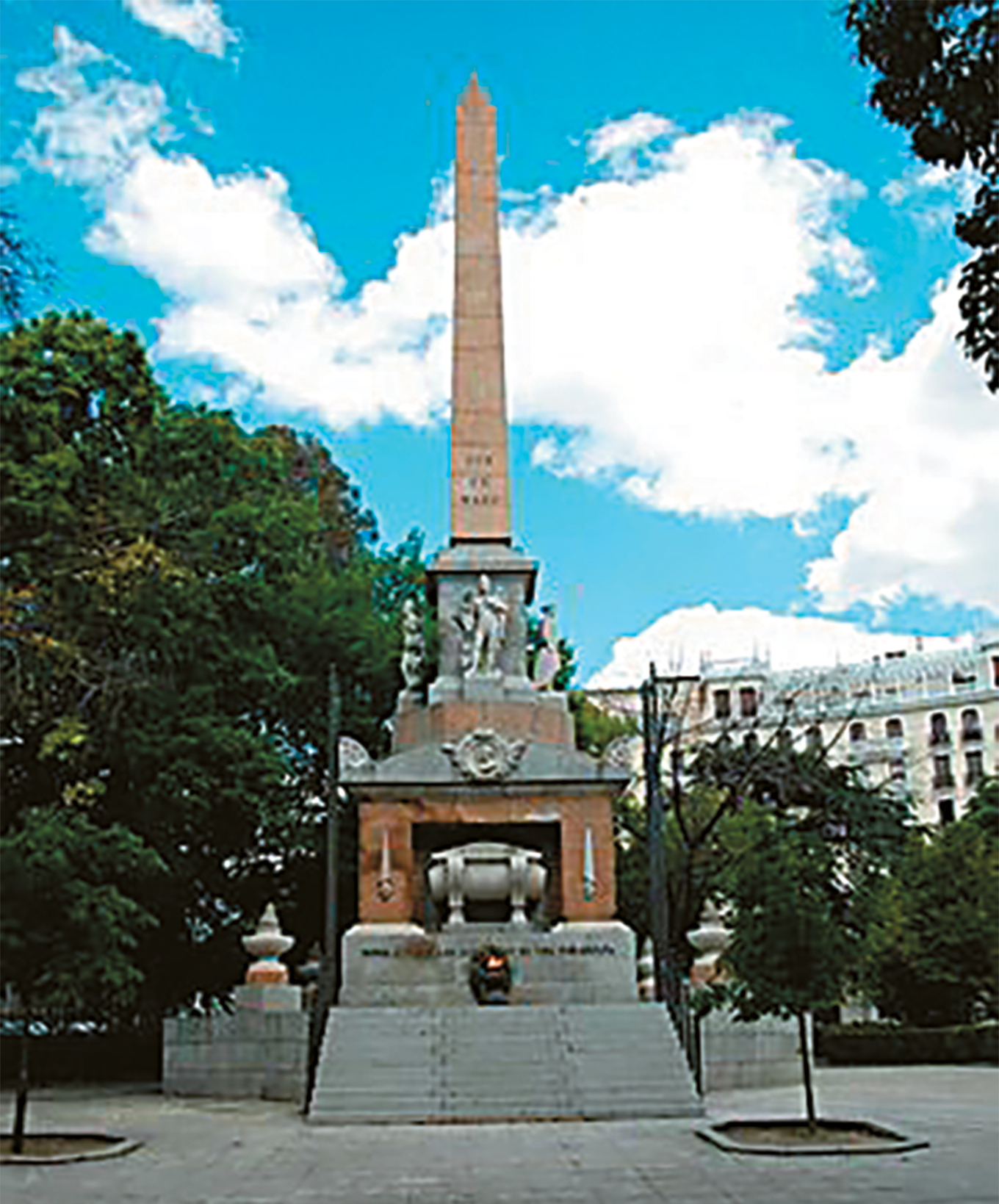
Spain / Monument to the Fallen
In Armenia
In the Armenian capital Yerevan, Victory Park is an entire memorial complex. In front of the massive statue of Mother Armenia lies the tomb containing the ashes of an unknown soldier from the city of Mozdok, along with an eternal flame burning within a five-pointed star. On the large, heavy stone slab, the inscription reads:
“Your name is unknown, your deed is immortal.”
In Brazil, the Monument to the Dead of World War II, also known as the Monumento aos Pracinhas, stands in Flamengo Park in Rio de Janeiro. Completed in 1960, its underground mausoleum houses the remains of 467 soldiers of the Brazilian Expeditionary Force who died in battle in Italy. The monument is considered a military site, guarded by armed sentries, and visitors are required to behave respectfully.
In Bolivia, the monument located in one of the busiest areas of La Paz, at Plaza del Obelisco, does not enjoy any special protection. It honors the fallen soldiers whose bodies were never found during the Chaco War (1932–1935). However, it has had a troubled history — in 1979 it was moved to the General Cemetery, only to return to its original location in 2007. Meanwhile, during the dictatorship of García Meza, there was an unsuccessful attempt to dismantle it.
The Australian Tomb of the Unknown Soldier is housed indoors in the Hall of Memory in Canberra, and guarded by armed personnel from all three branches of the Armed Forces. Although the idea of honoring an unknown Australian soldier was first discussed in the 1920s, it was on the 75th anniversary of the end of World War I, in 1993, that the body of an unknown Australian soldier was transferred from the Adelaide Cemetery in France and buried there.
In Cyprus
The Liberty Monument in Cyprus has its own unique story. It was erected in 1973 to honor the EOKA fighters of the 1955–1959 Liberation Struggle. It consists of 17 statues arranged on three levels. At the top, two EOKA fighters break their chains to open the prison gate, allowing Greek Cypriot prisoners to escape British rule.
The emblematic monument, located a few meters from the Archbishopric, was scheduled to be inaugurated in 1974 by President Makarios, but this never happened due to the coup d’état and the Turkish invasion. Thus, it was officially inaugurated only last April, 51 years later, by President Nikos Christodoulides of the Republic of Cyprus.
However, even this monument has not been spared from vandalism. In 2018, “unknown perpetrators” spray-painted slogans and defaced several statues during the night.

Cyprus / Liberty Monument
In Iraq
One of the newest and most striking is the Monument to the Unknown Soldier in Iraq, located in central Baghdad, completed in 1982 amid the Iran–Iraq War. The monument represents a traditional shield falling from the grasp of an Iraqi warrior.
The shield is suspended above a metal-layered cube connected to an underground chamber. The Unknown Soldier Monument was followed by the Al-Shaheed Monument (1983) and the Victory Arch (1989) — all in the same area, all designed by sculptor Khaled al-Rahal, a favorite of Saddam Hussein, forming a symbolic ensemble intended to enhance his leadership image.
Ask me anything
Explore related questions