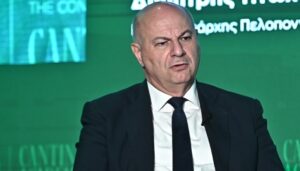
At the 3rd Cantina Academy organized by Proto Thema and Cantina Magazine in Kalamata, the Minister of Rural Development and Food, Kostas Tsiaras, emphasized the government’s determination to “go all the way” regarding the cleanup at OPEKEPE and the monitoring of European subsidies.
The discussion also included Peloponnese Regional Governor Dimitris Ptochos and the CEO of the Hellenic Development Investment Bank, Antigoni Lymberopoulou, with Proto Thema’s director, Babis Koutras, as moderator.
Tsiaras stressed that the ministry “has taken on the portion of responsibility that corresponds to it” in the OPEKEPE case, noting that “efforts were made, but they proved insufficient.” “For the first time, we are clashing with such interests,” he said, acknowledging that the controls until now had been conducted “not to this scope and intensity.”
The minister noted that critical payments to beneficiaries are expected in the coming weeks and estimated that by the end of the year “the process will have normalized.”
“The issue is for European funds to go to the real beneficiaries. We have said that we will address this pathology by going all the way. It is certain that the phenomenon of some receiving illegal subsidies will be eliminated,” he emphasized.
Tsiaras revealed that the European Commission has already intervened with clear warnings: “The Commission sent us two letters clarifying that if controls are not intensified before each payment, European resources will be put at risk. We are talking about amounts exceeding three billion euros annually.”
Regarding the new development strategy, the minister highlighted the importance of regional plans, noting that “for the first time, there are regional development plans in Greece. Every month we visit counties across the country to review local development plans. The goal is, in an organized way, to draw European resources and distribute them to the real beneficiaries, aiming for funds to go directly to primary production.”
On Goat and Sheep Pox
Referring to the crisis caused by goat and sheep pox, Tsiaras described the virus as “extremely resilient,” since it “survives for more than six months,” and stressed the need for close cooperation with the Regions and livestock breeders to contain it.
“There were regions that managed to implement measures and had no cases, while in others we had widespread transmission,” he noted.
The minister emphasized that addressing the phenomenon requires scientific guidance, saying, “Science will tell us what must be done going forward. One aspect is the vaccine, the other is disease containment. We also requested police assistance to prevent illegal actions, such as unauthorized vaccinations or animal transfers.”
He also explained that experts are firmly opposed to vaccination at this time, stating, “Our scientists are clear—they do not recommend vaccination. Farmers are in a difficult position, but we cannot do anything other than follow the scientific guidance. The government will stand by the livestock breeders—this is our policy to support Greek animal husbandry.”
Ask me anything
Explore related questions