Major Robbery at the Louvre Exposes Long-Standing Security Concerns
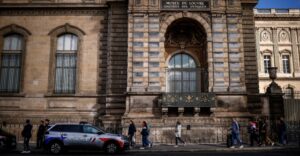
The world was shocked last Sunday when four men managed to steal jewels worth around €88 million from the Louvre. For those who work at the museum, however, the heist came as little surprise, writes Politico.
Elise Miller, the museum’s hall supervisor and trade unionist, explained that colleagues had long found it remarkable that nothing dramatic had happened sooner. While France—and Paris in particular—enjoys a reputation for cultural supremacy, critics say the robbery underscores that the state has not sufficiently invested in the Louvre. Complaints about underfunding have been mounting for months, unlike Sunday’s robbery, which lasted only a few minutes.
“A State of Disrepair”
Kim Pham, the general administrator of the Louvre, told MPs during a parliamentary hearing in February that the museum’s infrastructure was in a “poor, sometimes dilapidated state” and emphasized the urgent need for modernization, particularly regarding security.
Miller noted that union representatives have repeatedly warned the French culture ministry about underfunding issues, including the reduction of qualified security and surveillance staff—but to no avail. A partial report by France’s Court of Audit, reviewed by Politico, cited “persistent delays” in replacing security equipment such as cameras. In one-third of the ward where the robbery occurred, no cameras were present at all. The report concluded that the obsolescence of security infrastructure is outpacing the investments meant to address the problem.
Exploiting Inaction
Earlier this year, French President Emmanuel Macron announced a €700–800 million funding plan to modernize the museum, though the upgrades are not expected to be completed until 2031. Peter Fowler, managing director of Westminster Group, a British company providing security solutions for the Tower of London, said the robbers likely took advantage of inaction: “How easy it was shows how lax the security measures were.” Museum spokespeople, however, insisted that security mechanisms were in place.
“We Were Defeated”
Over 230 years after Louis XVI was beheaded near the Louvre, calls for accountability have resurfaced. Politicians from both the left and the far right have criticized Rashida Dati, France’s culture minister, who plans to run for mayor of Paris next year. Dati admitted that administrative weaknesses may have contributed to the heist but stressed that responsibility is collective after “40 years of neglect, during which problems were covered up.” She added, “We have always focused on the safety of visitors to cultural institutions, much less that of the artworks themselves.”
Louvre director Laurent de Carre also faced intense questioning before the Senate’s culture committee. The 59-year-old curator, visibly overworked, defended the museum’s security procedures: “Despite our efforts, we were defeated,” she said, adding that she has long tried to highlight “the state of decay and general obsolescence of the Louvre, its buildings, and infrastructure.”
Following the robbery, some reports accused de Carre of financial mismanagement and spending on non-essential projects, such as a lavish dining room. She dismissed these as distortions, explaining that the room serves as a meeting space, not exclusively for the museum’s president. De Carre also disputed certain points in the auditors’ report, insisting there were no delays in security upgrades and that planned measures would soon be implemented.
At a Council of Ministers meeting on Wednesday, President Macron urged his cabinet to “maintain their composure” while investigations continue.
Macron’s Plans
Macron’s renovation plan for the Louvre was meant to be a “jewel in the crown” of his cultural legacy, similar to the restoration of Notre Dame after the 2019 fire. The modernization includes upgrading infrastructure, enhancing security, and relocating Leonardo da Vinci’s Mona Lisa to its own room.
The robbery has added urgency to the project. Macron has called for proposals to accelerate security upgrades by next week, including next-generation cameras, improved perimeter scanners, and a central control system.
However, the effort faces political and budgetary challenges. Sebastian Le Corneille’s minority government is prioritizing defense and industrial reinvestment, which may make museum security a lower priority. A museum staff spokesperson emphasized that while budgetary constraints exist, commitments to the Louvre must be upheld: “The Louvre is 68 percent self-funded, which is a huge percentage. For the rest, the state cannot impose any more cuts.”
Ask me anything
Explore related questions