





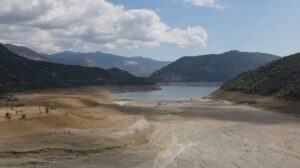
Concerns are mounting over the risk of drought in Attica, as water reserves in Lake Mornos, the main reservoir supplying the Athens basin, have dropped to historic lows.
Official data reveal the severity of the situation. According to EYDAP’s latest measurements, as of October 23, 2025, the Mornos reservoir held only 156,996,000 cubic meters of water — the lowest level in 15 years for this date, marking a nearly 45% drop compared to the same time last year (285,021,000 m³ on 23/10/2024).
Surface Area of Lake Mornos Down 44%
Satellite data from the National Observatory of Athens (NOA) confirm the critical condition.
An analysis conducted by Meteo.gr on October 9, 2025, showed that the lake’s surface area had shrunk to 8.3 square kilometers, a 44% decrease compared to the 2016–2024 average of 14.9 km².
The dramatic drop in water levels has exposed an eerie landscape: the submerged village of Kallio, once hidden beneath the surface, has re-emerged — a sight reminiscent of the severe drought of the early 1990s, as captured in drone footage by the Orange Press Agency (September 15, 2025).
“2025 Is One of the Driest Years of the Decade”
Speaking to the Orange Press Agency, Kostas Lagouvardos, Research Director at the National Observatory of Athens, explained:
“Both satellite imagery and rainfall measurements in the Mornos region show that we are at extremely low levels for this time of year. It’s not as bad as 1993, but compared to the past decade, this is one of the driest years.”
Rainfall at a 10-Year Low
Graphs from the Observatory illustrate the trend clearly: total rainfall in the Mornos area since the start of 2025 has remained consistently below the 2015–2024 average.
“Rainfall this year has been among the lowest in the last ten years,” Lagouvardos noted.
He added that snow cover during the past winter was also well below average (2005–2024), depriving the reservoir of crucial meltwater during spring.
“It’s natural to be concerned about what lies ahead — especially if this winter brings little snow or rain. We hope that the coming months will bring enough precipitation and snowfall to help offset the current deficit,” he concluded.
“Bleak” Figures for Mornos Water Reserves
An Orange Press Agency comparison of publicly available EYDAP data
(source) shows a steady decline in Mornos water reserves (in cubic meters) measured each year on October 23:
- 2025: 156,996,000 m³ (lowest in 15 years)
- 2024: 285,021,000 m³
- 2023: 496,455,000 m³
- 2022: 601,375,000 m³
- 2021: 523,928,000 m³
- 2020: 489,881,000 m³
- 2019: 532,841,000 m³
- 2018: 605,563,000 m³ (highest in 15 years)
- 2017: 482,332,000 m³
- 2016: 573,263,000 m³
- 2015: 591,653,000 m³
- 2014: 533,100,000 m³
- 2013: 577,015,000 m³
- 2012: 507,466,000 m³
- 2011: 521,016,000 m³
- 2010: 554,770,000 m³
Ask me anything
Explore related questions




