





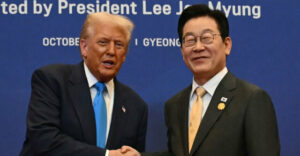
United States President Donald Trump announced today that Washington and Seoul have “substantially completed” their new trade deal, following a meeting with his South Korean counterpart Li Jae Myung. Now the U.S. president seems to be focusing on his meeting with the Chinese president tomorrow.
“We had an excellent meeting today with South Korea… A lot was decided. We basically closed the deal,” Trump said during a dinner with Lee. Earlier in the day he had announced that the deal would be completed “very soon.”
The deal, which covers trade, investment and technological cooperation, is seen as pivotal to strengthening US-Korean relations at a time of heightened geopolitical tensions in Asia.
The eye is on Beijing
The visit to South Korea completed the US president’s cycle of contacts in Asia, but attention now turns to Trump’s next stop – China. On Thursday, he is expected to meet with Shi Jinping, with the agenda including a potential global trade deal.
Trump, however, made it clear that he will not meet with North Korean leader Kim Jong Un on this trip, though he has left the possibility open in the past.
The welcome to Trump and the “golden” gifts
Upon his arrival in South Korea, Trump received an impressive reception. A military band played the Village People’s “YMCA” – a song that has been associated with his election rallies – and then the US president attended an Asia-Pacific Economic Cooperation (APEC) event, where he spoke to business leaders about his trade policy.
The South Korean government has honored Trump with the Grand Cross of the Order of Mugungwa, the country’s highest honor, for his contribution to peace on the Korean peninsula. At the same time, President Lee offered him a copy of a gold crown – a gift with strong symbolism – and a dessert decorated with gold leaves, served on a plate with the word “PEACE” on it to commemorate, as Lee’s office put it, “the golden age of the Korea-U.S. alliance.”
Despite a warm official welcome, Trump faced small but intense protests in the city of Gyeongju, where activists held banners with slogans against his policies, calling him an “authoritarian leader”. The riots were contained, however, without any tensions with police.
Seoul’s request for nuclear-powered submarines
During the meeting, Lee formally asked the US president for approval to import nuclear fuel so that his country can build nuclear-powered submarines.
“If the president makes a decision to allow us to acquire fuel for nuclear-powered submarines, we will deeply appreciate it,” Lee said at the bilateral meeting. As he explained, South Korea does not intend to deploy nuclear-armed submarines, but rather conventionally armed nuclear-powered vessels to counter threats from North Korea and China.
“Diesel submarines have limited sinking capability and have difficulty detecting North Korean or Chinese submarines,” he noted, adding that acquiring nuclear-powered submarines would allow Seoul to undertake more naval defense operations and “significantly reduce the burden on U.S. forces.”
Washington has long opposed such plans, citing the risk of nuclear proliferation. However, the debate has come back to the forefront following the unveiling earlier this year of North Korea’s nuclear-powered submarine under construction, which is seen as a major threat to stability in the region.
Increased defence spending and “less burden” for the US
South Korea’s president has pledged to increase his country’s defence spending to reduce dependence on the US military presence in the region. “Our goal is to lighten the burden the United States carries in the defense of the peninsula,” Lee said, stressing that Seoul intends to enhance its own operational capabilities.
Ask me anything
Explore related questions




