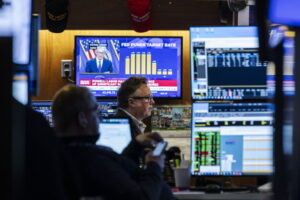
Wednesday’s Wall Street session had an unexpected outcome, as all indices in the early hours were heading for new highs for the second day in a row, only to end up either losing altogether or simply limiting their gains due to the negative impact of Jerome Powell’s statements. Significantly, only Nasdaq “closed” in… green!
Specifically, the Dow Jones was down 0.16% at 47,632 and the S&P 500 was down 30 points at 6,890. In contrast, the Nasdaq gained 0.55%, to 23,958, a new high boosted by Big Tech and especially Nvidia.
In the bond market, Treasuries fell with the 10-year yield rising about 8 basis points to 4.062% and the 2-year yield jumping 10 points to 3.596%.
Key to the change in market sentiment was what Jerome Powell said after the Fed meeting.
At the meeting the FOMC decided – as expected – to proceed with its second rate cut of the year, with a 25 basis point cut in the 3.75% to 4% range. However, the decision was not unanimous, as Trumpian Stephen Miran insisted on a larger cut of 50 basis points, while instead the more stringent St. Louis Fed President Jeffrey Schmidt, who had backed the September cut, called for rates to be left unchanged this time due to inflationary pressures.
In the final statement, Fed officials reiterated their assessment that “hiring has slowed” and that “risks to employment have increased in recent months.” They stressed, however, that inflationary pressures are also building, with the index “elevated relative to the beginning of the year.”
The latest consumer price index data, released long delayed last Friday due to the shutdown, showed underlying inflation rose at its slowest pace in three months. However, the structural index stands at 3% on an annualized basis, well above the Fed’s target.
The disagreements within the board were not seen as a good sign by the market, especially given that the Fed chairman himself appeared highly cautious in his remarks regarding the FOMC’s next steps.
“There were sharply conflicting views in the Committee’s discussions about how we should move in December,” Powell pointed out at his regular press conference, making it clear that “a further cut in the policy rate is by no means a foregone conclusion, far from it.”
“In terms of how that might affect the December meeting … we just don’t know what data we’ll have in hand,” he added, also referring to the lack of data due to the prolonged shutdown. “If there is a very high degree of uncertainty, then that could be an argument for a more cautious stance before any move. But we’ll have to see how things play out.”
His comments were intended to temper market expectations, where the likelihood of another quarter-point cut in December was more than 90 percent before his speech, as it was with the impact immediately visible in stocks and bonds.
“Given the disagreements on both sides, it will be difficult to get a clear direction for December,” argued Neil Data of Renaissance Macro Research.
“Powell reflects the tension within the Fed between those who favor more aggressive easing and those who are concerned that inflation remains too high even as the labor market weakens,” said Michael Rosen of Angeles Investments for his part.
“Our view is that the market has overestimated the pace and intensity of future rate cuts. Inflation is still above the Fed’s target and we believe monetary policy remains relatively loose as nominal interest rates are lower than the growth rate of nominal GDP.”
At the equity level, the change in landscape was noticeable across most sectors.
Companies and chains related to consumer discretionary, which is bearing the brunt of interest rate setting, came under the most pressure. Among them are CostCo, McDonald’s, Visa and Mastercard.
In contrast, tech stocks pushed back negative forces driven by Nvidia and its mini-rally that pushed its value above the $5 trillion historical milestone. In fact, in doing so, it became the first company in the world to reach that… mythical number.
To put it in perspective, Nvidia, with its market capitalization now, is equivalent to about 25 Disney, 50 Nike and over 900 Macy’s. And it’s twice the size of the combined key stock market indices of Germany and France!
Other companies in the microchip industry, such as Broadcom, AMD and Micron, have also emerged as winners, given that media reports indicate that there will likely be an agreement on restrictions on microchip exports to China at the Trump-Shi meeting on Thursday.
Overall, moreover, the positive signals from the long-awaited summit between the US and Chinese presidents tomorrow have worked to encourage the market, especially technology groups that have significant openings and exposure to the Asian superpower’s market.
.
Ask me anything
Explore related questions