





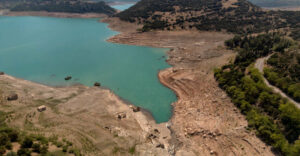
Model Thessaly for the half-billion euro project is being enlisted by the government to shield Attica’s water supply. With a closed invitation to major construction companies and activation of Article 55 of the recent law on national priority projects, as was done in Daniel’s infrastructure for Thessaly, the tender for the “Evritos” project, which envisages the partial diversion of two rivers in Evritania, is projected to be the prevailing plan for the tender to be launched in the summer of 2026.
It is a technically ambitious diversion project that will connect the Karpenisiotis and Krikeliotis rivers with the Euinos reservoir, ensuring water for at least 30 years. However, time is pressing: the reserves in the reservoirs have fallen to 380 million cubic metres, which is 250 million less than the normal average, while the management of EYDAP under Mr Haris Sachinis has already notified the Ministry of Environment and Energy that the system is on “red alert”.
According to what Minister Stavros Papastavrou said yesterday at the 100th anniversary event of EYDAP, “until 2021 the reserves were stable at 1.1 billion cubic meters. From 2022, however, the decrease reaches 250 million cubic meters per year.” At the same time, there is a 25% decrease in rainfall, a 15% increase in evaporation, and a 6% increase in consumption. “Climate change has accelerated the rate of decline in water supplies. That is why we need to move immediately,” he stressed.
The two tunnels that will change the hydrological map
The solution promoted through the “Evrytos” project envisages the construction of two tunnels, about 14 and 6 kilometres long and 4 metres in diameter respectively, which will channel up to 200 million cubic metres of water a year – an amount capable of covering almost all of Attica’s shortfalls. The tunnels will be built at such a height that they will only take water when the level of the two rivers rises due to rainfall, thus ensuring the continuous ecological supply of the two rivers.
EYDAP stresses that the “gravitational flow” of the Evinos, i.e., the natural movement of water from higher to lower points, thanks to the difference in altitude between the springs and the basin, is the secret of Athens’ low tariffs. “Water moves by its natural force, without pumps and without electricity.”
Unlike Lake Yliki, which needs pumping stations to send water to the capital, Evritos will operate without energy costs, drastically reducing emissions and operating costs.
Ask me anything
Explore related questions




