





Pavlos Geroulanos continues to voice a different outlook from the PASOK leadership about the party’s direction before the upcoming elections. At every opportunity, he lays out concrete proposals for achieving the surge in public support that many in the opposition hope for.
Concern and unease about PASOK’s performance against New Democracy remain central in daily discussions. Polls consistently show a wide gap between the ruling party and PASOK, while some fear the center-left could lose ground if Alexis Tsipras reenters politics with a new party.
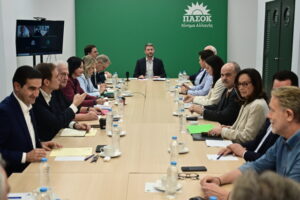
During yesterday’s meeting of the Organizing Secretariat for the Party Conference, no final date was set, though its head Giannis Vardakastanis suggested it would be held in March 2026.
Earlier that day, in an article on his website, Geroulanos wrote:
“We have work to do and no time to waste. We must act quickly to show society that we bring something new, fresh, dynamic, and sincere — and prove that we mean what we say and apply it first ourselves. Such a Conference of Renewal for PASOK will send strong pre-election signals of revival — for the movement and for the country.”
In the same article, Geroulanos directed serious criticism at the party leadership, questioning the effectiveness of its internal operations:
“If PASOK is to become an example of a different political path, it must show today — through its own decisions — how it intends to govern tomorrow.
If PASOK is ready to lead Greece into an ‘explosion of democracy,’ with a clear message of meritocracy, transparency, justice, and respect for institutions, then it must first practice these principles in its own functioning.”
At the same time, Nikos Androulakis has a more optimistic view of PASOK’s current position. Speaking to SKAI TV, he said:
“New Democracy’s decline is irreversible. PASOK, with its program, sense of responsibility, and clear strategy, will be the force that surprises everyone and emerges victorious in the next elections.”
When asked to respond to Geroulanos’s remark that PASOK hasn’t yet experienced an “explosion of democracy,” Androulakis avoided comment:
“I don’t know what Mr. Geroulanos said. I know that PASOK officials should talk about our program and our goal — to defeat New Democracy.”
Inside PASOK, more and more officials are looking for new ways to strengthen the party’s momentum, seeing the conference as a key opportunity to set a clear, productive course. Like Geroulanos, Haris Doukas supports an open conference that allows a genuine clash of ideas leading to unity around shared goals.
Both call for an open discussion on post-election alliances. Doukas firmly rejects any cooperation with New Democracy, while Geroulanos notes:
“We have nothing to fear. Beyond rejecting any scenario of collaboration with New Democracy — which would harm both the country and our movement — we have much to gain from open, honest dialogue with the Greek people. Personally, I believe in a PASOK that follows an independent path, yet remains open to society, civic groups, and even other parties that share our values — so we can build together the major changes Greece needs.”
During the meeting chaired by Vardakastanis (in Androulakis’s absence), Kostas Pantazis, a close ally of Geroulanos, presented his set of proposals and again pressed for a specific conference date.
Tonia Antoniou, Hara Kefalidou, and Theodoros Margaritis (leader of the Renewing Left faction) all spoke in favor of open debate. Margaritis remarked pointedly that while PASOK often talks about broadening its alliances, it should also value those within the party “who stood firm in difficult times and helped shape its progressive identity.”
Margaritis and others from his group even proposed dialogue with other progressive forces, not excluding Tsipras’s new party from an open discussion.
Officials close to Androulakis reportedly struck a more cautious tone, believing the leadership wants to gain time and avoid internal debates that might open sensitive issues.
Thanasis Glavinas, former party spokesman, said everyone should safeguard the pre-conference process “so it becomes a model — as the leadership elections once did.” He also urged greater focus on youth participation.
Heraklis Droulias, another close aide to Androulakis, agreed that more space should be given to renewal and internal expansion within PASOK.
A major plenary session of the Central Organizational Committee is expected at the end of November, marking the formal start of the pre-conference process and defining the key topics for debate.
Ask me anything
Explore related questions




