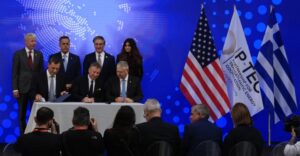
Five major Greek-led cross-border initiatives are reshaping the energy landscape of the Eastern Mediterranean and Eastern Europe. Greece’s plans to become a regional gateway for energy gained new momentum after a series of agreements—signed in the presence of senior U.S. government officials and energy-sector representatives—during the Transatlantic Energy Cooperation Ministerial Meeting (P-TEC), held in Athens on November 6–7.
The project’s concern:
-
A new “vertical” natural gas corridor originating in Greece
-
A long-term agreement to import U.S. LNG and re-export it across the region
-
The electricity interconnection between Greece and Egypt
-
A proposal to supply Cyprus with natural gas from Israeli fields
-
Offshore drilling in the Ionian Sea to explore a potential natural gas target
Environment and Energy Minister Stavros Papastavrou told the Athens–Macedonian News Agency (APE):
“The 6th session of the Transatlantic Energy Partnership (P-TEC), which concluded in Athens a few days ago, left a strong geopolitical footprint for Greece and the entire Eastern Mediterranean. This was not a meeting of words and declarations but of concrete agreements and decisions in the energy sector—with results that hold immediate and long-term value.
We capitalized on our country’s unique geographic position, its infrastructure, the clear commitment of the EU and the United States to move away from Russian gas, and Greece’s political and economic stability. As a result, Greece is becoming a gateway for American LNG to Europe and a secure starting point for the new development corridor toward Northeastern and Central Europe, while reducing Turkey’s influence on the new energy map.
Greek energy companies stood shoulder-to-shoulder with some of the world’s largest energy giants, demonstrating credibility and expertise. During P-TEC, they signed agreements of great and multi-layered significance—both for today’s energy landscape and for the decade ahead.
The work continues. We must now implement all agreements swiftly and consistently, strengthening the central artery of growth and stability for our region and for Europe as a whole.”
The Five Projects in Detail
1. The Vertical Gas Corridor
At P-TEC, the gas transmission operators (TSOs) of Greece, Bulgaria, Romania, Moldova, and Ukraine jointly submitted a request to their national energy regulators to approve two new cross-border supply routes—Route 2 and Route 3.
Route 2 will originate at the Alexandroupolis floating LNG terminal, and Route 3 will begin from the transnational TAP pipeline. Route 1, which starts from the Revithoussa LNG terminal, has already been approved.
Approval of the new routes—combined with tariff reductions and upgrades to network capacity—will enable greater volumes of gas to transit through Greece, replacing Russian gas, which under EU decisions must cease flowing to member states by the end of 2027.
These routes will also allow natural gas deliveries to Ukraine.
2. U.S. LNG Supply and Regional Re-Exports
ATLANTIC–SEE LNG TRADE (a joint venture of the AKTOR Group and DEPA Emporia) signed a 20-year agreement with U.S.-based Venture Global to import 0.5–1.5 million tonnes of LNG annually from 2030 onward. This marks Greece’s first long-term LNG supply contract with a major U.S. producer.
The company also signed 20-year Memoranda of Understanding—also beginning in 2030—with Ukraine’s Naftogaz (up to 0.7 million tonnes annually) and with Romania’s NOVA POWER & GAS and Transgaz (up to 1.4 million tonnes annually) for LNG sales.
3. Greece–Egypt Electricity Interconnection
This is a 3,000-MW electricity interconnection that includes 9.5 GW of renewable energy capacity (wind and solar) to be developed in Egypt. The project is led by Elica Interconnector of the Copelouzos Group and is currently undergoing detailed seabed mapping.
According to the company, 60 Greek industrial firms have already signed agreements to purchase power through the interconnector, with roughly one-third of the electricity intended for re-export.
4. Supplying Cyprus with Natural Gas
Energean—a company of Greek interests—has proposed supplying Cyprus with natural gas from the Israeli fields it operates. Under the proposal submitted to the governments of Cyprus and Israel, Energean would construct a new undersea pipeline linking the “Energean Power” FPSO in Israeli waters directly to Cyprus.
Israel’s Minister of Energy and Infrastructure, Eli Cohen, expressed strong support, noting that gas sales to Cyprus would enhance Israel’s regional and European standing, contribute to stability and prosperity, and generate significant state revenue.
The gas would come from Israel’s Katlan field.
5. Ionian Sea Drilling
A $100 million drilling project in “Block 2,” west of Corfu, is now a realistic prospect after ExxonMobil agreed to join the exploration consortium, acquiring stakes from Energean and Helleniq. The final decision will depend on the reassessment of seismic data; if positive, Greece could proceed with the development of production wells and the installation of the required extraction, processing, and transport infrastructure, at a total investment of around $5 billion.
A commercially viable hydrocarbons discovery would be a milestone—both for Greece and for the EU—especially if quantities can meaningfully contribute to regional energy needs.
Also under consideration is the Great Sea Interconnector, which would link Greece, Cyprus, and Israel, for which updated studies and new investors are being sought.
.
Ask me anything
Explore related questions