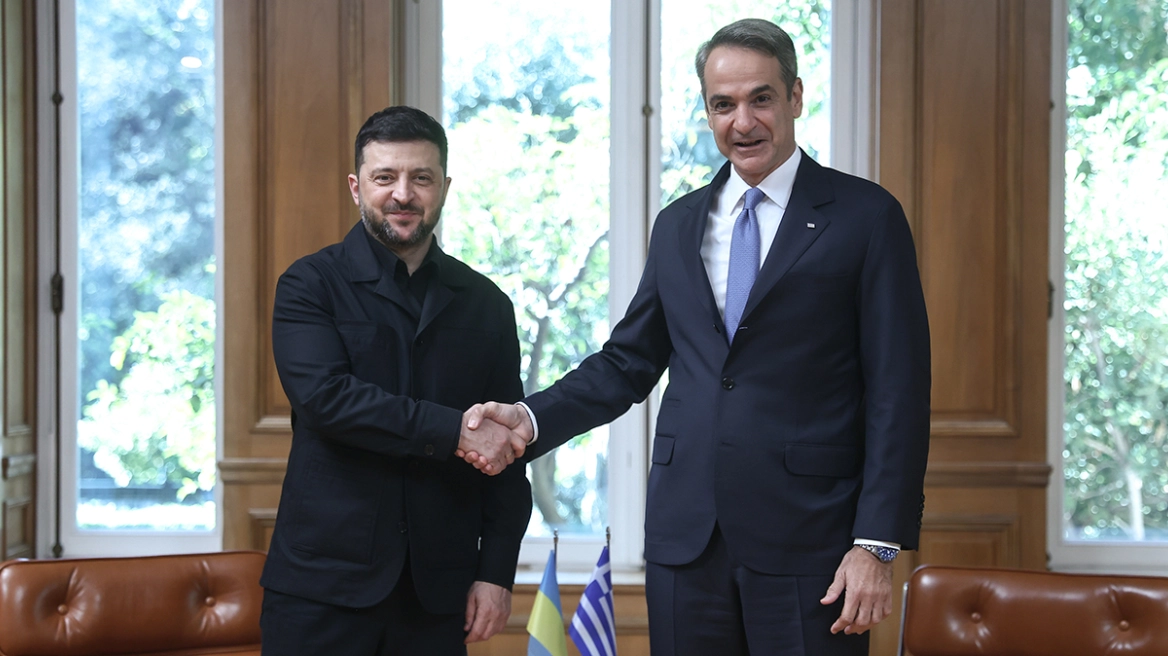
“Greece thus—put very simply—becomes a provider of energy security for your homeland.” With this phrase, spoken by Kyriakos Mitsotakis to Volodymyr Zelensky yesterday afternoon at the Maximos Mansion, the prime minister signaled the government’s intention to play a new and upgraded role in the energy equation of the broader region, demonstrating in this way Greece’s strategic importance for the United States.
It was no coincidence that the U.S. ambassador, Kimberly Guilfoyle, was present at the Maximos Mansion yesterday for the signing of the agreement between DEPA and Ukraine’s Naftogaz for the transport of American LNG, starting from Alexandroupoli.
Both the presence of Ms. Guilfoyle—who arrived at the Maximos Mansion together with the Minister of Energy, Stavros Papastavrou—and the practical activation of the “vertical corridor” project ending in Ukraine were, in effect, the continuation of the major PTEC conference that took place a few days ago at the Zappeion. After all, the implementing entity of the Naftogaz agreement, which will be put into effect initially from December to March 2026, will be the company Atlantic-See, that is, the DEPA–Aktor consortium, which was announced along with the involvement of the American DFC at the energy forum.
The American LNG will be transported via Route 1, jointly provided by the Transmission System Operators (TSOs) of Greece (DESFA), Bulgaria (Bulgartransgaz), Romania (Transgaz), Moldova (VestMoldTransgaz), and Ukraine (GTSOU).
As Ukrainian President Zelensky noted, the agreement represents a step toward safeguarding his country ahead of a difficult winter, as the Russians are relentlessly bombing critical energy infrastructure and time is needed for repairs. For Greece, the agreement is yet another step toward strengthening its strategic partnership with the United States, with the country acting as a “hub” for Europe’s energy security as well as for Washington’s economic interests.
Both the agreement signed yesterday and the image of Ms. Guilfoyle being present at the final signatures constitute, for the Maximos Mansion, a substantive political response to recent criticism about the lack of relations with the new Trump administration and about the alleged imbalance in favor of Turkey at Greece’s expense.
Nevertheless, Turkey still cannot satisfy the Trump administration’s key demand—reducing dependence on Russian energy sources—while Mr. Mitsotakis is emphasizing at every opportunity that Europe will cut direct natural gas supplies from Moscow and will, de facto, function as an entry gate for American LNG to the European continent.
In other words, within the framework of Donald Trump’s transactional foreign policy, in which economic agreements carry heavy weight, Athens views energy as a form of “currency” to secure a consistent place at the American president’s table.
Ask me anything
Explore related questions