Athens and Nicosia are rushing to pre-empt developments in the region, as both President Trump’s active involvement in the Middle East and the U.S. strategic decision—expressed by the new ambassador, Kimberly Guilfoyle—to exploit the Eastern Mediterranean to secure energy for Europe, along with the ambitious IMEC project, will inevitably lead to a broader American engagement aimed at restoring a climate of peace and cooperation in the area. It is clear that Washington does not want local confrontations and regional rivalries that could destabilize the investment environment and undermine designs of broader geopolitical significance, such as IMEC and the networks that will develop alongside that corridor.
Expansion of cooperation
Athens, having already taken an important step by assuming a central role in supplying Eastern and Central European countries with LNG coming mainly from the United States, wishes to expand cooperation through involvement in the relaunch of the Greece–Cyprus electrical interconnection project, while also highlighting the “authorship” of the initiative to reduce regional tensions through its proposal for the 5×5 Forum. Thus, it is estimated that a convincing response will be given to potential recommendations and pressures regarding dealing with the problems in the Eastern Mediterranean, which also impede American planning.
The new realities emerging in the region have also led to a different approach by the leaders of the two countries, Kyriakos Mitsotakis and Nikos Christodoulides, to the problematic situation created around the Cyprus–Crete (GSI) electrical interconnection. In their meeting on Wednesday in Athens, they agreed to initiate a new techno-economic feasibility study of the project by an independent assessor, which will also have the approval of the EU, so that when the study is completed there will be a clear picture of the financial structure and cost of the project, which is believed to have skyrocketed compared to original estimates (€1.2 billion).
Expectations
With the new study, there will no longer be any doubts about the economic viability of the project, and then of course the path will open for the search for investors, since at this stage both questions about viability and geopolitical risk—due to Turkey’s reaction—have discouraged interested investors, mainly from Gulf countries.
Athens expects that once this process is completed and the project is included in a broader framework that will also attract U.S. interest, it will become possible to bring in American investors, including even the U.S. state investment fund (DFC). On Thursday, in an interview with OPEN, Energy Minister Stavros Papastavrou said that interest has been expressed by American actors in the project, and, as he noted, “we are in an exploratory phase. The Americans want the data so they understand what, how, and where. This project has a broader geopolitical dimension that functions multi-dimensionally,” while there is also interest from Gulf countries and Israel.
The process that has been decided inevitably leads to a temporary freeze in activities—the surveys have remained frozen since summer 2024 anyway. One major question is how the project operator ADMIE will handle the new delay, as it has financial obligations to the French company Nexans, while the Cypriot regulatory authority has not changed its stance regarding recognition of the €250 million in expenditures that ADMIE claims to have already paid.
An “antidote” to Turkey
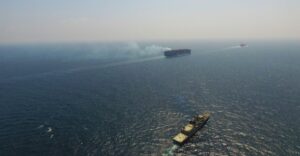
The expectation is also that if American investors get involved and the project becomes part of a broader U.S. regional energy plan, Turkey’s threats will be neutralized. For more than a year, Turkey has prevented seabed surveys by sending warships and issuing constant threats, thus choking a particularly important project.
Regarding the 5×5 forum initiative, led by Foreign Minister Giorgos Gerapetritis, it remains at an early stage. According to well-informed sources, the foreign minister does not intend to send formal invitation letters to his counterparts from the other four countries (Cyprus, Egypt, Turkey, Libya), but will instead explore their intentions through one-on-one contacts. The initiative must overcome many obstacles, the most significant being Turkey’s demand for representation of the pseudo-state and the absence of a legitimate, unified representative for Libya.
There are also differing approaches to delimitation issues in the region and the fact that Turkey and Libya are not parties to the UN Convention on the Law of the Sea. Besides, the problem with delimitations is not so much whether dialogue takes place bilaterally or multilaterally, but the lack of willingness for compromise and understanding, as well as the selective and often arbitrary interpretation of international law and the Law of the Sea.
A special formula
The assessment at the Greek Foreign Ministry is that Turkey will not be outright negative about participating, even if it needs to employ some formula to appear to represent the pseudo-state.
Gerapetritis’ goal is to establish a framework of commitment so that any discussions are conducted under certain principles: respect for international law, the European acquis, and state sovereignty.
As a diplomatic source said, “either we will find a way forward and begin to discuss the problems, or the one who does not show a constructive stance will be left holding the ‘black Peter’.” Although the success of the initiative is doubtful under current conditions, Athens wants this process to be underway in case some sort of American initiative for resolving Eastern Mediterranean problems arises.
Nicosia’s stance
At the same time, similar moves are being made by Nicosia, with President Christodoulides sending reassuring messages to both Ankara and Washington ahead of Cyprus’ assumption of the EU presidency on January 1, 2026. In an interview with the Financial Times, the Cypriot president convincingly explained that he does not intend to exploit the Cypriot presidency in order to pressure Turkey or “freeze” EU-Turkey relations.
On the contrary, he said he will propose inviting both Tayyip Erdogan and Hakan Fidan to informal councils, and in the first phase to ease visa procedures for Turkish businesspeople.
He also stressed that he prefers to deal with a Turkey that is close to the EU. At the same time, addressing Washington, he emphasized that the EU must stand by Trump and his efforts to bring peace to the Middle East, while Cyprus has also taken on a role in transporting humanitarian aid to Gaza under the framework set by the Trump Plan.
Athens is also working at the diplomatic level to prepare for the 6th round of the Strategic Dialogue with the U.S., which, after the energy agreements, is gaining momentum.
The new U.S. administration and the State Department leadership do not appear eager for such procedures. It is telling that no Strategic Dialogue has taken place with any allied country in recent months. As a source with full knowledge of Washington’s processes noted, for this Strategic Dialogue to have substance, very good preparation is required. This preparation has already begun, is being carried out systematically, and has been significantly strengthened by the tangible results of the energy cooperation—boosted by Energy Minister Papastavrou and successful visits of other ministers to the U.S. capital.
Foundations of trust
The same source points out that all this preparation and the highlighting of areas of cooperation between the two countries “builds trust,” which is expected soon to lead to an invitation for Prime Minister Kyriakos Mitsotakis to the White House—though such a meeting must have a concrete agenda and substantive content, which is precisely the Greek goal.
The last ten months since Trump took office have shown that the new power structure in Washington does not want meetings merely “for the photo”—and this is taken into account by all involved in these processes.
A checkmate move via India
With a checkmate move of high geopolitical value for the regional balance of power, the issue of the Greece–Cyprus electrical interconnection resurfaces after a sequence of diplomatic actions. In the Athens–Nicosia–Brussels triangle, the… cable has returned with new momentum, as in the wake of P-TEC and the 3+1 format, the project is gaining a multilateral rather than merely bilateral dimension.
Specifically, speaking to Greece Talks, Minister of Environment and Energy Stavros Papastavrou confirmed such a prospect, stating that the electrical interconnection with Cyprus is becoming part of a broader geopolitical and energy plan within IMEC—that is, the effort by Europe and the U.S. to bring India closer to Europe. The elevation of the cable issue to one of major energy and geopolitical interest for the U.S. and Europe was sealed in the meeting held mid-week between Papastavrou and EU Commissioner for Energy and Housing Dan Jørgensen, where the update of the project’s financial and technical details was discussed at the European level.
At the same time, integrating the Greece–Cyprus interconnection into the commercial routes created by IMEC constitutes a strong form of geopolitical shielding for the project at the regional level, given Turkish reactions, as Turkey had previously treated the issue as part of its bilateral agenda with Athens.
The strategic-level partnerships brought about by the U.S. agenda in the region will be reinforced in real time, with the Minister of Environment and Energy traveling to the United States in early December to set the next steps in energy planning in motion.
Ask me anything
Explore related questions