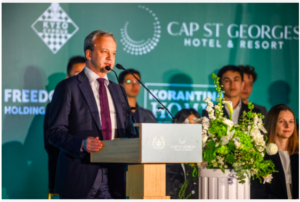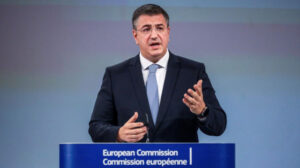
The EU’s military mobility package was presented in Brussels by Commissioner for Sustainable Transport and Tourism Apostolos Tzitzikostas, together with Commission Vice-President and High Representative of the EU for Foreign Affairs and Security Policy Kaja Kallas, Commissioner for Technology, Security and Democracy Henna Virkkunen, and Commissioner for Defence and Space Andrius Kubilius.

According to speakers at a joint press conference, the military mobility package marks a decisive step in strengthening Europe’s ability to respond to crises or threats whenever they arise. The upgraded infrastructure to be created will allow for the rapid and seamless transport of troops and military equipment across Europe’s bridges and tunnels, on roads and railways, and through ports and airports. “This is why we are creating the Military Schengen,” Tzitzikostas said.
In his statement, Tzitzikostas referred to the two main pillars of the measures on military mobility: infrastructure and the institutional framework.
Regarding infrastructure, the Commissioner for Sustainable Transport and Tourism stressed, among other points, that preparatory work has been carried out by the Commission since 2017. “The greatest strength of European transport is the Trans-European Transport Network, which is also the foundation of military mobility. Last March, we agreed to establish four European military mobility corridors. At the same time, together with the Member States, NATO Military Staff and the EU, we identified more than 500 sites where priority projects need to be implemented to deliver rapid results in strategic locations. We know the hotspots, the gaps and the stakes, and we are now ready to act. In most cases, we are upgrading existing infrastructure for both military and civilian use. This means widening tunnels, strengthening bridges and rail lines, and expanding the capacity of ports and airports. Every euro we invest in dual-use infrastructure is an investment in security as well as in our economies and societies. Our 2030 agenda is clear: these projects must be completed by the end of this decade. We estimate that implementing the 500 infrastructure projects will require around €100 billion. We must therefore start investing now,” Tzitzikostas said.
The main funding instruments for the military mobility infrastructure project are the SAFE programme, the Action for Europe in the Field of Security programme, and Cohesion Policy resources. In the next programming period (post-2028), the Connecting Europe Facility (ESDP Infrastructure) mechanism for military mobility will increase tenfold to €17 billion. The European Competitiveness Fund will also contribute to financing.
The Commissioner called on Member States to upgrade military mobility corridors and identify the most strategic infrastructure projects, as well as to cooperate closely with one another, since this infrastructure goes beyond the borders of any single Member State.
Regarding the institutional framework and measures to reduce bureaucracy—seen as an obstacle to unhindered and rapid military mobility—Tzitzikostas noted that “the clear objective is to unify the rules of all Member States in terms of permits and customs procedures. Reducing bureaucracy means issuing transit permits for military equipment immediately. It means streamlined rules for the transport of dangerous goods, including explosives. It means allowing heavier and wider vehicles on European roads. It means permitting military transport during weekends and public holidays. It means reducing total movement time from weeks or even months, as it is today, to just three days.”
Concluding his presentation, Tzitzikostas outlined the timetable for the adoption of the military mobility measures. As he stressed: “Our proposal is realistic and future-oriented. Now we must move from words to actions. On Monday, we will discuss the package with MEPs. In the first week of December, we will begin discussions with Member States. And we must keep the bar high. 2030 is very close. The threats are real. Our response must be immediate. Europe has no time to lose.”
Ask me anything
Explore related questions