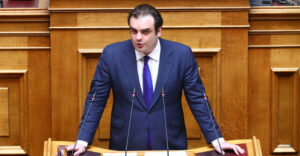
Amid international economic and geopolitical uncertainty, the Minister of National Economy and Finance, Kyriakos Pierrakakis, presents the final draft of the State Budget for 2026 at 11 a.m. in the presence of Deputy Minister Nikos Papathanasis and Deputy Minister Athanasios Petralias. Immediately after its submission to the Parliament, the political leadership of the ministry will present the main points and parameters of the new budget.
The dominant element of the final plan is boosting income and reducing the tax burden for the middle class, young people, and families with children through a comprehensive tax reform.
The main economic forecasts and targets are not expected to deviate from those contained in the draft Budget submitted to the Parliament in October by Kyriakos Pierrakakis.
Specifically, based on the draft, it is expected to provide for 2026:
– A real growth rate of 2.4%, compared with a forecast of 2.1% announced last week by the European Commission in its autumn forecasts
– strong primary surplus of the general government, which is projected at 2.8% of GDP for 2026.
– a rapid deceleration of general government debt as a share of GDP in the EU for the sixth consecutive year, reaching 137.6% in 2026, the lowest level since 2010.
– a fall in unemployment: the unemployment rate is projected to fall further to 8.6% in 2026, the lowest level since 2008.
Support measures and tax cuts
.
The new Budget will incorporate permanent fiscal interventions to support household income, amounting to €1.76 billion for 2026, including:
- 1. Tax reform and relief
- The reform of the income tax scale for employees, pensioners, farmers and self-employed persons is estimated to benefit around 4 million taxpayers at a cost of €1.2 billion in 2026, with measures such as:
- – reduction of tax rates by 2 percentage points for incomes between 10,000 and 40,000 euros.
- – special reliefs for families with children, with the tax on incomes up to 20,000 euros to be zero for families with 4+ children.
- – zero tax on incomes up to 20,000 euros for young people up to 25 years old.
- 2. Salary Increases
- – Public Employees: a horizontal wage increase is foreseen from April 2026, in line with the increase in the minimum wage. In addition, interventions are made in the special pay scales of the Armed Forces and the Security Forces.
- – pensioners: further increase of pensions based on inflation and GDP, and not offsetting 50% of the increase in pensions against the personal difference.
-
-
- 3. New measures for property and housing
- – ENFIA: 50% reduction of ENFIA for main residences in settlements with a population of up to 1,500 inhabitants (outside Attica), with complete abolition in 2027.
- – Rent Tax: Introduction of an intermediate rate of 25% (from 35%) on income tax for rents from 12,000 to 24,000 euros.
-
– Introduction of an intermediate rate of 25% (from 35%) on income tax for rents from 12,000 to 24,000 euros.
- – Terms: Reduction of living presumptions by an average of 30%.
- – Rent refund: the refund of one rent per year (November) to eligible tenants (main and student housing) continues, a measure with an annual cost of 230 million euros.
Investments and expenditure
The rate of change in investment is expected to rise to 10.2% in 2026, among the highest investment increases in the EU27 for that year.
The Public Investment Development Programme is projected to be significantly expanded with resources of €16.7 billion for 2026.
At the same time, spending on National Defence is swelling: physical deliveries of equipment are expected to increase to 2.3 billion euros in 2026, compared to 1.7 billion euros in 2025
2020.2025, compared to 2025.2035, will be 2025.2025, compared to 2025.2035.
Ask me anything
Explore related questions