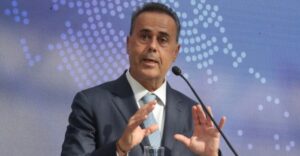
Negotiations will be completed in the next few days, for the Board of Directors of the Hellenic Hydrocarbon and Energy Resources Management Company (Hellenic Hydrocarbon and Energy Resources Management Company) to approve the contract with Chevron and Helleniq Energy for drilling in the Ionian Sea.
Environment and Energy Minister Stavros Papastavrou said, speaking to ANT1, that the contract opens a new cycle for the hydrocarbon sector in Greece. The process has reached its final phase. “By the end of November, the contract will be sent to the Audit Court, then to the Parliament and immediately after that, seismic and geophysical exploration will start from 2026. So we will have Chevron and ExxonMobil, the two largest listed oil companies in the world in the Greek field. This means both a geostrategic strengthening of our country and hope for a significant boost to our national wealth,”
he said.
In early 2027, the first exploratory drilling
On the commitment for the first exploratory drilling by the ExxonMobil – Energean – HelleniqEnergy consortium in 18 months, i.e,. in early 2027, in the Ionian Sea, Papastavrou said: “We have to do everything humanly possible to catch up. It has to do with the future of our children.” He also explained that “if it turns out that there are commercially exploitable deposits, it immediately means an increase in national wealth, significant public resources, new quality jobs, with increased wages and a strengthening of our energy security, beyond geopolitics.”
Papastavrou then presented the “Amorgorama” as an innovative example of self-organization and environmental responsibility. He explained that it is a project that is not imposed by the state, but born out of the local community, being an international good practice. As he said, “it is an initiative of the fishermen of Amorgos themselves, the 45 fishermen of the island, who decided that in order to be able to fish tomorrow, they must self-regulate today. It is an initiative that is unique in Europe, profoundly Greek”. He also noted that “during the fish breeding months, from April to May, they do not fish at all and collect waste” and “they have chosen three areas where they do not fish all year round”. The Minister also stressed that this collective attitude “is an act of responsibility that protects marine wealth and shows that the islanders love and manage their land in a way that is a model for the whole of Europe”. He also drew a parallel between their example and an inscription from the 3rd century BC found in Herakleia, 22 nautical miles from Amorgos, which contains a resolution of the island’s inhabitants to ban the import of animals from outside the island in order to protect the island’s flora and fauna. “In other words, the concept of self-management has existed for 2,500 years in the Cyclades,” Papastavrou said.
About Alexis Tsipras’ book
Asked about Alexis Tsipras’ book, the Minister commented that “the period of his government was associated with toxicity, targeting of political opponents and, unfortunately, their families. My family was one of them, as were many others. Every person has the right to write a book. But I believe he ought to begin with an honest self-criticism. This, unfortunately, I have not seen.”
In the same context, Papastavrou pointed out that “at that time, Mr. Tsipras poisoned our political life, and divided our country. To see the other person as a political opponent, yes, to argue against him, yes, to argue against him, yes, to want to eliminate him by any means, that is what is taking us back – and that is exactly what Mr. Tsipras did. If one really wants to turn over a new leaf, one must first acknowledge one’s mistakes. Otherwise, he just changes the wrapping, not the content.”
Ask me anything
Explore related questions