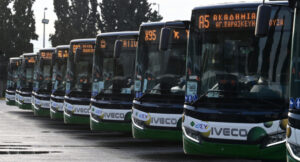
In a bid to enforce the Road Traffic Code, 600 OSY buses will be fitted with digital cameras using artificial intelligence to record road-network issues and issue fines for violations.
Selected OSY buses will carry high-resolution digital cameras, powered by AI, which will detect infractions not only to ensure the free flow of vehicles in bus lanes but also to document broader road network problems.
OSY has launched a tender for a “System for Recording and Analysis of Road-Network Conditions, Traffic, and Traffic Violations Using Special Electronic Devices (Fixed Cameras), pursuant to Article 107 of the Motor Vehicles Code.” The project is worth more than €1.56 million (including VAT), has a 12-month implementation timeline, and the tender submissions are due by Monday, 8 December 2025, with the opening of bids on Thursday, 11 December.
A pilot program is already underway: the system is being tested on 10 bus lines in Attica, with cameras positioned to capture every vehicle that illegally enters bus lanes, illegally parks, or commits other common violations.
How It Will Work
The system will collect, store, and analyze real-time data on:
- Traffic conditions and vehicle flow
- Road infrastructure condition (e.g., potholes, cracks, general wear)
- Traffic violations around buses (illegal stopping, running red lights, entering bus lanes)
The stated goals of the project are to optimize OSY’s network operations, enhance passenger and driver safety, reduce operating costs, and immediately alert competent authorities of incidents requiring intervention. Simultaneously, the system will generate useful data for improving routes, identifying bottlenecks, and shaping sustainable mobility policies.
To achieve this, the system will leverage cutting-edge technology: high-resolution day/night cameras, IoT sensors collecting real-time data, and AI / computer-vision algorithms to automatically detect objects, vehicles, and violations. The data will be managed through a cloud-based platform allowing OSY to monitor, analyze, and visualize traffic patterns.
Video streams will be converted into analytics, providing traffic forecasting and early warnings for incidents or infrastructure problems.
At the heart of the system lies a central platform, composed of four main subsystems:
- Driver Behavior & Offence Detection: Real-time detection and recording of violations such as illegal stopping, red-light offences, or traffic in bus lanes — with fines automatically sent to the offender’s registered address.
- Fleet & Traffic Monitoring: A live, interactive map view of all buses and traffic flows.
- Roadway Structural Health Assessment: Identification and classification of road deterioration (cracks, potholes) by severity.
- Data Visualization: Presentation of statistics via graphs, tables, and heat maps.
The AI algorithms have been trained using real traffic data to recognize and categorize different types of vehicles (cars, trucks, motorcycles, buses). Using the collected data, the system will compute key metrics: volume and speed of vehicles by type, average delay times, congestion levels, and CO₂ emissions per traffic flow.
These metrics will be displayed as heat maps, helping OSY and other agencies to pinpoint problematic areas in the network. This technology will not only support better fleet management, but also inform policy-making to improve urban mobility.
The expected benefits include:
- Increased safety for drivers and passengers
- Improved service quality
- Reduced delays and operating costs
- Better infrastructure maintenance through early detection of road deterioration
Through the platform, OSY staff will be able to monitor in real time:
- The position and status of each bus
- Recorded violations
- Areas with high congestion or road health issues
All data will be exportable, searchable, and stored for historical analysis.
This initiative is made possible under Article 107 of the Road Traffic Code, which permits the detection of traffic offences via special electronic devices (such as cameras), provided the public is clearly warned.
OSY’s system will solely record offences — it will not perform any enforcement intervention itself. Data will be automatically forwarded to the relevant authority for processing.
OSY is also taking steps to comply with GDPR and ensure that any data collected (from citizens or staff) is processed in full respect of privacy.
The system is designed for interoperability: it can connect with public-sector information systems, such as the Ministry of Transport’s Vehicle Register, the national tax register, the Citizens’ Register of the Ministry of the Interior, and the National Communication Register (EMEP).
It is also scalable: in the future, the system could be expanded to recognize additional offences, such as speeding, pedestrian-crossing violations, or careless driving.
The contract is broken down as follows:
- €900,000 (€1,116,000 incl. VAT) for the base project
- €360,000 (€446,400 incl. VAT) for optional scope expansion (up to 40% more)
The contract lasts 12 months, with the possibility of extension if not all installation or equipment delivery is completed in time.
During pilot operation, system parameters will be tuned to real-world conditions, and OSY staff will be trained on the platform and analytic tools.
Deputy Transport Minister Konstantinos Kyranakis told APE-MPE that the addition of 600 more cameras (to join the ones already piloted) will strengthen a measure that is already working. “The more we protect bus lanes from illegal use, the faster the buses move — and that is immediately felt by citizens at the bus stop,” he said.
He emphasized that the goal is not to penalize as many drivers as possible. “The enforcement is to keep a network that serves hundreds of thousands of people every day running smoothly … The first cameras have been piloted on 10 buses and the algorithm has been trained … We do not punish; we respect the person waiting at the bus stop every day for their ride to work or home.”
Ask me anything
Explore related questions