





Among the many events that took place in the USSR under Nikita Khrushchev’s rule, a prominent place is held by the uprising and massacre at the Electric Locomotive Factory in the city of Novotcherkassk, Rostov Region (Southern Russia) in 1962. Dozens of people lost their lives, and many more were injured. The events remained hidden for about 30 years. Only Solzhenitsyn, in The Gulag Archipelago, had made mention of the issue, though with many inaccuracies. Let us now, as almost everything has been revealed, see what happened in Novotcherkassk in 1962.
The Situation in the USSR in 1962
In the spring of 1962, the USSR faced serious economic problems. Due to agricultural shortages and the need to finance investments, the Khrushchev government announced price increases on various basic goods. On May 30, 1962, it was announced that retail prices for meat and meat products would rise by 30% and butter by 25%. This was a “temporary decision,” deemed necessary to boost agricultural production.
There was a belief that the Soviet people would understand. However, this did not happen, as other decisions had negatively affected food supplies, particularly meat and butter. The increases were considered excessive by most workers.
Novotcherkassk 1962
Novotcherkassk, the cultural capital of the Cossacks and the official capital of the Don Cossacks, had around 130,000 inhabitants in 1962. In the early 1930s, the Novotcherkassk Electric Locomotive Factory (NEVZ) began operations in the city, employing 12,000–13,000 workers. The city was also an educational center, with around 30,000 students. Living conditions were tragic. Many workers slept in barracks or tents. The Tuzlov River divides the city into two parts: one containing the administrative offices and the old town, and the other the industrial area with barracks and a railway station. Bus routes between the two sides of the city were irregular, so night-shift workers, who received a meager meal, had to wait until morning to reach their homes. Working conditions at that time (1962) were abysmal. Recently, 200 workers in one department had suffered poisoning.
Shortly before, Boris Kurotsky had been appointed director of NEVZ, and throughout 1962, as part of a nationwide wage reform, his policies led to a wage reduction of around 30%, which caused outrage among the workers. In general, there was widespread dissatisfaction in the USSR at the time with Khrushchev’s policies.
Historian Tatyana Bokharova, in her book Novotcherkassk, the Bloody Noon, publishes excerpts from KGB notes with conversations of ordinary people who patiently stood in queues for food at railway stations and factories. A driver in Arkhangelsk complained: “Life is getting worse and worse. Kennedy would do the right thing if he dropped an atomic bomb on the Soviet Union.” A senior technician in Moscow expressed his frustration: “How are we supposed to believe these official public announcements when they tell us that rumors of price increases in the USSR are hostile propaganda spread by the BBC, and then it turns out the BBC was right?” Finally, a worker in Gorky concluded: “If this happens, we’ll need to make posters and go to the regional party committee.”
The KGB itself had noted the terrible living conditions in Novotcherkassk, but by then it was impossible to stop the dramatic developments.
Start of the Strike (June 1, 1962)
The strike at NEVZ began spontaneously on the morning of June 1, 1962, in the steel department of the factory. Workers gathered to discuss the previous day’s food price increases, which heavily burdened their finances. Some CPSU officials who tried to justify the new policy were met with hostility. The head of the foundry, Chernyskov, ordered the workers to return to their positions, but they moved to the square outside the factory administration building. At some point, the factory director Boris Kurotskin arrived to confront the gathered workers, whose numbers were estimated at several hundred.
During the heated discussion, a worker said to the director: “We have never seen meat.” Kurotskin replied: “If there isn’t enough meat, eat pies with liver.” According to the criminal records released in 1994, the phrase was: “… eat cabbage pies,” while Alexander Solzhenitsyn in The Gulag Archipelago mentions: “… pies with jam.” This caused outrage among the workers, who informed their colleagues. Some shouted: “The swindlers are mocking us.” On the morning of June 1, 1962, the NEVZ workers’ strike began. Gradually, more and more workers joined, overpowering the factory guards and activating the sirens.
Engineer Vyacheslav Chernik later said that “everyone did what they considered right, based on what they had learned from Soviet propaganda films about workers’ strikes.” The workers dismantled a fence and covered the railway tracks with wooden planks, blocking train traffic. When a passenger train heading from Saratov to Rostov stopped at the improvised workers’ barrier, they boarded the train. Some entered the driver’s cabin and activated the train whistle to sound continuously.
Others wrote on the train cars: “Meat, butter, raise wages,” “Make sausages from Khrushchev,” “Send Khrushchev to the butcher,” etc. One factory engineer urgently requested that the train be allowed to pass, but his furious colleagues assaulted him, and some even suggested throwing him into the locomotive furnace!
The Strike Escalates Out of Control
Very quickly, local and provincial authorities were notified. The head of the city party organization and KGB officials established a “command post” in the NEVZ director’s office. Around 12:30 p.m., Alexander Basov, First Secretary of the Rostov provincial party organization, ordered the commander of the North Caucasus Military District, General Isa Pliev, to deploy troops. Basov arrived at the factory in the afternoon. At 4:30 p.m., together with other officials, he addressed the workers through loudspeakers. Since no concessions were made, they began receiving stones and kefir bottles and hurriedly retreated indoors. Basov was trapped inside the factory, and the police who tried to free him were pushed back by the workers. Around 6–7 p.m., 200 policemen attempted to disperse the workers’ crowd, which included dozens of KGB agents disguised as workers, but failed. Two hours later, military forces arrived in the area. Five vehicles carrying soldiers and three armored personnel carriers, however, did not move against the crowd. The soldiers sided with the strikers, and the officers made great efforts to return them to their positions.
The mass gathering in the district square at night did not lead to any decision. The strikers contented themselves with burning portraits of Khrushchev and other CPSU leaders. News of the strike, which had escalated into an uprising, reached Moscow, from where senior officials arrived in Novotcherkassk. Twenty-two people were arrested as ringleaders, 20 of whom were released to avoid losing control of the situation. Meanwhile, military forces (army and MVD personnel), at least 3,000 in total, were gathered inside and around Novotcherkassk. The bridge over the Tuzlov River was blocked by 15 tanks and three personnel carriers. They were led by a WWII hero, General Matvei Sapozhnikov, who had distinguished himself at the Battle of Brody and was Pliev’s deputy. Key buildings, such as the Gorkom (Regional CPSU Committee), the post office, the railway station, and the prison, were guarded by strong forces. The demonstrators returned home, and around midnight, the police dispersed the last 20 remaining protesters. Basov, who had been trapped in the factory, was freed in a paratrooper operation (!) and evacuated wearing workers’ clothes.
June 2, 1962: The Novotcherkassk Massacre
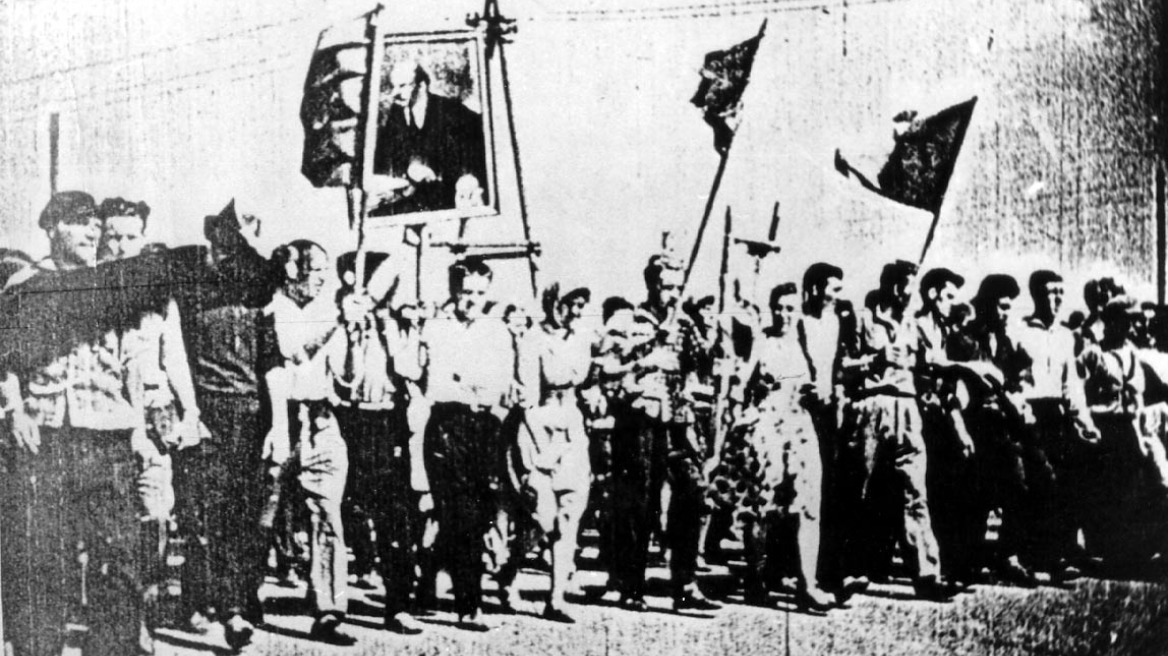
On the morning of June 2, 1962, the morning-shift workers arriving at the factory found it occupied by soldiers. Enraged, they chose not to work under the threat of weapons. They joined other demonstrators and began a march toward the city center. The number of demonstrators is uncertain. According to the KGB, it was 5,000, while other sources put it at 12,000. Meanwhile, although the train the workers had blocked the previous day had been moved, on June 2 they tried to stop another passenger train for a short time. Sapozhnikov, to whom we will refer extensively, ordered his soldiers not to take any action. Around 10:30 a.m., the demonstrators began their march toward the center of Novotcherkassk (about 9 km). They carried red banners and portraits of Lenin to show their loyalty to revolutionary ideals.
Some shouted slogans like “Meat, butter, raise wages.” The procession included the workers’ wives and children, who wanted to demonstrate their peaceful intentions. When they reached the Tuzlov River bridge, soldiers and cadets from a nearby military school did not respond. Thus, the demonstrators, having also passed some fire trucks behind the tanks, crossed to the other bank. Since the Tuzlov was shallow at the time, some crossed directly through the water. Their morale was high. They sang The Internationale. Around noon, they reached the city. A high-level delegation from Moscow had arrived, consisting of the hardliner Frol Kozlov, Anastas Mikoyan, who had previously worked in Rostov, Andrei Kirilenko, and Dmitry Polyansky, along with Central Committee Secretaries Selepin and Ilitsev, who settled in the heavily guarded Gorkom. Kozlov had previously contacted Khrushchev, who ordered him not to make any promises to the demonstrators. Khrushchev even asked him if he liked what he had said earlier to representatives of the Cuban youth (“The enemies remain among the people,” “The enemy may be wearing the same work clothes as you,” etc.). Mikoyan wanted to speak to the gathered crowd in Lenin Square (formerly Ataman Square, as Ataman is a title for Cossack leaders) but was prevented.
Soon, the highest-ranking CPSU officials “escaped” through some door to a neighboring military complex building. Enraged, the workers attacked the security forces and took over the Gorkom. They tore down portraits of Khrushchev and smashed the furniture. Another group, about 50 people, attacked the nearby police station to free the two workers who, as they believed, were still there. Those workers had been evacuated during the night.
A clash followed, during which soldier Azizov killed a worker who tried to take the weapon of a colleague. This was followed by a volley of gunfire directed at the demonstrators who had entered the police station and not only them. Five workers were killed. Two 16-year-old children who happened to be passing outside the building were seriously injured and died a few days later.
Meanwhile, the leadership of the military forces had been assumed by order of Pliev by General Olesko. Taking a microphone, he warned the workers from a balcony to disperse, otherwise the soldiers would shoot them. The demonstrators did not believe him. “They will not shoot the people,” they said. At 12:30, Olesko ordered “fire.” The first shots were aimed above the workers’ heads, who assumed they were blanks. Soon, however, a storm of fire lasting 1–4 minutes caused the deaths of 16 people and injuries to hundreds. There is a version that those who fired “to kill” were men from the KGB or other security services. In total, 24 were killed and 87 injured. Three of them were amputated.
The Attempted Cover-Up by the Soviet Authorities
Immediately afterward, KGB agents and police loaded the bodies onto trucks. Fire engines washed the blood from the streets and the square. The stains remained, however, and the authorities paved over the entire area. The injured were taken to the city hospital, which became full. Other patients were discharged (this reminds us of Tashkent…) urgently, to make room for the injured workers. A curfew was imposed in the city from 9 p.m. to 6 a.m. Patrols and checkpoints, as well as a telephone blackout, isolated Novotcherkassk. The victims’ bodies, to prevent incidents, were buried in pairs at sites far from the city. The 80 people who participated in the burials were forced to sign confidentiality agreements, swearing they would never reveal what they had seen and done. The families of the victims did not learn the burial sites until 1992.
Meanwhile, the hunt for those responsible continued among those who had escaped. Another 146 people were arrested by June 12. Few of the detainees were actually held. In a radio message, Mikoyan condemned the “uprising” but admitted that the workers were right on some issues. In contrast, Kozlov labeled the workers as “hooligans” and “provocateurs,” promised improvements in living conditions and food distribution, but emphasized that order would be maintained “by any means necessary.” NEVZ director Kurotskin was dismissed and expelled from the party. He was succeeded by… his predecessor Ambroskin, who was particularly popular with the workers and improved conditions at the factory. Basov, Pliev, and Olesko were transferred away from Novotcherkassk.
The Trials of the Accused
114 worker-demonstrators were subsequently tried. The most important trial was of 14 individuals (13 men and one woman, E.P. Levchenko) in August 1962. They were charged with “mass disturbances” and “robbery.” Seven of them were sentenced to death and executed. The remaining six and Levchenko were sentenced to 10–15 years in prison, although most were released earlier. Regarding the Novotcherkassk massacre, there was complete obfuscation by the authorities and very little information was known. Only Solzhenitsyn in The Gulag Archipelago devoted 2–3 pages, though with several inaccuracies. Other prominent Soviet dissidents, such as Andrei Sakharov, learned about the events and unsuccessfully tried to inform the international public.
Glasnost and Rehabilitation
It was only in 1987 that Petr Siunda, one of the NEVZ workers arrested on June 1, 1962, and imprisoned for several years, through his memoirs, leaflet distribution, and interviews, brought the events to light and sought to restore the memory of those killed or executed. The Soviet public, and especially Soviet officials, were astonished. Investigations began, and in 1992 the victims’ bodies were found and buried with honors in Novotcherkassk. By 1996, the memory of most of the dead had been restored (including a hairdresser struck by a stray bullet in her salon and a citizen who violated the curfew). The murders appear to have been ordered by Khrushchev himself and carried out on the orders of high-ranking officials sent to Novotcherkassk, by a unit of the “Internal Troops” from Rostov-on-Don. It involved 10 snipers equipped with two machine guns positioned at the Don factory. Many aspects of this massacre, which remains a stain on the CPSU, remain unclear.
Matvei Sapozhnikov (1906–1994)
The WWII hero, General Sapozhnikov, refused to attack the demonstrators with tanks as ordered by Pliev: “I see no enemy here around whom we could turn our weapons against,” he said. Later, he sent six letters to the Committee of the Soviet Komsomol (Communist Youth) and to various higher education institutions, informing them about the Novotcherkassk massacre. In 1966, he was placed in reserve, and in 1967 he was expelled from the CPSU. He was brought to trial for “anti-Soviet activity” by the KGB (August 26, 1967) but was acquitted due to his rank and the letters he had sent. In his diary in 1967 he wrote:
“Personally, I cannot hide my indignation or anger at those who committed these arbitrary and outrageous acts. I only regret that I could not truly combat this evil. In the struggle against despotism and tyranny, I did not have the capacity to fight to the death. In the struggle against the evil that remains widespread and entrenched in the army, the tyranny of arbitrariness, malice, and hypocrisy, I did not have sufficiently effective weapons, except for the deceptive belief that truth itself would prevail and that justice would triumph.”
Ask me anything
Explore related questions




