





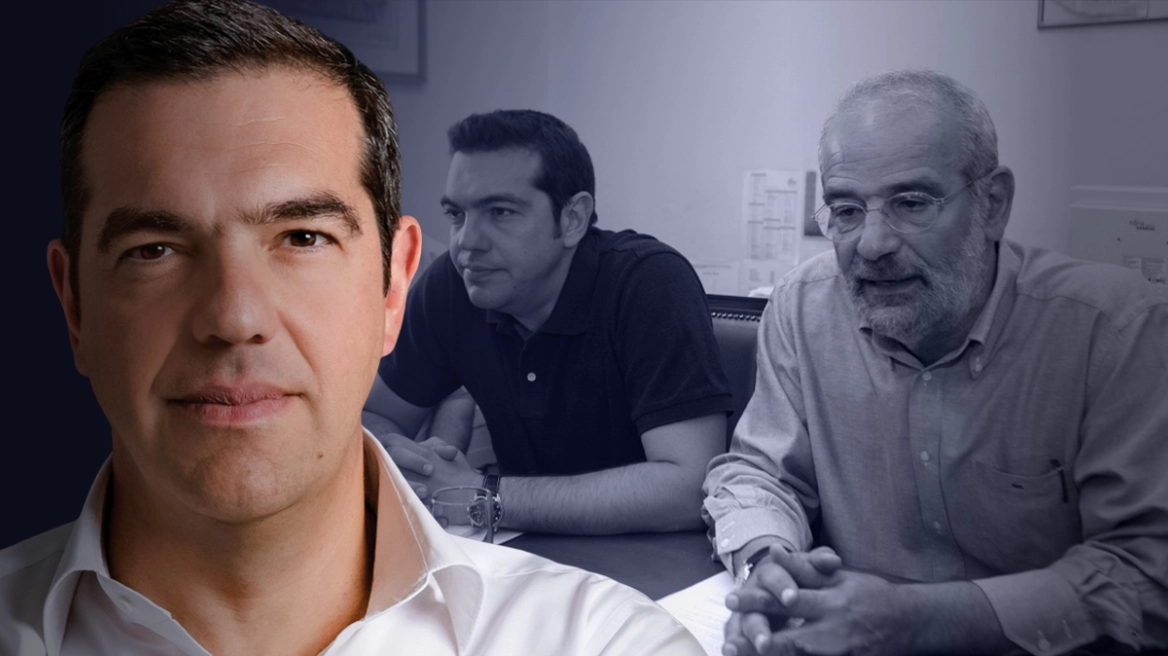
Alexis Tsipras attempts, through his Ithaca, to restore the truth surrounding the complex relationship he developed with Alekos Alavanos, his predecessor in the leadership of SYN/SYRIZA.
From his point of view, Alavanos, having personally chosen him as his successor, seems to have later regretted it and tried to sideline the supposed protégé and favorite he himself had selected.
This unexpected and puzzling reversal by Alekos Alavanos pushed Alexis Tsipras to act decisively and to quietly remove his own mentor.
Alexis Tsipras writes about Alekos Alavanos
On November 27, 2007, Alekos Alavanos [then president of SYN since December 2004] announced, ahead of the party’s upcoming Congress, that for personal reasons he would not again be a candidate for the presidency of SYN. It was a decision that surprised most people, because there seemed to be no clear logic behind it: his tenure as leader had been brief, and the election result had been deemed satisfactory.
Despite persistent efforts by senior party figures to persuade him otherwise, he insisted, citing health reasons as well. And although he had never spoken to me directly about the matter, in informal discussions with members of the Political Secretariat he apparently pointed to me as a possible successor.
At the time, I couldn’t even imagine such a discussion taking place about my name. I was thrilled because I was preparing for a trip to Venezuela, where I would join an international delegation of election observers. With me was Kostas Isychos, then head of SYRIZA’s International Relations, a deep connoisseur and lover of Latin America, having been born, raised, and having relatives in the suburbs of Buenos Aires, Argentina. In Caracas, in fact, I had the chance to watch Hugo Chávez’s main speech up close, and later to meet with the Deputy Minister of Energy.
On the return flight from Caracas, Isychos hinted at something, and I almost snapped at him. “Come on, Kostas, cut the jokes,” I said, ending the conversation immediately. But as soon as I returned to Greece, I found a message on my phone from Alekos Flambouraris, asking me to visit him urgently at his home. I went there with my suitcase still in hand. He welcomed me, offered me coffee, asked about Venezuela, and I began analyzing the Chávez phenomenon to him.
[…]
Alekos gave me an analysis of populism straight out of the manuals of the Renewing Left of Angelos Elefantis, but in the end he admitted that there had never been a mass popular movement that came to power without reference to major leadership figures. At some point I told him:
— “Is this why you called me here, to talk about Venezuela?”
— “No,” he answered in his familiar mild manner.
— “So what is it?”
— “Alavanos insists on resigning.”
— “Couldn’t you convince him it’s a mistake?”
— “We tried, but we didn’t succeed.”
— “And now?”
— “Now we’re going to make you President,” he dropped the grenade as casually as he could.
At first I refused even to discuss it. It was far too premature as an idea. But Alekos insisted. I asked whose idea this was and he replied that it was Alavanos’s, but Voutsis agreed as well. I told him that whatever the situation, they needed to forget about it.
— “When I didn’t even want to become an MP, Alekos, how am I supposed to become President?”
Flambouraris, with paternal indulgence and the calm of experience, asked me not to answer immediately. To think about it for two or three days.
“Sometimes these things aren’t decided by us,” he said. “They come to us without us realizing it. But remember this: no one regrets decisions taken by taking a risk. Everyone regrets the opportunities they let slip away.”
These last words were too weighty not to trouble me. That night, naturally, I couldn’t sleep—and it wasn’t the jet lag from the transatlantic trip. It was an unexpected and startling proposal; the motives behind it troubled me, but even more so my own answer, given that I was fully aware of how big a change this would bring to my life—and what a major challenge it would be for me and my party.
The following days were filled with discussions. I hesitated greatly, but once I accepted the proposal, things moved much faster than anyone could have imagined. The mere news of a 34-year-old standing for the leadership of a parliamentary party became a catalyst for wider developments in a political system that seemed stuck.
The 5th SYN Congress, on February 10, 2008, was perhaps the only one in the party’s brief history that had drawn public interest. In the secret ballot, facing the candidacy of Fotis Kouvelis, I was elected President with 70.4% of the delegates’ votes. It was a small political earthquake. I was the youngest political leader in the country’s history.
Immediately after my election, SYRIZA saw an unprecedented surge in the polls. By the end of the same month, surveys showed that our numbers had more than doubled. In one poll, a few days before PASOK’s scheduled Congress on March 14, we appeared in second place with 18%, leaving PASOK third with 17%. This set off alarm bells in the political system, especially in PASOK’s headquarters, which was scrambling to find a defensive line against the new phenomenon.
[…]
My election and the particularly positive public reception essentially expressed a broad demand for the renewal of the political personnel. This demand concerned not only age or demeanor, but also the content of politics. Voters were tired of the alternation in power of two parties whose only real differences were their memories. My rise to SYN’s leadership broke established political norms. A young man who didn’t resemble a typical politician—an ordinary kid next door who burst unannounced onto a stage of propriety, corruption, and family-based politics. A nobody, without a family name tied to a political dynasty, not yet 34, riding a motorbike and wearing jeans—standing against two heirs of political dynasties: a Karamanlis and a Papandreou. In a political scene dominated by these two families for nearly six decades. That alone was enough to draw attention.
In the months that followed, up to December, SYRIZA continued its rise in the polls, gaining increased public interest for its actions, its alternative aesthetic, and its different, less conventional tone, which often startled the established political class and journalists.
[…]
PASOK under George Papandreou, without lifting a finger—helped by KKE and New Democracy—neutralized its most serious competitor in its effort to regain momentum as the main opposition party and claim the government with confidence. The “SYRIZA phenomenon” seemed, temporarily, to lose its shine. And I along with it.
Around that time, the first cracks with Alavanos began to appear. He had decided to resign as President of SYN, but not from the leadership of SYRIZA’s parliamentary group. Earlier, during SYRIZA’s polling surge, signs had already appeared of his desire not to withdraw from the political spotlight.
He gradually adopted an increasingly intense level of activity.
He began touring and didn’t leave any important party representation without taking it on himself. He even decided to represent SYRIZA in a meeting with Karamanlis at the Maximos Mansion regarding the December unrest, and began giving ambiguous answers to every question about his decision to resign from SYN’s leadership.
As we approached the European elections, this behavior worsened. It was around then that I began to realize what I had initially refused to believe: his resignation was a maneuver to free himself from the party he saw as a burden. He had taken a risk by bypassing the party hierarchy and helping elevate an outsider to the leadership. But unfortunately for him, things had not gone the way he expected. The developments had pushed him into the background—something he was not ready to accept. In order to reverse the course of events, he took full control of SYRIZA’s presence in the European election campaign, reducing me to the role of a bit player.
The result of the European elections of June 7, 2009 was disappointing: PASOK came first with 36.6%, New Democracy followed with 32.3%, KKE came third with 8.35%, LAOS fourth with 7.15%, and SYRIZA was reduced to fifth place, with just 4.7%. From the very next day, SYN and SYRIZA were gripped by introversion, as expectations of a much better result had been dashed. In an atmosphere of complete questioning of my leadership—by Alavanos, some SYRIZA components, and the renewing faction of SYN—a very difficult, almost nightmarish summer unfolded.
I quickly realized that unless I took political initiative, both I and the party would inevitably face a dead end. I attempted to cut the Gordian knot by turning to the party base. On August 25, I announced to the Political Secretariat that at the upcoming Central Committee meeting I would request the convening of an Extraordinary Congress of SYN in October 2009.
Meanwhile, the news from the economic front was ominous. Dark clouds were gathering over the country’s fiscal sky. The “shielded economy” that Karamanlis’s ministers boasted about was beginning to crumble. The deficit had exceeded acceptable limits, even for partners who for years had turned a blind eye.
Karamanlis, realizing the storm would break over his head, decided to cross the Rubicon. And while I was planning extraordinary congresses, he was planning an extraordinary snap election to escape the worst. On September 2, 2009, he abruptly announced early elections for October 4.
SYRIZA was in turmoil. The sense of confusion was pervasive. In Secretariat meetings, the SYN delegation—with my firm stance—requested that the 2007 arrangement remain: the President of SYN would also head the SYRIZA ticket. The factions supporting Alavanos refused and proposed him as the head instead. The climate began to resemble dissolution.
At the same time, the “Renewing Wing” suggested that SYN run independently in the elections, with me as its head. However, this was a trap: such a move would inevitably lead to a split—SYRIZA would run separately, with Alavanos leading it.
In this climate, I decided to go above and beyond with a proposal hard to reject. Instead of going into the election with a single head of the ticket, we would submit to the Supreme Court a ballot headed by representatives from all components—nine in total. And I would be one of the nine. All nine of us would run with preference votes in our constituencies. And the new President of the Parliamentary Group would be elected by the new MPs. I also agreed that all nine of us would appear at the press conference at the Thessaloniki International Fair. At that point, we had nothing left to lose—after all, we had already become a comedy sketch.
The one thing I insisted on, and on which I was immovable, was representing the coalition in the televised leaders’ debate. My proposal—made at the last moment before submitting the ballots—was theoretically radical and seemed like a major concession for SYN, the main party in the coalition. Practically, however, it was the move that got us out of the dead end.
After three long sessions, with time running out, the proposal was accepted. Alavanos stepped aside, and I assumed full responsibility. I went to Thessaloniki with the other eight for a parody of a press conference. The atmosphere was heavy and tense; everything hung by a thread. PASOK seemed to be charging ahead, and the possibility of SYRIZA failing to clear the 3% threshold was more than real.
Yet deep inside, I believed we would secure parliamentary representation. And on September 21, that belief became certainty. In the pre-election leaders’ debate, where I represented SYRIZA, I not only managed to stand with dignity, but, by general admission at the time, left very positive impressions. In the days that followed, polls measured us as being safely within Parliament. That night, after the debate, I was no longer just a candidate: in essence, I was already the leader of SYRIZA.
In those critical hours, it wasn’t formal party procedures that determined the outcome, but my decision to step forward and hold my ground—despite my youth and inexperience—in a tough political contest. I met the demands of a national audience under relentless pressure, during a three-hour televised duel with no room for hesitation or mistakes. That night, life itself gave me the leadership mandate. My performance contributed to SYRIZA’s parliamentary presence.
In the elections of October 4, 2009, PASOK prevailed comfortably by ten percentage points, while SYRIZA crossed the parliamentary threshold with 4.6%, electing 13 MPs. I was elected MP for the first time, topping the preference votes in Athens A by a wide margin. A few days later, SYRIZA’s Parliamentary Group unanimously elected me its President.
Ask me anything
Explore related questions




