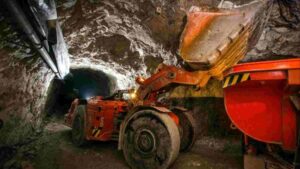
The military regime in Niger announced last Sunday night its intention to release to the international market the uranium produced by Somaïr, a subsidiary of the French giant Orano, which lost operational control of the company when Niamey nationalized it in June.
Somaïr (Société des mines de l’Aïr, “open-cast mining company”) was 63.4% owned by Orano and 36.6% owned by the Nigerien state.
The exploitation of uranium deposits in Niger lies at the heart of the brinkmanship between the military junta, in power since the July 2023 coup, and the Orano group. The issue is one of several points of contention between France, the former colonial power, and the Nigerien military authorities.
The latter have made no secret of their willingness to turn to new partners such as Iran and Russia. Moscow expressed in July its willingness to begin uranium mining in Niger.
Niger, with “dignity,” has decided to “put its production on the international market,” a reporter for state television Télé Sahel said, quoting a statement by the junta leader, General Abduraman Chianni.
According to media reports, Chianni stressed that it is “Niger’s legal right to dispose of its natural wealth, to make it available to whoever wants to buy it, in accordance with market rules and in full independence.”
Orano lost operational control in December 2024 of its three subsidiaries in Niger: Somaïr, Cominak (closed since 2021), and the company managing the Imouraren field.
The latter site contains one of the largest uranium deposits in the world: reserves are estimated at 200,000 tonnes. Niamey has revoked Orano’s exploitation licence.
In June, the junta announced the nationalization of the Somaïr mine.
Orano, whose share capital is 90% owned by the French state, has initiated several international arbitration proceedings against Niger.
At the end of September, the French company announced that a court had ruled in its favour regarding the Somaïr mine.
According to Orano, the court ordered the Nigerien authorities not to sell uranium produced by Somaïr, whose facilities hold around 1,300 tonnes of enriched ore with an estimated commercial value of €250 million.
According to information published in recent days by the media outlet LSI Africa and WAMAPS, a group of West African journalists specializing in security issues in the Sahel, a convoy carrying some 1,000 tonnes of uranium recently left Arlit, the northern city where Somaïr’s facility is located, bound for the port of Lomé, Togo, passing through Burkina Faso.
Agence France-Presse notes that it has so far been unable to independently verify this information.
Niger accounted for 4.7% of global natural uranium production, according to 2021 figures from the Euratom Supply Agency (ESA).
Ask me anything
Explore related questions