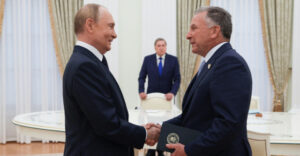
On Tuesday afternoon (2/12), Vladimir Putin will meet at the Kremlin with the U.S. delegation, which will consist of U.S. President Donald Trump’s special envoy, Steve Witkoff, and Jared Kushner, Trump’s son-in-law.
According to Kremlin spokesman Dmitry Peskov, the U.S.–Russia meeting is scheduled to begin after 17:00 Greek time.
When asked whether additional U.S. officials would participate, Peskov replied that no other American representatives are expected beyond the two envoys and an interpreter. He added that the talks will last as long as necessary, with no set time limit.
The central focus of the discussions will be efforts to resolve the Ukraine crisis, including proposals the United States has submitted on the matter.
Trump has repeatedly stated that he wants to end the war in Ukraine, which his administration describes as a “bloodbath” and a “proxy war.” However, his peace efforts—including a planned summit with Putin in Alaska last August—have so far failed to produce results.
Putin, for his part, has also said multiple times that he is willing to engage in talks aimed at achieving peace, while noting that if Ukraine refuses an agreement, Russian forces will advance further and seize more Ukrainian territory.
CNN: Why Trump chose Witkoff and Kushner for the talks with Putin
According to CNN, during his second term Trump has chosen a close circle of businessmen and long-time associates to handle major international crises.
At the center of these missions are Steve Witkoff and Jared Kushner, who have already played a decisive role in achieving the ceasefire agreement between Israel and Hamas.
According to U.S. government officials, the success of the talks that led to the Gaza ceasefire was the key reason Witkoff and Kushner were placed at the forefront of diplomatic efforts to end the war between Russia and Ukraine. After the agreement, Trump described Witkoff as an “exceptional negotiator because he is an exceptional person.”
Witkoff was initially appointed special envoy for the Middle East, with the primary mission of helping end the war in Gaza. However, his role expanded quickly to include efforts to halt the war in Ukraine.
A former senior State Department official noted that Trump “was always reluctant to yield to bureaucracies” and preferred “personal diplomacy.” The official said the practice resembles pre–Cold War eras, before the creation of the National Security Council and the professionalization of the diplomatic and administrative corps.
Ask me anything
Explore related questions