





Sound messages of praise for the Greek economy were sent out by international markets and European institutions last week. The total recovery of the economy from the adventure of the last decade with growth rates almost twice the European average and rapid reduction of public debtfueled the interest of foreign investors, upgrading the country’s position in the claiming of critical positions in the European structure and winning the praise of markets and international organizations.
The new scene was reflected last week in three different but interdependent fields: a) In London, by the great interest shown by the international investment community in Greek banks at the Morgan Stanley and Hellenic Financial Services Conference; b) In Brussels, by the announcement of the two candidates for the presidency of the Eurogroup, one of whom is the Greek Minister of National Economy and Finance Kyriakos Pierrakakis and c) In Luxembourg, from the new green light given by the ESM for the early repayment of a €5.29 billion memorandum loan.
The signals from London
In the first case, what is notable is that the interest in Greek banks at the London conference came mainly from large long-term investment funds. These are funds that a few years ago were not interested in investing in Greece. That is why dozens of meetings were held at the Morgan Stanley conference with the management and representatives of the major Greek banks. High on the agenda of the discussions were the forecasts for the course of key banking figures, which were considered particularly positive, alongside those for the Greek economy, according to circles involved in these contacts. According to the same players, a decisive factor in the launch of these developments is the acquisition of AXAE by Euronext.
The European upgrade
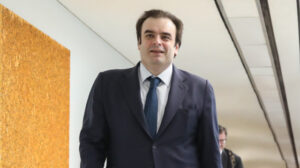
Never before had a Greek finance minister claimed the position of Eurogroup chairman. The negative tradition has been “broken” by Kyriakos Pierrakakis who is now, and with strong chances, claiming this position together with the vice-president of the Belgian government and budget minister Vincent van Petegem. The nomination of the Greek minister has received a very positive response from the international press, which has distinguished and highlighted the differences between the two candidacies. A “reformer profile” with an emphasis on digitisation, modernisation of the public sector and openness to innovation and investment was mentioned in reports in the European and British press. The common thread of the analyses in the European and British media is that the candidacy of Pierrakakis is the culmination of the upward trend of the Greek economy, with fiscal balance and rapid debt reduction as key features. The election of the new Eurogroup president will take place next Thursday, December 11.
Debt repayment
Greece’s debt is expected to fall this year to 145.9% of GDP from 154.2% of GDP in 2024, to be further reduced to 138.2% in 2026, 131.7% in 2027, 124.6% in 2028, and 119% in 2029. This is a rapid decline that is foreseen in the Multiannual Fiscal Planning presented by the Ministry of Economy and Finance. The continued deceleration of the public debt is due to the upward trend of the economy, as well as the early repayments of public debt, due to the high primary surpluses achieved in recent years. The green light for the new early repayment of memorandum debt was given last week by the ESM. This is a prepayment of the GFL loan that was part of Greece’s first financial support programme, agreed in May 2010. It consisted of bilateral loans totalling €52.9 billion provided by 14 eurozone member countries, of which €31.6 billion is still outstanding. It should be noted that Greece has already repaid its loans to the IMF since 2022.
Ask me anything
Explore related questions




