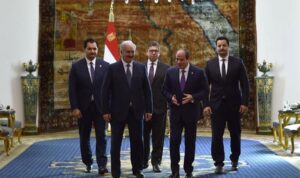
The recent meeting in Cairo between Egyptian President Abdel Fattah el-Sisi and Libyan Field Marshal Khalifa Haftar, who controls Eastern Libya, focused on several regional issues, including the delimitation of the Exclusive Economic Zone (EEZ) between Egypt and Libya. This development carries important implications for Greece.
According to Ahram Online, President Sisi expressed full support for efforts to stabilize Libya and conduct simultaneous parliamentary and presidential elections. He also called for the immediate withdrawal of foreign forces and mercenaries from Libya. The discussions included the “delimitation of shared maritime borders between the two countries,” with both sides agreeing on the importance of cooperation that serves mutual interests without violating international law.
This is particularly significant as Haftar controls Libya’s eastern maritime areas, which are technically under the jurisdiction of the internationally recognized Tripoli government. Egypt had previously sparked tensions with Tripoli by unilaterally delimiting its EEZ with Libya, ignoring the Turkish-Libyan memorandum. After Greece published its own maritime spatial planning map outlining its maximum claims, reactions came from Egypt, Tripoli, and Eastern Libya.
In August, Athens kept a low profile following Cairo’s reaction. Greek Foreign Ministry spokesperson L. Zochiou noted that the response was “expected from a neighboring country with which maritime delimitation is pending, such as Egypt. The map clearly indicates potential boundaries where no bilateral agreement exists, based on the median line principle.”
Contacts with both Tripoli and Benghazi had also expressed willingness to start EEZ negotiations or refer disputes to The Hague.
The Sisi–Haftar talks are closely watched to see whether they will confirm Egypt’s initial EEZ claims, which ignored the Turkish-Libyan memorandum and overlapped part of the area allocated to Libya. A key point of interest is whether discussions will extend to Greece, to define the tripoint for the EEZ between Libya, Egypt, and Greece.
Athens has been actively working to prevent the ratification of the Turkish-Libyan memorandum. This effort included the recent visit of Libyan Parliament Speaker Aguila Saleh to Athens, where he met with Greek Foreign Minister G. Gerapetritis and Parliament Speaker N. Kaklamanis.
A leak regarding Saleh’s meeting with Kaklamanis, suggesting that Athens requested Libya not to ratify the memorandum, sparked reactions in Libya. Media outlets influenced by Turkey cited Misbah Douma, a Libyan parliamentary deputy, who accused Greece of interfering in Libya’s internal affairs, insisting that “agreements are sovereign decisions governed by international law, and no country has the right to dictate to Libya whether to ratify, abandon, or annul them.”
Two Libyan MPs accompanying Saleh later clarified that the leaked content was inaccurate. Saleh reportedly reassured Greece that “Libya is a sovereign state, and no external party may interfere in its internal affairs or impose directives.” He emphasized that “loyalty to friends does not mean compromising national sovereignty or questioning Libya’s independent decision-making for the benefit of its people.”
This episode underscores the importance of avoiding spontaneous public statements on sensitive foreign policy issues, which can lead to unintended and counterproductive outcomes.
Ask me anything
Explore related questions