





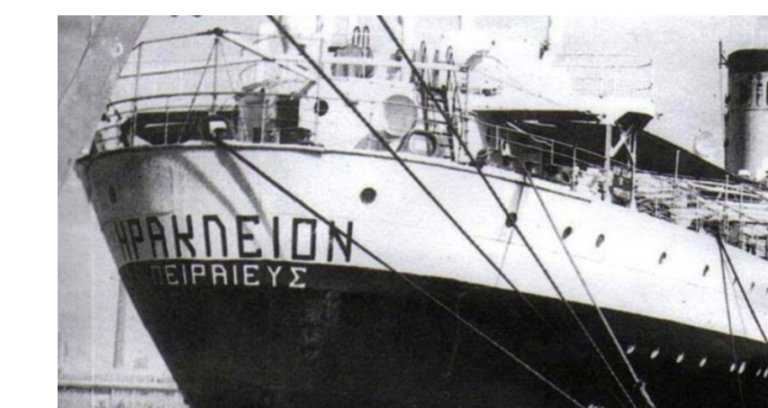
Hundreds dead, only 47 survivors—and a final death toll that was never officially confirmed. The sinking of the ferry Heraklion off Falkonera became a national shockwave that exposed fatal gaps in maritime safety and reshaped Greek coastal shipping.
Today, Monday, December 8, marks 59 years since the sinking of the passenger–car ferry Heraklion, one of the most devastating maritime disasters in post-war Greece. Despite decades of investigation, the exact number of victims has never been fully documented beyond the 47 who survived.
On this grim anniversary, meteorologist Theodoros Kolydas reminded the public that the tragedy was not “just another accident,” but an event of national magnitude that brutally revealed the systemic failures of the era.
“The Heraklion disappeared in the waters of Falkonera within minutes, dragging hundreds to the bottom. The worst maritime disaster of post-war Greece wasn’t a mere mishap—it was a nationwide shock that laid bare the omissions, negligence, and entrenched attitudes surrounding maritime safety,” he wrote.
He added that the tragedy became a turning point:
“Nothing remained the same after that night. The Heraklion didn’t just scar the victims’ families—it marked the Greek state itself and changed how we view sea travel, ship inspections, corporate responsibility, and crew training.”
From Oil Tanker to the “Miracle” of the Crete–Piraeus Line
The Heraklion’s story began long before its final voyage. Built in 1949 in Glasgow as the tanker Leicestershire for the England–Burma route, the vessel was purchased in 1964 by the Typaldos brothers and hastily converted into a ferry.
Later reports revealed that this conversion undermined the ship’s stability.
Despite known issues—insufficient ballast, poor repairs, doubts about seaworthiness—Heraklion was promoted as the fastest vessel on the Crete–Piraeus route, gaining the reputation of a maritime “wonder.”
A handwritten note from the then-Minister of Shipping allowed it to return to service, even though key structural problems remained unresolved.
The Final Departure — and the Refrigerated Truck Full of Oranges
On December 7, 1966, the Heraklion was scheduled to depart Souda at 19:00. Loading was complete: 16 trucks, a military vehicle, and a private car were already in the garage.
But a refrigerated truck carrying about five tons of oranges arrived late.
Despite the local port authority’s objections, the company and the ship’s captain, Emmanouil Vernikos, delayed departure to load the extra truck—a decision that would prove fatal.
Weather in the Myrtoan Sea was rough but not extreme. The real danger lay below deck: the late-arriving refrigerated truck was not properly secured. Witnesses later said it was held in place only by wooden wedges.
A Ship Lost in Minutes
A few hours after departure, as the ship battled heavy seas near Falkonera, trucks inside the garage began to shift violently. One overturned; others smashed into each other.
Sailors reportedly warned the captain, but no effective action was taken.
The refrigerated truck with the oranges slammed repeatedly against the starboard bow door until it broke through and fell into the sea. Water rushed into the garage at terrifying speed.
Passengers were asleep and received no clear instructions. Lifesaving equipment was inadequate. The evacuation devolved into chaos.
At 02:05, Heraklion sent out its final SOS.
Seven minutes later came a single word:
“We are sinking.”
Delayed Rescue — Survivors Found After 10 Hours in the Water
The state’s response was painfully slow. With no real operations center at the Ministry of Merchant Marine, four hours passed before the first naval vessel was dispatched.
The passenger ship Minos, only 15 nautical miles north of the disaster, was never alerted.
Survivors were found after noon, having spent over 10 hours in the freezing sea. Many later said they were saved from hypothermia by the layer of leaked fuel that coated their bodies and insulated them from the cold.
Among the victims was 22-year-old philosophy student Alkistis Agorastaki, remembered for encouraging and helping fellow passengers for hours before succumbing. She was posthumously awarded the Silver Medal of the Academy of Athens.

Trials, Light Sentences, and Unanswered Questions
Fourteen months later, the case went to court. After a 37-day trial, four individuals—including owner Charalambos Typaldos and senior company executives—received sentences of just 5–7 years, widely condemned as “a slap on the wrist.”
Investigations uncovered severe problems with the ship’s conversion, inspection process, certification, and even last-minute attempts to patch hull cracks. The captain was reported to have panicked after the garage door broke open, contributing to fatal mistakes.
Falkonera — A Dangerous Passage
The sinking occurred near the rocky islet of Falkonera, a notorious crossroads of opposing currents that create hazardous whirlpools.
Writer Andreas Karkavitsas once described it as a “wave-beaten boulder.”
The lighthouse there, destroyed during WWII, had long remained unrepaired—something many linked to repeated shipwrecks in the region.
A Disaster That Reshaped Greek Shipping
The tragedy triggered sweeping reforms:
- The creation of a national maritime operations center
- The introduction of sailing bans during severe weather
- Stricter inspections, training requirements, and certification
- The founding of ANEK Lines, a community-funded Cretan shipping company born from collective grief
How Many Died? A Question Still Without an Answer
Official figures listed 206 passengers and 70 crew. Only 47 survived.
The 1975 report cited 247 dead. Later estimates rose to 273, then 277.
But eyewitnesses claimed that about 150 Roma passengers were traveling unofficially in the garage.
Back then, last-minute paper tickets were common, making precise counts impossible.

Many researchers believe the true number of victims exceeded 400.
Only 25 bodies were ever recovered. The rest remain in the deep waters of the Myrtoan Sea—making Falkonera not just a treacherous passage, but the site of one of the darkest chapters in Greek maritime history.
Ask me anything
Explore related questions




