





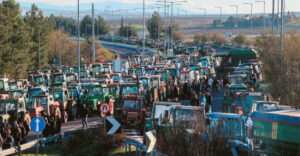
“Previous years, we took to the streets because we couldn’t even cultivate. Now, we’re at the roadblocks because we can’t survive.” It took only a few hours last Sunday for hundreds of tractors to gather at the Nikaia junction and soon after shut down the Athens–Thessaloniki highway.
While the figures show that national and EU subsidies to the primary sector are increased compared to previous years, farmers are multiplying their blockades and say they are determined to strengthen them further. National highways are already cut off, new blockades are being set up daily, and farmers are expected to decide on next steps and on whether — and when — they will accept the government’s open invitation for dialogue on Sunday in Nikaia, Larissa. And while blockade leaders are calling for calm, the incidents in Crete indicate fractures in their ranks.
On farmers’ scales also weighs the order by the Prosecutor of the Supreme Court instructing local prosecutors to intervene when they detect offenses such as obstruction of traffic, violence against officials, property damage, etc. In their initial reactions, farmers express indignation, describing this as new pressure by the government and arguing that there was no similarly swift reaction in the OPEKEPE (Payment and Control Agency for EU Aids) scandal.
Leonidas Vasileiou, 33, spokesman for the Federation of Farmers and a vineyard grower from Tyrnavos, belongs to the small group of younger farmers. Across Europe, fewer and fewer young people choose this profession; according to recent Eurostat data, only 3.5% of the total active farming population is under 35. The same data, raising the pressing question of the future of the primary sector in the EU, shows that for every young farmer there are 19 over the age of 55.
Mr. Vasileiou studied agronomy and chose to return home, using his scientific knowledge to become a farmer aligned with the demands of a new era. Today, with 12 years of professional experience behind him, he finds he may be the only one of his peers still in the field — the rest, disappointed, now work in cafés in Larissa.
Tractors on the roads: truths and lies about the farmers’ blockades
Leonidas Vasileiou, vineyard grower in Tyrnavos: “In previous years we took to the streets because we couldn’t cultivate. Now we’re at the blockades because we can’t survive.”
Submission of Declarations
According to official data recently released by the Ministry of Rural Development, the 612,000 farmers who submitted declarations in the Integrated Administration and Control System (IACS/OSDE) for EU subsidies are receiving increased payments this year, reaching a total of €3.7 billion by year-end, from both EU and national funds.
However, it is important to point out that only about 200,000 of those receiving subsidies are farmers by main profession. This year, OSDE applications were 40,000 fewer than last year. Considering the revelations about the OPEKEPE scandal, the question becomes more pressing: what other sector is subsidized with such amounts, and why do farmers still protest — even blocking roads and “punishing” society?
“We need to really see how much money we received, when we received it, and what obligations had stacked up in the meantime. Being a farmer is an extremely difficult profession, but in the end, let’s decide: do we want farmers and agricultural production or not? Do we want Greek products on the shelves?” says Vasileiou. He argues that their decision to protest followed a series of payment schedules that were not kept and promises that remained on paper.
“We all understand that after the OPEKEPE revelations checks had to be made, but why, for example, wasn’t the payment schedule for the basic subsidy kept? We should have been paid 70% by the end of October; instead, at the end of November we received 44%. We are at the end of the cultivation period — we can neither sow nor even prune the trees because there is no money for labor.”
The Ministry responds that the reduction in the basic payment is temporary and partly due to the fact that around 44,000 producers are undergoing re-evaluation, while more cross-checks have been carried out as agreed with the EU.
Potential Beneficiaries
Under this framework, 44,000 farmers are under review, considered potential beneficiaries, and will be paid once checks and documentation are completed. Another 2,000 will not receive subsidies due to completely inaccurate declarations or ongoing judicial and police investigations.
A major issue for farmers, especially in Thessaly, is the low prices of key products like cotton and soft wheat — particularly cotton, where international prices are very low. “In reality, only pistachios are doing well,” they say, adding that while lentils on store shelves exceed €6 per kilo, the farm-gate price is €0.70.
“People hear someone cultivates, say, a thousand acres of wheat and think they’re making money. In practice, you take home €5–7 per acre. With a lost cultivation year, why would someone continue next year?” says a farmer from Larissa.
Lack of Liquidity
Meanwhile, farmers — especially in Thessaly, still carrying the damage of storm Daniel — cannot cover the costs for the new farming season. Agricultural supply store owners are “crying, they’re at their wits’ end,” a local agronomist told Proto Thema, adding that the liquidity problem spreads across the entire local economy. While large funds were indeed disbursed in Thessaly after the disaster, this often happened without logic, balance, or fairness.
For instance, many growers with orchards destroyed by flooding were left outside the designated affected zones and excluded from the reconstitution program for plant capital. Even if they had the funds to uproot and replant, they cannot expect production — and therefore income — for at least seven years.
Farmers also complain that those enrolled in three environmental programs received payment for the second year of the scheme — that is, funds for 2025 instead of 2024 — a few hours after the first roadblocks last Sunday. The initial deadline had been missed at EU level. Although farmers are expected to be fully paid by year-end, increased national co-financing will be required as a penalty.
Farmers across Thessaly and other regions have also been waiting for payments under “Measure 23,” an emergency support scheme for reduced production due to climate change and natural disasters, covering crops such as cotton, vineyards, almonds, pears, pistachios, and chestnuts.
“Since June we’ve been getting month-to-month postponements, and the payments still haven’t been made. And while we expected on average €100 per acre, now they’re telling us it will be reduced by about 25%,” says Vasileiou.
For decades, farmers’ protests have been almost an annual tradition. Since the mid-1980s, farmers take to national and provincial roads in December, with varying participation, followed by negotiations in Athens — after which they usually return to the fields by mid-January to prepare for sowing and the new season.
“This year is different,” says Vasileiou. “Normally, the first days were just exploratory. Participation wasn’t large from day one; protests started more ‘softly.’ This year, within hours, hundreds of tractors lined up in Nikaia, on the E-65, and daily more colleagues join in many regions. Until Sunday (today), we continue to reinforce the blockades. I can’t predict what comes next. Assemblies are daily — we assess developments and decide accordingly.”
A sense of mass mobilization is felt throughout Larissa, Karditsa, and Trikala. Some speak of widespread anger; others believe that the early clashes with police triggered the surge in participation.
Facing this growing pressure, the Ministry insists that issues are resolved through dialogue. Ministry officials say farmers at the blockades have not even submitted a clear list of demands to form a basis for negotiation. Farmers respond that such demands have already been presented in earlier meetings — and now they expect the Prime Minister to meet them at the blockades.
“A year of high performance”
The government claims that subsidies this year are higher than ever, even as farmers intensify their blockades. The Ministry notes that 2025 is a year of strong performance for the Agricultural Development Program, with payments accelerating significantly, boosting producers’ liquidity and enabling investment across the country.
Ask me anything
Explore related questions




