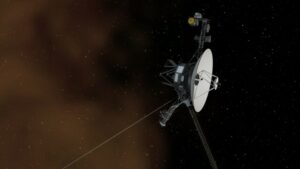
NASA’s Voyager 1 spacecraft is expected to reach another historic milestone in November 2026: it will be at a distance of one “light-day” from Earth.
This distance, approximately 26 billion kilometers, means that light — and any signal traveling at the same speed — will take 24 hours to reach the spacecraft and another 24 hours for a response to be sent back.
This delay illustrates the enormous distance Voyager 1 has now traveled.
Launched in 1977, the spacecraft continues to move away from Earth at a speed of over 61,000 km/h. Without any orbital adjustments since then, it has entered interstellar space, beyond the heliosphere — the Sun’s magnetic “bubble.”
Together with its twin, Voyager 2, it is the only operational spacecraft exploring this region, using its remaining instruments to collect primary scientific data.
Maintaining communication with such distant spacecraft is a challenging task. Voyager 1 transmits data at a rate of only 160 bits per second — comparable to old dial-up internet — as the distance greatly weakens its signal.
Receiving this data requires multiple deep-space antennas, and NASA’s team is updated only intermittently on the spacecraft’s condition.
Continuing the mission requires difficult choices. NASA has shut down several systems and instruments to conserve power, keep the spacecraft warm, and ensure the antennas remain aligned and pointed toward Earth.
Despite these limitations, the two Voyagers continue to surprise. Voyager 2 will not reach a distance of one light-day until 2035, likely beyond its operational lifetime. Nevertheless, both spacecraft continue to operate daily, breaking every longevity record.
NASA’s team is working to ensure both spacecraft reach their 50th “birthdays” in 2027 — a remarkable achievement for the oldest functioning spacecraft in the history of space exploration.
Ask me anything
Explore related questions