





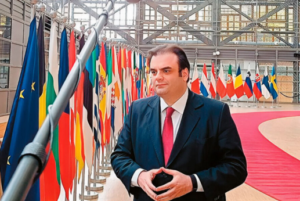
The final battle for the presidency of the Eurogroup, the informal but powerful “conclave” of the eurozone’s finance ministers, begins today (11/12) in Brussels. The two main contenders for the position—the Greek Finance Minister Kyriakos Pierrakakis and his Belgian counterpart Vincent Van Peteghem—will have to wait until the afternoon for the result of the crucial vote, for which EU diplomats and officials have expressed widely divergent and at times contradictory predictions.
The 20 finance ministers of the eurozone, who make up the Eurogroup, will begin gathering in Brussels at 15:00 Greek time, while the meeting will start about two hours later. Shortly afterward, roughly halfway through the session, the voting process will begin, after which everyone will know whether the fifth president in the history of the club of EU member states that use the euro as their official currency will be elected in the first round or whether a “second round” will be required.
To secure the presidency—whether Mr. Pierrakakis or Mr. Van Peteghem, both of whom come from the center-right European People’s Party (EPP), which dominates the EU political scene—a simple majority is sufficient. This means that 11 votes out of the total 20 will be needed to determine whether the next Eurogroup president will come from Greece or Belgium. It cannot be ruled out that if no majority emerges for either candidate, the one with fewer votes may be asked to step aside, allowing the Eurogroup to unanimously appoint the new president. This has happened in the past.
In 2017, Portugal’s Mário Centeno was elected after three rounds of voting, while in 2020 Ireland’s Paschal Donohoe was elected Eurogroup president in the second round, defeating Spain’s Nadia Calviño, who had been considered the clear favorite.
The factors that will influence the result
The EPP has six votes (Belgium, Greece, Ireland, Latvia, Luxembourg, and Portugal), and therefore the process is not expected to be determined solely by political criteria and alignments within the European political groups, but also by current geopolitical developments.
Belgium strongly opposes attempts by the European Commission and many other EU member states to use “frozen” Russian assets held in EU financial institutions to finance Ukraine, which urgently needs economic support. Around €185 billion in frozen Russian assets are held by Euroclear, the Brussels-based financial depository, while another €25 billion are in institutions in other member states, such as France, Sweden, and Cyprus.
The Belgian government worries it may ultimately be forced to return the funds to Moscow if Russia challenges the asset freeze in Belgian courts or if sanctions against Russia are not renewed. Belgium’s stance has annoyed several EU member states, particularly the Baltic countries—Lithuania, Estonia, and Latvia—all of which belong to the eurozone and thus hold a vote in the Eurogroup.
However, several supporters of Mr. Van Peteghem turn this argument around, claiming that granting the Eurogroup presidency to Belgium could be an effective way to soften the country’s resistance to using frozen Russian assets for Ukraine’s needs.
On the other hand, awarding the Eurogroup presidency to the Greek Finance Minister Mr. Pierrakakis would send a clear message in every direction, as it would signify that the “treatment” imposed on Greece after the financial crisis worked—bringing the country from the brink of being forced out of the eurozone to the point where it now presides over it.
A comparison between Belgium and Greece in terms of public debt and fiscal policy—which would have seemed unthinkable a few years ago—shows that Greece’s outlook is now more favorable. According to Eurostat data, Greece’s debt-to-GDP ratio is declining thanks to strong growth and surpluses, while Belgium’s remains high (around 107% of GDP) and may surpass Greece’s by the end of the decade if its deficits are not controlled.
The “musical chairs” in Brussels and Frankfurt
The first task of the new Eurogroup president—whoever is elected—will be to initiate the process for the so-called “musical chairs,” as several important seats on the board of the European Central Bank will change hands in the coming months, and the eurozone finance ministers will need to agree on the succession. The first expected to leave Frankfurt next May is the ECB Vice-President Luis de Guindos of Spain, followed shortly by Ireland’s Philip Lane. The ECB President Christine Lagarde has repeatedly urged member states to nominate more women to fill these positions. In this context, another name from Greece has been mentioned as a possible successor to Vice-President de Guindos: that of Ms. Christina Papakonstantinou, Deputy Governor of the Bank of Greece. However, her chances will undoubtedly depend on whether Mr. Pierrakakis will preside over the Eurogroup for at least the next 2.5 years.
Ask me anything
Explore related questions




