
The accused in the case of the murder of Garyfallia Psarrakou was unanimously found guilty of manslaughter with intent in a calm mental state by the Aegean Mixed Jury Court of Appeal.
The court rejected the defense’s claims of boiling of mental impetus and reduced imputation.
At the same time, the prosecutor was against the request of his advocates to recognize the mitigating circumstance concerning his lawful previous life and good conduct after the act and during the time of detention.
The Prosecutor’s Statement Before the Verdict
In his detailed statement during the trial for the murder of Garyfallia in Folegandros at the Syros Court of Appeal, the presiding prosecutor rejected the claim that the accused was experiencing a psychotic episode, emphasizing that the accused was fully aware of his actions.
He pointed out that in previous incidents involving a former partner—such as when she rubbed potato chips on his face during an argument, and later during an unwanted pregnancy—the accused had responded calmly, without signs of losing control. According to the prosecutor, this disproves the claim that he was unable to control his actions.
He also disputed the claim that the accused pulled Garyfallia from the water, noting that it would have required three people to do so. Regarding the vehicle, he argued that it did not veer off course by itself; rather, the accused intentionally caused it to leave the road, as the road was straight and uphill.
Closing Remarks
The prosecutor noted that the paranoid disorder cited by the defense does not eliminate the individual’s capacity to understand their actions. He emphasized that the accused was functional—he served in the military, had a job, and interacted socially. The accused himself had described Garyfallia as an “angel,” yet “he did not save her, not even in the final moment,” while she was, as he said, an intelligent and strong young woman.
The prosecutor gave special attention to Garyfallia’s plea, “What are you doing, help,” describing it as the “key” moment of the incident. He observed that the accused “now does not remember, although at first he did,” and that there was no preceding negative event that could have acted as an additional stressor—they were reportedly happy.
According to the prosecutor, the accused described all stages of the attack, indicating that there was no sudden loss of control but rather awareness and control over each action. He stated that the accused was in a calm mental state, that there was no “heat of passion,” and that the circumstances do not align with psychosis, schizophrenia, or delusional disorders.
Addressing the jurors, he said their decision should be guided by conscience and reality. He emphasized that “intent means knowing the consequences of one’s actions,” and that the accused “committed the act with full control.”
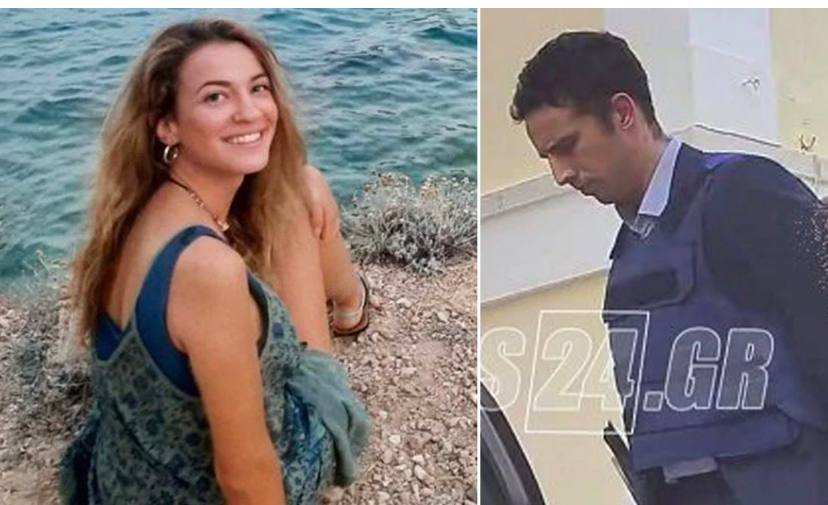
In closing, referring to a photo of Garyfallia, the prosecutor expressed sorrow over the loss of a young life but stated his duty to propose a guilty verdict for the accused.
“The whole universe conspired for it to happen,” the accused provocatively said in his testimony
In his testimony for the murder of Garyfallia in July 2021 in Folegandros, the accused focused on “memory gaps” and mental disorganization shortly before the incident.
He described the emergence of psychotic symptoms days before the murder, claiming he was being monitored by drones and felt like he was “boiling inside.” However, his memory is missing at key moments.
When the car veered off course, he said: “I didn’t understand what happened” and “I don’t remember” why he lost control of the steering. After the crash, his memory returns: he recalls Garyfallia shouting “help” and his attempts to pull her from the sea and administer first aid. However, he cannot recall how she ended up in the sea.
When asked by the prosecutor if he believed Garyfallia fell off the cliff on her own, he answered no, adding, “I believe, as Paulo Coelho says in The Alchemist, that the whole universe conspired for it to happen.”
The accused contested his initial confession (“I got angry and killed her”), saying it was made under pressure and in a state where “he would say yes to anything,” calling it “the confession of a person in that condition.”
The court president noted that the accused remembers the events before and after the murder clearly, but not the act itself. The accused replied, “I cannot recall it,” expressing remorse and sorrow over the loss.
Ask me anything
Explore related questions