





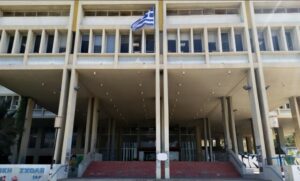
On the occasion of today’s (12/12) absence from teaching duties of the Professors of Philosophy of the National and Kapodistrian University of Athens, the Dean and member of the Board of Directors of the Association of Professors of Philosophy, Professor Dimitrios Drosos, speaks to protothema.gr.
The spearhead is the registration of students by law, with the deadline being December 31, 2025. The issue is causing strong reactions not only among students themselves but also among academic staff.
Concerns about the horizontal application of the law
The issue of inactive students is not new, as there are students who remain enrolled without completing their studies for decades. Drossos stresses, however, that the horizontal application of the law by the Ministry of Education for those who exceed the n+2 year limit does not take into account the specific needs of each department and the facts of the moment. “There are departments where the average graduation rate exceeds 5-6 years, even for four-year studies,” he notes, noting that there are students who owe a single course for years and are at risk of being dropped, even though they have completed almost all the credits required for a degree.
Proposals for targeted dropouts
A clear distinction between active and inactive students is the goal of the proposals of both the POSDP and the administration of the ECPA. According to the dean, “by setting a specific time period, for example, the last 5-7 years, to determine who has shown persistent indifference, a general ‘call’ could be made to students for new enrollment. In this way, truly inactive students could be directly deregistered, while those who wish to complete their studies would be allowed to do so.”
“There is a large portion of students, about 70-80%, who are truly inactive as they have career or other commitments. But there is also a percentage, those who are currently around 24-30 years old, who, due to economic circumstances or pandemic, have been forced to work but wish to get their degree.”
“Foreign universities do not have old students,” the Dean points out, as there “a student who does not renew his registration for a certain period of time is considered a non-student. On the contrary, in Greece, the State did not previously require renewal of registration, resulting in the accumulation of inactive students.”
Estimates of the number of students to be deregistered
Drossos estimates that, if the law is implemented horizontally, about 280,000 students are expected to drop out of Greek universities, while the academic community’s proposal will reduce this number by 10-15%, ensuring that those who wish to complete their studies will be able to do so. It should be noted that the law provides for reduced tuition for those who are proven to be working, but does not give an extension of time to students who are working without having yet received their degree.
Protests and action by teachers
The POSDEP and the Association of Faculty Members of the Faculty of Philosophy have called for an extension and additional measures to facilitate discussions with the ministry. Today, 12 December 2025, a vacation from teaching has been announced to highlight the problem and pressure for a review of the law. “It is understood that we are obliged to implement the law. We wish to be given the opportunity for dialogue with the leadership of the Ministry of Education to seek the best solution in the interest of students.”
Professor Drossos concludes.
In his personal opinion, “a realistic solution could be the re-registration of all students within a set period of time – for example, 8 months – with those who do not register for three or four semesters being considered non-students. In this way, about 70% of inactive students would leave voluntarily, without the need for horizontal de-registration. But those who enroll would be allowed to continue their studies until they receive a degree. The measure would apply to those who entered before 2022, as the ‘terms of the game’ were known then, which is not the case for earlier students.”
The Senate and the Faculty Association advocate a clear distinction between active and inactive students, in order to delete inactive students and allow those interested to complete their studies, taking into account the difficulties of the financial crisis and pandemic.
About the mobilizations
The Board of Directors of the Association of Faculty Members of the Faculty of Philosophy of the University of Athens, during its recent meeting, “confirmed the full opposition of the Association to the promoted deletions of students who exceed n+2 years of study” and decided to abstain from teaching at the Faculty of Philosophy. This is the first organized reaction by the teaching staff and, according to university sources, other faculties nationwide are expected to follow.
It should be recalled that this mobilization follows that of the administrative staff: the Federation of Administrative Staff of Higher Education (ODPTE) had launched a Strike-Absence from any administrative procedure related to the student expulsions. In fact, the Single Court of First Instance of Thessaloniki rejected (5/12/25) the appeal of the Greek State, which requested that the strike-absence of the administrative staff be declared illegal and abusive.
According to the decision, the lawsuit of the state was dismissed as unfounded, as it was considered that the strike-absence does not cause any damage to the state, since the students who are in the process of deletion have already lost all benefits, such as allowances and free textbooks. Therefore, the delay in compiling the lists “does not impose any burden” on the plaintiff.
Ask me anything
Explore related questions




