





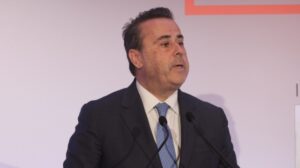
The Minister of Environment and Energy described as “necessary and timely” the meeting held between EU Energy Ministers and NATO’s Deputy Secretary General, Ms. Radmila Šekerinska. It is noted that this was the first time NATO’s leadership participated in a meeting of European Energy Ministers. As Mr. Stavros Papastavrou emphasized, energy security is national security, it is European security—concepts that are inseparable.
Referring to NATO’s recent Round Table on Energy Security, Mr. Papastavrou stressed that “energy is an important tool in times of peace, but it turns into a weapon in times of war,” as clearly demonstrated by the conflict in Ukraine, adding that Europe can no longer ignore the vulnerability of its energy infrastructure.
At the same time, he highlighted the broad range of initiatives currently underway, including energy network packages, Projects of Common Interest, obligations stemming from NATO, as well as discussions on the EU–US framework agreement. He called for these efforts to be coordinated—while fully respecting their respective institutional frameworks—under a common direction, with the aim of maximizing Europe’s overall energy security. “No energy independence, no energy resilience and prosperity in the EU can be achieved unless we ensure our energy security,” he stated characteristically.
Greece’s upgraded role
Speaking at the Council, Mr. Papastavrou highlighted Greece’s upgraded role in the new energy architecture, following the 6th Ministerial Meeting of P-TEC held in Athens. He stressed the importance of recent energy agreements in the effort to fully eliminate dependence on Russian natural gas, underlining Greece’s strengthened position as a strategic energy hub in Southeastern Europe.
“We realized that there is full alignment between the United States and the European Union regarding complete independence from Russian natural gas,” the Minister emphasized, making special reference to Turkey and the gas transported via TurkStream, which the EU must ensure is not of Russian origin.
Meetings with the new Cypriot Energy Minister and the Vice-President of the Commission
On the sidelines of the Council, Mr. Papastavrou and Mr. Tsafos held their first introductory and cooperation meeting with the new Minister of Energy, Commerce and Industry of Cyprus, Mr. Michalis Damianou. The atmosphere was cordial, and it was agreed that the two countries would move forward with the implementation of the steps announced by Greek Prime Minister Kyriakos Mitsotakis and the President of the Republic of Cyprus, Nikos Christodoulides.
At the same time, the leadership of the Ministry of Environment and Energy met with the Vice-President of the European Commission for a Clean, Just and Competitive Transition, Ms. Teresa Ribera, with whom they discussed issues related to the challenges facing the competitiveness of the European economy.
Networks and Energy Corridors
Earlier, Deputy Minister of Energy Nikos Tsafos, speaking at the Council, focused on the Commission’s plan for energy networks. Mr. Tsafos stated that Greece “is very satisfied with the progress achieved on this issue. As you know, Greece supports greater interconnectivity. We agreed on this very ambitious level of funding. Our key priority is that these investments focus on strategic projects that will remove major bottlenecks. We need to examine where there are significant price differences across European markets. The text takes into account that certain markets, mainly on the periphery of Europe, may require more investment in order to strengthen their interconnection with the rest of Europe.”
Mr. Tsafos also referred to congestion points that are observed—which “change as systems evolve”—as well as to the need to make better use of the existing infrastructure.
Ask me anything
Explore related questions




