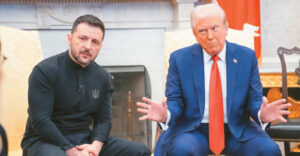
The United States is offering Ukraine security guarantees equivalent to those provided by NATO‘s Article 5, U.S. officials said Monday, in a move that represents the clearest and strongest security commitment made to date by Donald Trump’s administration to Kiev. However, according to Politico, the proposal comes with an implicit but clear message: Ukraine is urged to accept it immediately, as a future version of the deal may not be as generous.
The proposal for “Article 5-type” guarantees was formulated in the context of marathon consultations in Berlin, involving US special envoy Steve Whitcoff, US President Jared Kushner’s adviser and son-in-law, as well as Ukrainian and European officials. Washington is attempting to increase pressure on Kiev to accept terms that could lead to an end to the war.
Ukrainian President Volodymyr Zelensky, like many European leaders, had so far appeared wary of any agreement without an explicit and binding security guarantee from the United States, expressing fears that Russia could attack again after a period of relative calm. The new U.S. proposal appears to attempt to allay these concerns, but at the same time push Zelensky toward a quick decision.
“The basis of this agreement is essentially very, very strong guarantees, similar to Article 5,” a senior U.S. official said. “Those guarantees will not be on the table forever. They are available now, as long as there is an agreement that is completed in the right way.”
Nearer than ever to peace, Trump says
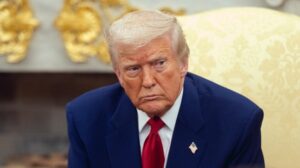
Later on Monday, Donald Trump said he had telephone conversations with both Volodymyr Zelensky and European leaders, and said he had also spoken with Russian President Vladimir Putin, without specifying when. “I think we’re closer than ever and we’ll see what we can do,” the U.S. president told reporters at the White House. Asked if there is a time limit on security guarantees, he replied that “the time limit is whenever we can complete it.”
The weekend talks focused mainly on the details of security guarantees the US and Europe would provide to Ukraine, but also included territorial issues. General Alexus Greenkewich, head of the U.S. European Command and NATO’s top commander in Europe, also participated in the consultations.
Estimation that Russia will accept Ukraine’s EU membership
According to U.S. officials, Washington estimates that Russia will accept such a framework in a final agreement, as well as Ukraine’s accession to the European Union. This is, however, an optimistic assessment, given the Kremlin’s refusal so far to back down in the peace talks. Moscow has not yet taken a position on the new agreements being worked out in Europe in recent days.
“We believe that the Russians, in a final agreement, will accept all those elements that allow for a strong and free Ukraine. Russia has indicated that it is open to Ukraine joining the EU,” said a second U.S. official, who, like the first, spoke on condition of anonymity because of the sensitivity of the negotiations.
It is not clear when or how the Trump administration will convey the new facts to Moscow. Kremlin spokesman Dmitry Peskov said Russia was awaiting an update from the U.S. side on the Berlin talks, adding that Vladimir Putin “is open to peace, to a serious peace and serious decisions” but “is not at all open to tricks aimed at obstructionism.” Asked if negotiations could be completed by Christmas, Peskov replied that predicting a timetable for a peace deal is “unknowable work.”
The second US official said the Ukrainian delegation appeared pleasantly “surprised” by Donald Trump’s willingness to agree to stronger security guarantees and seek their ratification by Congress so that they would apply beyond his term in office. The US side also spoke positively about the attitude of European partners, who in previous months had been concerned that the Trump team would pressure Ukraine to accept unfavorable terms.
Washington’s security assurances worthy of note, Merts said
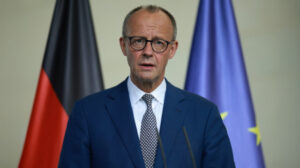
“The legal and material security guarantees put on the table by the United States here in Berlin are remarkable,” German Chancellor Friedrich Murch said after the talks. He, along with the leaders of Denmark, Finland, France, Italy, the Netherlands, the Netherlands, Norway, Poland, the United Kingdom, Finland, Sweden and the European Union, issued a joint statement welcoming the “significant progress” of the U.S. initiative and pledging to support Ukraine in ending the war and deterring Russian aggression, including a U.S.-backed European multinational force.
Over the weekend, Volodymyr Zelensky admitted that Ukraine would not seek NATO membership, meeting a longstanding Russian demand. Donald Trump, who did not attend the Berlin meetings but was briefed twice by Steve Whitcoff and Jared Kushner, planned to intervene by phone at a dinner of leaders, foreign ministers and security officials. “He’s really pleased with where things stand,” the first U.S. official said.
At the same time, Whitcoff and Kushner sought to narrow disagreements between Ukraine and Russia over territorial control. Moscow still claims control of the entire eastern Donbass region, even parts it has not militarily occupied. According to one of the US officials, the talks considered a proposal – which has not yet been finalized – for joint control of the Zaporizhzhya nuclear power plant, with Russia and Ukraine sharing energy production.
The Americans avoided giving details of how the remaining territorial issues would be bridged, noting however that they had presented Zelensky with “thought-provoking ideas”. Following the Ukrainian president’s response to the proposals, Whitcoff and Kushner are expected to discuss them with the Russian side.
“We feel very good about the progress we have made, including on land issues,” the first official said. The next step will be to convene working groups, likely in Miami next weekend, where military officials will review maps to resolve the remaining issues. “We believe we have resolved about 90 percent of the issues between Ukraine and Russia, but there are still some that remain to be resolved,” he concluded.
Ask me anything
Explore related questions