





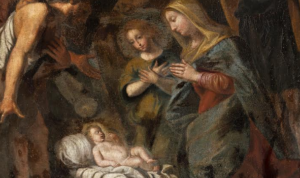
In the depths of the Greek soul there are certain sounds that seem to have been born together with the light of this land/Greece. Among them stands out the sound of the lullaby: a primordial human act, an act of love, reconciliation, peace, prayer, and promise. A promise to the child who sleeps, to the future that is coming, to the hope that rises, even after the darkest periods of history.
The lullaby constitutes not only tenderness, but also memory, tradition, folk wisdom, and theological depth, often without its creators or bearers being conscious of the depth of the words they whisper.
Such a moment of Greek musical tradition is the lullaby “Sleep, My Little Angel” (“Κοιμήσου, αγγελούδι μου, γλυκά με το τραγούδι μου”), incorporated into the work “The Song of the Dead Brother” by Mikis Theodorakis, with lyrics by Kostas Virvos.
It is a song that, although born out of the historical trauma of the Greek Civil War, simultaneously opens a path toward the mystery of Bethlehem, toward the utter humility and the glory of the God-Man Christ, toward the theology of the Incarnation as it was lived and expressed by the Fathers of the Eastern Orthodox Church.
The history of the song cannot be separated from the history of the cycle in which it belongs. Theodorakis composed “The Song of the Dead Brother” in 1961, in Paris, during a period in which he was seeking ways to unite popular musical expression with the deep wound of Greek society, to express a collective memory, and to offer the people, not only the beauty of songs, but also the “catharsis,” as he himself notes, of a new, contemporary “myth” born out of the Civil War.
The work is consciously placed in the form of ancient tragedy. The figures are archetypal, the action has a collective character, the Mother acquires dimensions of Jocasta, the two brothers recall Eteocles and Polynices, the people as Chorus sing and intervene, and the fate of the family becomes a symbol of the fate of the Nation.
Within this setting of anguish, betrayal, hatred, and a deep need for reconciliation, there is a lullaby. Not a lament, but a lullaby.
This is the first point of theological depth. For every person who suffers, even under conditions of civil hatred, the voice that remains untainted is the maternal voice.
The lullaby is the sound that hatred does not stain, that ideology does not contaminate. It is the sound of peace; that is why it is placed at the beginning of the work, not at the end. It is the beginning of the world, the beginning of human existence, the beginning of a possibility for reconciliation and restoration.
Virvos’ lyrics present a mother who sings to her child not only to lull it to sleep, but to initiate it into a world of struggle and responsibility:
“Sleep, my little angel,
my child, lullay, lullay,
grow up quickly
like the tall plane tree,
become a man in body and in mind
and always walk the righteous path.
Sleep, my little angel,
sweetly to my song.
Sleep, my little dove,
become like steel,
and let your little heart
grow as great as Christ’s,
so that you may never say in life ‘I cannot,’
and if need be, even take up the cross.”
An entire theology is hidden in these phrases: a calling to courage, to a broad heart capable of forgiveness; to the imitation of Christ; to the acceptance of the Cross not as punishment, but as the path of authentic love.
Here Greek folk tradition meets Saint Gregory the Theologian, who, speaking of the Birth of Christ, writes that the Word “put on humility, so that I might receive glory.” Birth is already Crucifixion, not yet in act, but in the intention of the Divine Economia/Dispensation.
When Virvos speaks of the child who may one day bear a cross, even without realizing it in Patristic language, he touches the very heart of Christology: that the human person, in order to resemble Christ, is called not only to live, but also to sacrifice, to offer, to love unto the end.
This lullaby, when one listens attentively also to the interpretations historically given by Giota Lydia, Despoina Bempedeli, Nena Venetsanou, and many others, does not raise its intensity or impose drama. It speaks gently, like a truth the child must hear even before learning to speak.
Theodorakis’s music wraps it in simple, clear folk tones that seek not effect, but memory. Thus the lullaby becomes an act of pedagogy. It teaches what love is, what greatness of soul is, what the cross is.
All this unfolds within a scene that, in an almost emblematic way, points to Bethlehem. For in Bethlehem, according to Byzantine iconographic tradition, the Mother of God does not smile as a mother defined solely by joy.
On the contrary, in the icon of the Nativity the Virgin bears a deep, inward expression. She lies down, often turned not toward the Infant but toward the believer, as if she knows that this Child did not come simply to live, but to give Life.
Her posture resembles that of a mother who does not lull a child destined for an ordinary life, but a child who will change the world through suffering. Her gaze is humble, calm, but profound, almost tragic.
The Fathers of the Church, such as Saint Epiphanios of Cyprus and Saint Romanos the Melodist, emphasize that the Virgin knew already from the Annunciation that her Son would become a “sign of contradiction.”
The image of Bethlehem, with the cave dark like a tomb, with the Infant swaddled like a dead body in a shroud, declares that the Mystery of the Nativity is inseparably united with the Mystery of the Passion.
From this perspective, the lullaby “Sleep, My Little Angel” stands as an extension of the Byzantine icon. The mother sings knowing, or intuiting, that the child will undergo trials, that life will not be merely a “dream,” but a struggle. “As great as Christ’s” is not only moral exhortation; it is a proposal of life, imitation of Christ, participation in the cruciform beauty of His love.
The history of Theodorakis’s work uniquely incorporates modern Greek pain. The composer recounts that, as he was composing the songs, the figures of friends and comrades lost in the Civil War seemed to come alive before him.
In his memory, Pavlos—a figure of popular imagination but also of reality—becomes the dead brother who bears the tragedy of the entire nation. Theodorakis sought to exorcise this evil not through dry political analysis, but through art, poetry, and music, through ancient tragedy that heals wounds not by erasing the past, but by transforming it.
Within this framework, the lullaby functions as the center of the drama, as the point where human tradition meets theological mystery, because every lullaby shows that the human person believes, even amid ruins, that the child who grows “like the tall plane tree” can restore meaning where meaning was lost, can love where hatred once reigned.
Our people, through this song, speak of a heart “as great as Christ’s” without employing academic theological language. Yet this is precisely the paradox and the greatness of Orthodoxy: that theology is found not only in the texts of Ecumenical Councils and the Fathers of the Church, but also in the sighs of mothers, in lullabies and laments, as expressions of prayer and invocations of divine mercy.
In Theodorakis’ work, there is an attempt to bring modern Greek tragedy into dialogue with the primordial drama of humanity, and this deeply recalls the Orthodox theology of the Incarnation.
God consents to become human, to enter human history, to take upon Himself human divisions, to endure, from His very Birth, social rejection and the tragic dimension of destiny.
The Incarnation, according to Saint John of Damascus, is “the descent of uncreated Grace into creation,” that is, God coming where there are wounds, not to judge them, but to heal them.
This is clearly evident in the icon of the Nativity. The cave is dark, black, like Hades; the newborn Christ is placed in a manger that resembles a tomb; His swaddling clothes resemble a burial shroud; angels hymn and shepherds adore, yet the Virgin remains calm, almost mournful.
Joseph, often seated to the side, represents human doubt and temptation. The entire icon is a unity of joy and mourning, birth and death, light and darkness. The Nativity of Christ is a salvific scene. God enters the world as an Infant in order to traverse the entire human journey, from cradle to grave.
Thus, when the folk mother in Theodorakis’ work says to her child, “and if need be, even take up the cross,” she speaks the language of the Virgin Mary. And when she says, “let your little heart become as great as Christ’s,” she speaks the language of Saint Maximus the Confessor, who teaches that the human person is called to become “by grace what God is by nature,” that is, to imitate Christ’s love, to become a pure, free, and expansive heart, as wide as His arms upon the Cross.
The lullaby remained deeply engraved in the memory of the people, because every people remembers what expresses its most authentic side. And the most authentic side of the Greek people was never hatred, but the longing for unity. As Theodorakis himself said, “I wanted never to let the memory of the people be extinguished.”
This longing for memory is profoundly theological. Christ was born to heal the memory of humanity, to awaken the nostalgia for paradise, to bring peace into the human heart, to reconcile humanity with God and humanity with itself.
The Nativity of Christ carries within it an invitation to unity. Christ did not come in a peaceful era; He came amid suspicion, imperial violence, and social divisions.
He was born as a “new Child” in order to unite and reconcile; therefore the angel sings: “Glory to God in the highest, and on earth peace.” Peace is the first gift of the Nativity.
The lullaby “Sleep, My Little Angel” is essentially a prayer for this peace. It is the folk voice that says: “I want you to grow up in a reconciled world, where you will be a man in body and in mind, but above all a human being with a great heart.”
It is the voice of a people seeking redemption, searching for a child to bear the future in his hands, longing to see the new generation not repeat the errors of the civil war.
The theology of the icon of the Nativity further reinforces this thought. In the icon, Christ stands at the center not only as an infant, but as the Savior of the world, who came to unite what was divided, to reconcile heaven and earth, the divine and the human.
The angels represent the heavenly realm, the shepherds the humble folk element, the Magi the wise and cosmopolitan element. All meet beside the Infant. It is the first great “reconciliation of humanity,” an image of the Kingdom of God within the world.
Thus, in Theodorakis’ work, the mother who lulls her child amid the pain of Greek history becomes an image of the Virgin Mary who lulls her Son amid the pain of human history.
And this child, called to grow up in difficult times, becomes an image of every generation called to bear its own cross with strength, with a heart as great as Christ’s.
At this point, the lullaby, Theodorakis’ work, the tragedy of Greek history, and the mystery of the Incarnation meet in a common place: the place of hope.
Greek tragedy teaches that after the Fall, after hubris, after catharsis, there is a new path. Orthodox theology teaches that after the fall of Adam comes the New Adam, that the Incarnation is the beginning of a new creation.
Saint Irenaeus says, “The Word recapitulates humanity,” and Saint Athanasiοs, “He became human so that we might become divine.”
The lullaby “Sleep, My Little Angel” is therefore a song of reconciliation. A song that reminds us that the maternal voice remains incorruptible even when ideologies collapse.
It is a song that speaks of a heart growing as great as Christ’s, of love that bears the cross, of a path leading from death to life. It is a hymn to peace, an invitation to unity, and a reminder that the Nativity of Christ is the beginning of a cosmic and at the same time divine reconciliation.
Perhaps this is the deepest reason why the song remains alive so many decades later. It shows us that every infant sleeping in its mother’s arms is a promise of life to history.
Just as the Divine Infant of Bethlehem slept in the manger in order to awaken the world to the truth of God, so every child lulled in a world wounded by wars, persecutions, and uprooting carries within it a flame, a flame that can become light.
The lullaby “Sleep, My Little Angel,” the Byzantine icon of the Nativity, Theodorakis’ work, and the Orthodox theology of the Incarnation, folk tradition and the Fathers of the Church, thus become one body, one voice, calling us to open our hearts and let them become “as great as Christ’s,” with the goal and destiny of deification.
Perhaps this is the greatest truth hidden within a simple lullaby: that maternal love, folk wisdom, and divine Revelation coexist together in the same cradle, the cradle of humanity, created “in the image” and called to live “according to the likeness.”
The Nativity of Christ, with the light of Bethlehem, reminds us that God became human as the Divine Infant so that every human being, through the pain of history and the tenderness of the maternal voice, might become a child of His Kingdom.
Have a blessed Christmas!
Ask me anything
Explore related questions




