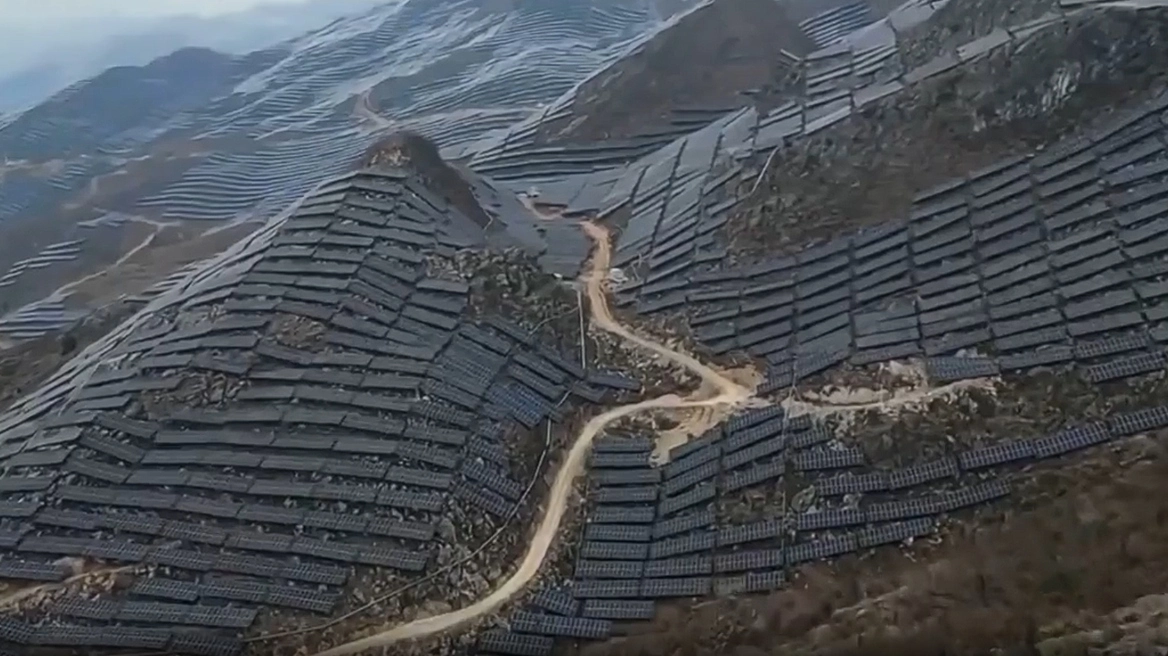
In the high-altitude regions of Guizhou Province in southwestern China, locals used to cultivate potatoes and buckwheat to make a living. With the rapid development of the new energy industry, these mountainous areas have now embraced new development opportunities.
“The crop yields in these areas were very low due to the high altitude and harsh climate. Additionally, grazing further degraded the environment,” said a local official, according to China Daily.
These disadvantages of the mountainous province have now been turned into advantages. The local government has introduced new energy industries, such as wind and solar power, to accelerate development. In 2019, a solar power plant was built and put into operation in the city of Erang in Weining, which is at the highest altitude in Guizhou. Covering over 866,000 square meters, the plant can produce 53 million kWh of electricity annually.
“The company pays hundreds of thousands of yuan in land rent to villagers and provides them with numerous jobs. The crops grown under the solar panels have thrived, playing an important role in restoring the natural environment,” said Tian Haokun, head of the solar power plant, which was constructed by Guizhou Jinyuan Co. Ltd. of the State Power Investment Corporation Limited.
To fully utilize the land, medicinal herbs and vegetables are also grown under the solar panels, increasing the land’s added value and creating more employment opportunities for local residents.
“We have about 30 villagers working for us every day. They clean the solar panels and remove weeds during the off-season. As a result, the villagers here have a steady income throughout the year,” said Zhang Puqing, who is in charge of another solar power plant in Anlong County, the Buyei-Miao Autonomous Prefecture of Guizhou.
In addition to solar energy, wind power is also thriving in the province. In 2011, the region saw its first wind power project launched and connected to the grid. By the end of June this year, the total installed capacity of new energy in Guizhou had reached 21.8 million kilowatts, with wind power accounting for over 6 million kilowatts and solar energy over 15 million kilowatts.
Meanwhile, a series of new energy projects are under construction across the province. By 2025, the total installed wind power capacity in Guizhou is expected to reach 10.8 million kilowatts, while solar energy is projected to reach 31 million kilowatts.
Ask me anything
Explore related questions