





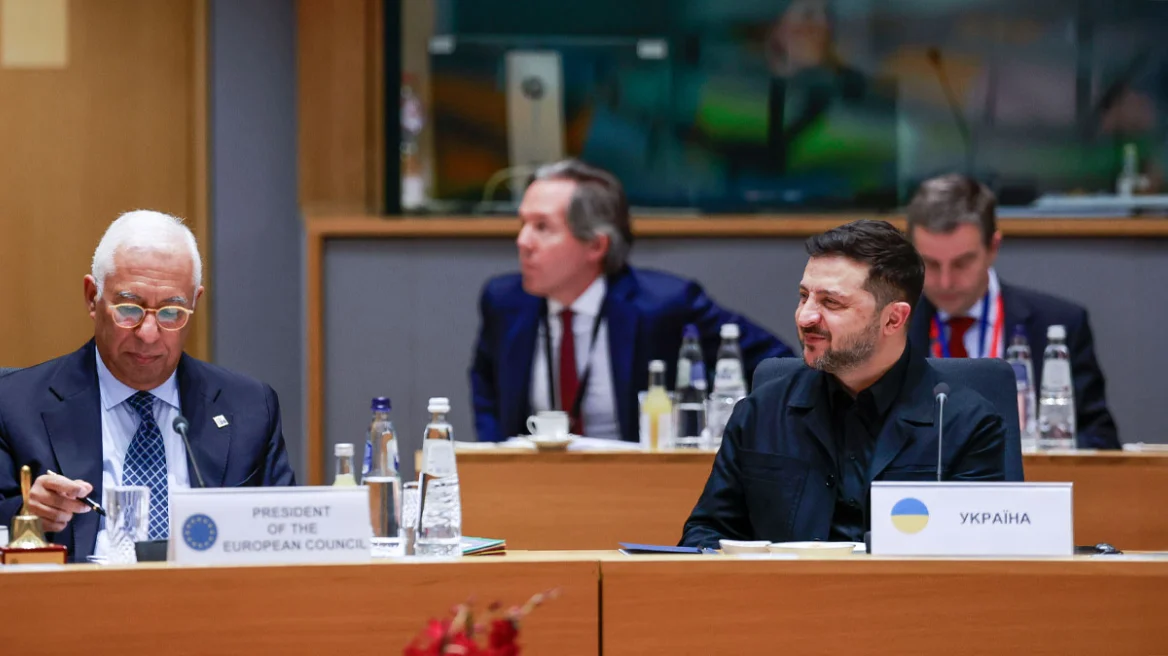
Politico describes the €90 billion loan for Kyiv as an agreement that shows Europe is still unwilling to pay to save Ukraine, after EU leaders ultimately failed to reach a deal on the “frozen” Russian state assets.
According to the European outlet, the outcome of the 16-hour negotiation that concluded in the early hours of Friday represents a “significant defeat” for German Chancellor Friedrich Merz and European Commission President Ursula von der Leyen.
As Politico notes, the agreement is an emergency plan based on joint EU debt, which had been promoted for weeks by Belgian Prime Minister Bart De Wever. It also includes yet another blow to EU unity, as three countries — Hungary, Slovakia, and the Czech Republic — will not take part.
“The agreement provides a critical lifeline for Ukraine’s war-ravaged economy, which is facing the risk of an imminent liquidity crisis as early as next spring, with the conflict with Russia continuing into its fourth year. Although the deal allows everyone to claim victory, it was not the solution that Germany and the Commission had been advocating in the run-up to the summit,” the analysis notes.After 15 hours of talks in Brussels, the EU summit reached an agreement on a €90 billion loan to Ukraine, with Greek Prime Minister Kyriakos Mitsotakis describing it as an “appropriate solution,” as he explained that it is “a loan from the margin of the European budget, which means that it has practically no fiscal consequences for any European country.”
An agreement was reached at the summit on financing Ukraine for the two-year period 2026–2027, announced the President of the European Council, António Costa, via X.
“The decision to grant €90 billion to support Ukraine for 2026–2027 has been approved. We kept our commitment,” António Costa stressed.
The cash will be raised through joint borrowing among 24 of the EU’s 27 countries, but all had to agree to the plan, because it is guaranteed by the EU’s central long-term budget.
All EU countries except the Czech Republic, Hungary and Slovakia will join together and raise €90 billion in joint debt, backed by the EU budget. This money will be lent to Ukraine over the next two years.
Kyiv will then use future Russian war reparations to repay the EU. And if Russia refuses to pay the money, “the Union reserves the right to use” its frozen state assets “to repay the loan,” EU leaders wrote in the final conclusions of the summit, the joint statement issued by the countries at the end of the talks.
German Chancellor Friedrich Merz said that Russia’s frozen assets in Europe will be used to repay the loan to Ukraine if Russia does not voluntarily decide to do so once the war in Ukraine ends.
“The frozen Russian assets will remain immobilized until Russia pays compensation to Ukraine,” he said. “Ukraine will only have to repay the loan after Russia pays compensation. And we make this very clear: if Russia does not pay compensation, we will use—in full compliance with international law—the immobilized Russian assets to repay the loan.”
“I assume the money will be available by the second half of January at the latest,” the German chancellor said when asked when the multibillion-euro loan would be available to Kyiv. The money will keep the country afloat over the next two years, Merz said, adding that the EU leaders’ agreement is “good news for Ukraine and bad news for Russia.”
Mitsotakis: It was the appropriate solution
“I believe that the solution that was chosen, namely a loan from the margin of the European budget—which means that it has practically no fiscal consequences for any European country—was the appropriate solution, taking into account the complexity and legal difficulties of the undertaking to utilize the frozen Russian resources at this moment. This possibility was not ruled out in the conclusions we agreed on, but it still requires more time for further processing if we eventually arrive at this solution,” Prime Minister Kyriakos Mitsotakis said in his statements after the end of the Summit.
“In any case, the message sent by the European Council is that Ukraine can cover its financing needs in the immediate future and that Europe stands tangibly by Ukraine’s side, using, as I said, the margin of the European budget, without there being practically any fiscal consequences for the member states,” the prime minister added.
Asked about the multiannual financial framework and whether he sees a risk that resources for defense and Ukraine could “sacrifice” others, the prime minister replied: “I think we are getting a bit ahead of ourselves. Essentially, discussions on the multiannual financial framework are only just beginning. What has been agreed in principle is its basic architecture, but no specific proposal has yet been made, beyond the Commission’s initial positioning regarding the amounts and how they are allocated among the various categories of the European budget. One thing is certain, and this also emerged from today’s discussion: there is a critical mass of countries— I would call them friends of cohesion and of the Common Agricultural Policy—that will not essentially accept cuts to these two programs, which constitute the two main pillars on which the entire framework of European financing has been built over recent decades. However, I estimate that these negotiations will be complex and difficult. The Cypriot presidency, which takes over in twelve days from now, will presumably present its first proposals for the specific allocation of resources, and we hope and wish that a year from now we will be able to agree on the next multiannual financial framework.”
Von der Leyen: The European Council agreement meets “pressing financing needs” for the “next two years”
European Commission President Ursula von der Leyen expressed her satisfaction that the European Council managed to secure an agreement that meets Ukraine’s “pressing financing needs for the next two years.”
The member states agreed to finance Ukraine through EU borrowing on the capital markets, granting €90 billion over the next two years. This will be done through “enhanced cooperation,” supported by the margin of the EU budget and based on unanimous agreement to amend the current Multiannual Financial Framework, Ms. von der Leyen explained.
As with the reparations loan, Ukraine will only need to repay the loan if it receives war reparations from Russia. Until then, Russian assets will remain immobilized and the EU continues to reserve the right to use the cash proceeds from Russian funds to finance the loan.
Financing for Ukraine after 2027 will be part of the ongoing discussion on the upcoming Multiannual Financial Framework (2028–2034).
Costa: “Europe stands by Ukraine for as long as it takes”
“In October we decided that the European Union would cover Ukraine’s urgent financing needs for 2026 and 2027. Last week we decided that Russia will not recover its assets until it ends its aggressive actions. Today we approved the granting of €90 billion to Ukraine for the next two years,” he noted.
According to the President of the European Council, as an emergency measure the EU will grant a loan to Ukraine, guaranteed by the EU budget, in order to immediately cover the country’s financing needs. As he clarified, “Ukraine will repay this loan only when Russia pays compensation.”
At the same time, the Union reserves the right to use the frozen Russian assets to repay the loan, while the European Commission was tasked with continuing work on creating a reparations loan based on frozen Russian assets.
In the same context, the “27” also agreed to extend sanctions against Russia. As António Costa emphasized, “our goal is not to prolong the war,” stressing that today’s decisions aim to achieve “a just and lasting peace for Ukraine.”
“The only way to bring Russia to the negotiating table is to strengthen Ukraine,” he said, adding that these decisions will provide Kyiv with the necessary means “to defend itself and support the Ukrainian people.”
The President of the European Council also sent a clear message to Moscow, saying: “First, you have not achieved your objectives in Ukraine. Second, Europe stands by Ukraine today, tomorrow and for as long as it takes. Third, Russia must sit at the negotiating table seriously and accept that it will not win this war.”
As he concluded, “the only way forward is a ceasefire and peace through negotiations,” making clear that the European Union’s political and economic support for Ukraine will not waver, with the aim of building “a free and prosperous Ukraine within the European Union.”
Macron: Dialogue with Russian President Putin could become “useful” again
French President Emmanuel Macron said in the early hours today, after the agreement reached in the EU to grant an interest-free loan of €90 million to Ukraine, that it could “become useful again” for Europeans to conduct dialogue with Russian President Vladimir Putin.
“In the coming weeks, ways and means must also be found so that Europeans, with good organization, can restart full dialogue with Russia, with full transparency,” he said during a press conference in Brussels.
What the conclusions text says
In the statement on Ukraine signed by 25 of the EU’s 27 leaders, the following is stated:
- The European Council held an exchange of views with Volodymyr Zelenskyy, President of Ukraine.
- The European Council confirms its continued and unwavering support for the independence, sovereignty and territorial integrity of Ukraine within its internationally recognized borders. The European Union will continue to provide, in coordination with like-minded partners and allies, comprehensive political, economic, humanitarian, military and diplomatic support to Ukraine and its people. The European Council expresses its appreciation for the determination and resilience of the Ukrainian people and leadership in resisting Russian aggression, which prevented Russia from achieving its military objectives.
- The European Council reaffirms the EU’s unwavering support for Ukraine’s path toward EU membership and welcomes the significant progress Ukraine has made so far under the most difficult circumstances. The European Union will continue to work closely with Ukraine and support its efforts to fully meet all requirements, in line with the merit-based approach. The European Union will continue to support Ukraine in building a peaceful and prosperous future within the European Union.
- The European Union supports a comprehensive, just and lasting peace in Ukraine, based on the principles of the UN Charter and international law. Recalling the principles set out on 6 March 2025, the European Council welcomes ongoing diplomatic efforts to end the war and calls on Russia to agree to a full, unconditional and immediate ceasefire, to which Ukraine remains committed, and to engage in meaningful negotiations aimed at achieving a just and lasting peace. For peace to be just and lasting, borders must not be changed by force and any future agreement must respect Ukraine’s independence, sovereignty and territorial integrity and guarantee Ukraine’s long-term security and ability to defend itself.
- The European Union and its member states will continue to actively participate in peace efforts, in line with the EU’s objective of promoting peace as enshrined in the Treaties. The path to peace in Ukraine cannot be decided without Ukraine. The European Union will decide on matters falling within its competence or affecting its security.
- The European Union and its member states are ready to contribute to strong and credible security guarantees for Ukraine, notably through the Coalition of the Willing and in cooperation with the United States. This will include supporting Ukraine’s capacity to deter aggression and to defend itself effectively. The EU’s and member states’ contribution will be based on their respective competences and capabilities and will be in line with international law.
- The European Council underlines the critical need to ensure that Ukraine remains resilient and has the fiscal and military means to continue exercising its inherent right of self-defense and to confront and deter Russia’s aggression, also in the long term.
- Recalling the October 2025 commitment to address Ukraine’s urgent financing needs for the period 2026–2027, including its military and defense efforts, the European Council took stock of the ongoing work to implement this commitment.
In line with previous European Council conclusions, which underline that, subject to EU law, Russia’s assets should remain immobilized until Russia ends its war of aggression against Ukraine and compensates it for the damage caused by the war, the European Union, given the unprecedented situation, approved—on the basis of Article 122 TFEU—exceptional, temporary and duly justified emergency measures that bind those assets on a more durable basis. The European Council takes note of the Commission statement made at the time of adoption of this act.
Following recent proposals by the Commission and the High Representative, the European Council calls on the Council and the European Parliament to continue work on the technical and legal aspects of instruments for establishing a reparations loan based on the cash proceeds linked to Russia’s immobilized assets.
Meanwhile, in order to ensure the necessary financial support for Ukraine from the second quarter of 2026, including its military needs, the European Council agrees to grant Ukraine a €90 billion loan for the years 2026–2027, based on EU borrowing on the capital markets, covered by the margin of the EU budget. Through enhanced cooperation (Article 20 TEU) with regard to the instrument based on Article 212 TFEU, the mobilization of EU budget resources as a guarantee for this loan will have no impact on the fiscal obligations of the Czech Republic, Hungary and Slovakia. This loan will be repaid by Ukraine only after reparations are received. Until then, the assets in question will remain immobilized and the Union reserves the right to use them to repay the loan, in full compliance with EU law and international law.
The European Council underlines the importance of the following elements in relation to the loan to be granted to Ukraine:
a) strengthening European and Ukrainian defense industries,
b) Ukraine’s continued upholding of the rule of law, including combating corruption,
c) the specific nature of the security and defense policy of certain member states and the security and defense interests of all member states.
- The European Council stresses the importance of intensifying member states’ efforts to address Ukraine’s urgent military and defense needs, in particular with regard to air defense and anti-drone systems and large-caliber ammunition. In this context, further support, development and investment in Ukraine’s defense industry remains vital, including through the establishment of Ukrainian defense production in member states. It is also important to further strengthen cooperation and integration between Ukraine’s defense industry and the European defense industry, drawing on Ukraine’s unique experience and expertise. In this context, the European Council welcomes the inclusion of cooperation with Ukraine in member states’ defense industry investment plans under the “Security Action for Europe” (SAFE) instrument.
- All military support and security guarantees for Ukraine will be provided with full respect for the security and defense policy of certain member states and taking into account the security and defense interests of all member states.
- The European Union remains determined to maintain and increase pressure on Russia to stop its violent war of aggression and to engage in meaningful peace negotiations. In this context, the European Council calls on the Council to continue work on a new sanctions package, with a view to its adoption as soon as possible after its presentation in early 2026. It also underlines the importance of further coordination with the G7 and other like-minded partners on sanctions, as well as further strengthening anti-circumvention measures.
- The European Council assessed efforts to curb the activities of Russia’s shadow fleet, which have effectively reduced Russia’s energy revenues, and welcomes the recent adoption of new sanctions to that end. It calls on member states to take further coordinated action and to cooperate with G7 partners, also in relation to port and coastal states and vis-à-vis flag states of third countries and all actors involved in the shadow fleet ecosystem, in order to further reduce Russia’s energy revenues and continue to address the significant risks posed by the shadow fleet.
- The European Council unequivocally condemns the support of third countries, as well as actors and entities within them, that enable Russia to continue its war of aggression against Ukraine. It condemns in particular the continued military support provided, inter alia, by Iran, Belarus and the DPRK. The European Council calls on all countries to immediately cease any form of support to Russia in its war of aggression against Ukraine, whether direct or indirect, in particular through the provision of dual-use goods or components.
- The European Council unequivocally condemns Russia’s ongoing large-scale attacks against civilians and civilian targets in Ukraine, including infrastructure, hospitals, medical facilities and the energy system. It calls for the immediate cessation of all military activities near Ukraine’s nuclear facilities, which pose a serious threat to their safety and security. The European Council also calls for every effort to be made to support Ukraine in repairing, rebuilding and strengthening the resilience of its energy system. The European Union and its member states, in cooperation with partners, will intensify the provision of humanitarian aid and civil protection assistance, as well as energy and related equipment, to Ukraine.
- The European Council reiterates its urgent call on Russia and Belarus to immediately ensure the safe and unconditional return to Ukraine of all illegally deported and transferred Ukrainian children and other civilians. Other humanitarian efforts and confidence-building measures, in particular the exchange of prisoners of war, should be part of the path to peace.
- The European Union remains firmly committed to ensuring full accountability for war crimes and other most serious crimes committed in connection with Russia’s war of aggression against Ukraine. In this context, the European Council calls for continued efforts to bring into operation the Special Tribunal for the Crime of Aggression against Ukraine, within the framework of the Council of Europe. It also welcomes the signing of the Council of Europe Convention establishing an International Claims Commission for Ukraine and calls for work to continue.
Ask me anything
Explore related questions




