





Any expectations that existed in local economies regarding commercial activity during this period are already being proven false. Despite the fact that the festive season traditionally serves as a critical “lifeline” for trade outside major urban centers, this year the situation in mainland Greece shows a market struggling to recover.
Farmers’ protests, recent bad weather, and already noticeable economic hardship create a scenario that hits demand, limits mobility, and erodes the most critical month of the year.
Daily economic losses are estimated at €31–45 million, with retail and logistics suffering the most, and each additional week of protests adding approximately €200 million in damage, mainly in regional areas.
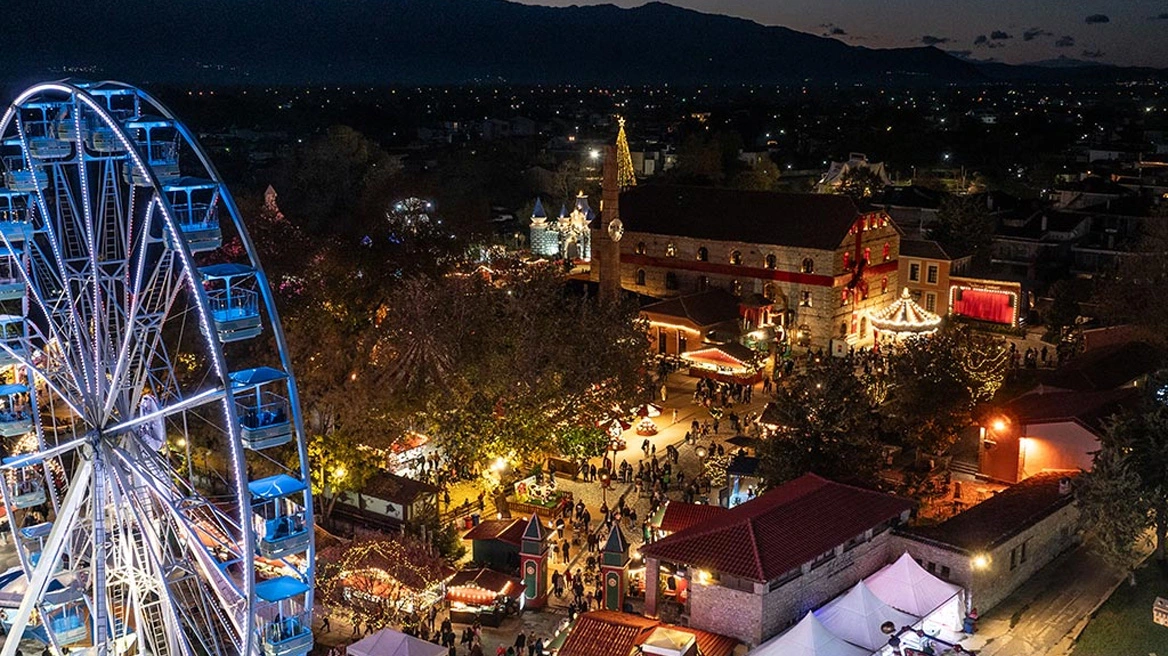
In Trikala, where the “Mill of the Elves” operates every December as a barometer for all of Thessaly, the reality behind the festive displays reflects the situation in the region. Despite increased activity in recent days, local business owners report a 30%–40% drop compared to last year—a loss that cannot be compensated by a few “busy” days.
“For many, December is the month that feeds the other 11,” notes Konstantinos Papaefthymiou, president of the Trikala Chamber of Commerce. “If it’s lost, it cannot be recovered.” He explains that this year’s period started with two weeks of bad weather, followed by agricultural protests that intensified uncertainty for families deciding whether to travel with small children, facing higher costs and the risk of long delays on the roads.
According to Papaefthymiou, the recent increase in traffic and visitor presence does not change the market’s main conclusion: a period of 40–50 days cannot be “saved” by four or five good days, while January and February are expected, according to local authorities, to be extremely challenging.
A similar picture comes from Magnesia, where the Magnesia Chamber of Commerce is calling for a political solution to the agricultural issue, warning that the continuation of protests threatens to collapse the festive market in Volos. Difficulties in mobility and consumer caution are suppressing demand during a period that, for many small businesses, determines their survival.
The situation in Trikala and Magnesia highlights that the problem is multifaceted. The regional economy had already entered the festive season showing clear signs of fatigue. Agricultural protests act as an accelerator: they limit mobility, remove farmers themselves—who are a critical consumer group in rural areas—from consumption, and squeeze turnover at the most crucial time.
The Numbers
At the same time, roadblocks and detours increase travel times and operational transport costs, which gradually pass on to the market. Heavy use of secondary roads has also revealed a serious road safety issue, further burdening the logistics chain.
The reality of the market is confirmed by estimates from the Piraeus Chamber of Commerce and Industry: daily economic losses are calculated at €31–45 million, with retail and logistics hit hardest, and each additional week of protests adding around €200 million in damage, mainly in the regions.
However, the stakes go far beyond local markets. For the economy overall, the risk is systemic: disruption of the supply chain, revenue losses during a critical period, increased costs passed on to prices, and damage to the country’s credibility as a commercial and tourist destination.
It is no coincidence that leading business organizations issued a joint call for immediate dialogue and assurance of economic activity.
In a joint statement, the Hellenic Association of Enterprises and Industries, the Hellenic Confederation of Commerce and Entrepreneurship, the Association of Greek Tourism Enterprises, and the Hellenic Federation of Industries emphasized that, while farmers’ demands are valid, the prolonged escalation of protests during the festive season threatens to cause disproportionate losses to trade, industry, tourism, and transport.
Already from the beginning of the month, with an unusually strong and unprecedented warning, Jumbo founder and president Apostolos Vakakis publicly intervened regarding the risks posed to the market by the escalating agricultural protests and the potential blocking of national roads, ports, airports, and customs, urging the government to implement effective solutions to maintain stability during this critical period for commerce.
“The Jumbo Group calls on the State to immediately and absolutely ensure market stability and the smooth functioning of the country during this critical period, because we simply do not have the luxury of half-measures that would mathematically lead to deadlocks and irreversible consequences for the export economy and for Greece itself,” he stated.
Ask me anything
Explore related questions




