





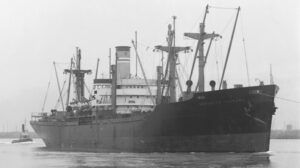
In late December 1950, while the Korean War was at its most critical point, a U.S. Navy cargo ship was carrying more people than had been predicted in its entire design. The SS Meredith Victory, unarmed and without basic passenger facilities, sailed from the port of Hungnam, carrying some 14,000 North Korean refugees.
The ship had five holds, each with three levels. People were stowed standing up, without light, heat or water. Despite the conditions, not a single death was recorded during the voyage. Instead, five births were recorded.
The five infants were born between December 23 and 25, 1950. Crew members, unable to pronounce or remember the Korean names, informally called them “Kimchi 1 through 5”. The name remained and went down in history as the “Christmas Miracle”.
The presence of so many civilians in Hungnam was a result of the collapse of the front after the Battle of Chosin Tank. The massive intervention of the Chinese People’s Volunteer Army, with superior numbers and operations in extreme temperatures, forced the US and UN forces into a rapid retreat. At the same time, tens of thousands of North Korean civilians, fearing reprisals, followed the army out to sea.
The Hungnam Evacuation became one of the largest humanitarian operations by sea. More than 100,000 civilians were transported in a matter of days. The Meredith Victory, designed for a crew of 60 and a cargo of war material, took on the disproportionate burden of 14,000 souls.
One of the five children was Sean Young-young, known as Kimchi 1. His parents had left two children in the North, considering the move temporary. The ceasefire line in 1953 dashed this expectation. After landing in Geodze, Sean grew up in the South, in an environment where absence was a permanent condition. His parents died without reuniting with the children they left behind. The search passed to the second generation.
Of the five children on the ship, two – Kimchi 1 and Kimchi 5, Lee Kyung-pil, are known to have tracked each other down decades later. Kimchi 2, 3, and 4 remain missing, possibly in North Korea or in the diaspora.
Today, 75 years later, the Christmas Miracle is treated not as a moving footnote to the war, but as historical evidence. It captures the scope of the refugee crisis, the violence of geopolitical rifts, and the long-lasting trauma of Korean separation.
Five births in a cargo hold did not change the outcome of the war. But they left a rare, human footprint amid one of the most unforgiving winters of the 20th century.
Ask me anything
Explore related questions




