





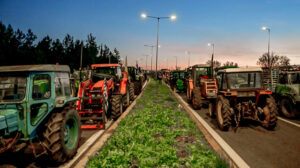
A rift marked by open clashes and sharp barbs has emerged within the farmers’ movement following the initiative from Epanomi, which called for alignment in favor of dialogue with the government. Statements from both sides have escalated tensions, reaching the level of characterizations, accusations of political motives, and public disputes over who represents whom at the road blockades.
The spark for the new round of tension was lit by the president of the Trilofos Farmers’ Association, Christos Tsilias, who spoke today on MEGA. He began by referring to figures within the Panhellenic Committee, naming its president, Vangelis Maroudas, as well as the president of the United Federation of Farmers’ Associations of Karditsa, Kostas Tzellas.
“First of all, Maroudas is the president of the panhellenic body—who voted for him to be president?” he said, also claiming that farmers who took part in the Epanomi meeting “received very harsh criticism” when they returned to their blockades and were forced, as he put it, to “balance things out.”
Mr. Tsilias then launched a fierce accusation against the Communist Party of Greece (KKE), prompted by a party statement which—according to him—portrayed farmers seeking dialogue as “willing accomplices.”
“Since yesterday, when the KKE officially issued a statement saying that we are the ‘willing ones’ who will talk to the government, it seems it does not want willing people, it does not want to solve problems, it does not believe in bourgeois societies, it wants communist societies, where problems are not solved and people are inconvenienced,” he said, even calling on air for a dialogue with the KKE’s General Secretary, Dimitris Koutsoumbas.
The president of the Trilofos Farmers’ Association insisted that “there are political motives” behind the reaction, noting: “I have been a trade unionist for 35 years; we have never sat at the table with these people, and it is a shame to end up in confrontation.” He stressed that “dialogue must take place in an orderly manner” and that the KKE reacted “at the mere sound of the word.” In the same context, he estimated that dialogue with the prime minister would take place “after January 10,” saying: “We will have spent 45–50 days on the road. This party (KKE) does not want to solve problems; it wants to inconvenience bourgeois societies.”
Mr. Tsilias also claimed that the KKE “has people at every blockade,” adding that “here we have isolated them; they are 10 kilometers away.” He referred as well to how governments had dealt with mobilizations in the past, contrasting that with the present situation where “they are calling us to dialogue,” asking rhetorically, “Shouldn’t it happen at some point?” At the same time, he said he would not attend the nationwide meeting expected on Sunday, stating: “For heaven’s sake, we have no business there… What is the purpose of this meeting?”
In the same vein, the vice president of the Pan-Serres Farmers’ Association, Giannis Kartalis, expressed his puzzlement over the objections raised by the Nikaia blockade to the Epanomi initiative, noting that dialogue is what is sought by all sides, provided the conditions exist.
“What is it that bothers them? Mr. Maroudas says it every day: when the conditions are created, we should go to dialogue. What is it that bothers them? Is there anyone here who wants to stay until Easter? There must be the right conditions,” he said.
The situation remains fluid ahead of Sunday’s nationwide meeting, where the data regarding the future of the mobilizations are expected to be laid on the table. At the same time, the initiative by 18 blockades and farmers’ associations to speak in favor of dialogue has “ignited fires,” with some distancing themselves or denying that the relevant statement represents them.
Ask me anything
Explore related questions




