





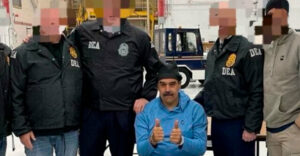
Around noon (7 p.m. Greek time), Nicolás Maduro is expected to appear before a New York court. It is a historic and critical moment for the future of the former Venezuelan president, as it will mark the start of the trial and reveal the stance he and his wife will take, while behind-the-scenes maneuvering continues over the country’s next day. With Donald Trump stating that the case against Maduro is legally “impossible to collapse,” Venezuela’s new interim president is lowering tensions and speaking for the first time about “cooperation,” even as the American president demands “full access.”
At the same time, unprecedented preparations are underway for the (naturally draconian) security measures covering the mere 9 miles (about 14.4 kilometers) from the Metropolitan Detention Center to the Manhattan courthouse, a route Maduro will travel. Since the defendant’s presence in New York is mandatory, the legal process to be followed does not differ from that applied to any other criminal (or non-criminal) defendant under ordinary criminal law.
The 92-year-old judge Alvin Hellerstein—appointed by Bill Clinton—who has handled Maduro’s case for the past ten years, will read aloud the charges against Maduro and his wife and then ask whether he pleads guilty or not guilty. It is customary for defendants who want to buy time to plead not guilty in order to delay proceedings, while those seeking plea deals or lighter sentences plead guilty. In Maduro’s case, this will be significant, as it will be the first clear indication of the stance he and his wife, Cilia Flores, intend to take at trial.
An official White House account shared footage of Nicolas Maduro in custody on US soil.
— Sky News (@SkyNews) January 4, 2026
"Perp walked," the caption from the Rapid Response profile on X read.https://t.co/Xzt4j1adIe pic.twitter.com/TpUo4TF6hd
As announced by U.S. Attorney General Pam Bondi, Nicolás Maduro and his wife face charges including narcoterrorism conspiracy, conspiracy to import cocaine, possession of machine guns and destructive devices, and conspiracy to possess machine guns and destructive devices against the United States. Some of these charges, such as terrorism, are federal capital offenses that, in the Southern District of New York, carry the possibility of the death penalty.
Maduro has the right to remain silent or to state that he will testify at a later stage of the trial. However, he is expected to plead not guilty in order to build the argument that he was not arrested but kidnapped, and that international law—through the abduction of a country’s president—and the human rights of both himself and Flores were violated. Here, the road will be particularly difficult for Maduro and his legal team, as there is unfavorable precedent: that of Panama’s military dictator Manuel Noriega some 30 years ago. Noriega was arrested and tried in the United States, where he raised the same legal argument, unsuccessfully (he died in prison).
U.S. officials, meanwhile—through both the words and actions of Marco Rubio—have sought to “lock in” the position that this argument cannot be credibly used by Maduro and that the case will be “infallible,” as Donald Trump described it. For this reason, Rubio stated to the media and posted across his social media accounts that Maduro is not a legitimately elected president, and that “the previous Trump administration, the Biden administration, this Trump administration, European countries, and others do not recognize Maduro as the true, legitimately elected president of Venezuela.” Therefore, since he is not the lawful president of a country, he was not kidnapped but arrested.
With these and many other arguments that both sides are expected to raise—if, of course, Maduro chooses to fight the case legally rather than seek a deal, mock the charges, or even abstain from the process altogether—the trial in Manhattan will proceed. The U.S. government wants the case handled swiftly, but it could still take up to two years before a final verdict is reached.
Ask me anything
Explore related questions




