





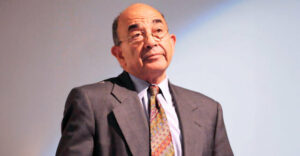
If there is one person who may “steal” a bit of the spotlight from Nicolás Maduro and his wife, Cilia Flores, today and in the coming days, it is the judge who will formally present the charges against them. After all, when the judge is a 92-year-old (!) appointee of Bill Clinton who has presided over some of the most significant cases in American history—including one involving the current president, Donald Trump—the case becomes even more interesting.
“He is very respected,” Trump said when he learned that Maduro’s case would be overseen by 92-year-old senior federal judge of New York, Alvin K. Hellerstein. He is one of the most experienced active judges in the U.S. federal judiciary, with many historic cases on his résumé and a reputation for strict adherence to the law and to the letter of procedural requirements. He has played a central role in some of the most sensitive cases heard by the U.S. District Court for the Southern District of New York.
Hellerstein, who was appointed judge on May 15, 1998, by then-President Bill Clinton and assumed senior status in 2011, has served for more than a quarter of a century at the Manhattan-based court, widely regarded as the most powerful federal prosecutorial district in the United States. Despite his age, he continues to hear major criminal cases involving terrorism and national security, relying on his vast legal experience and clarity of thought.
Of particular interest is the fact that Hellerstein is an Orthodox Jew—something that gives a different tone to the trial of one of the most important partners/allies of Iran’s theocratic regime, which in turn is considered Israel’s number-one enemy.
He is known for observing Jewish law, while at the same time maintaining a reputation for strict judicial independence and meticulous adherence to federal procedure.
Throughout his career, Hellerstein has presided over complex and politically sensitive trials, including major financial cases and consolidated civil actions arising from the September 11 attacks. He is known for his detailed rulings, firm courtroom management, and methodical approach to evidence and procedure.
Born in New York in 1933, Hellerstein earned his undergraduate degree and law degree from Columbia University. He served in the U.S. Army Judge Advocate General’s Corps before practicing law for decades. Since joining the federal bench, he has remained a central figure on the docket of the Southern District of New York.
Below are some of the most significant cases handled by Hellerstein.
Confirmation of a $400 Million Arbitration Award in an Oil Case (2013)
On August 27, 2013, Judge Hellerstein confirmed an international arbitration award of nearly $400 million owed by Pemex-Exploración y Producción (Pemex), a Mexican state oil company, to Corporación Mexicana de Mantenimiento Integral (COMMISA), a Mexican subsidiary of KBR.
In the case, COMMISA and Pemex entered into a contract for the construction of offshore natural gas platforms and later, in 2004, accused each other of breaching the contract. A long legal battle followed: Pemex terminated its contracts with COMMISA, while COMMISA submitted its claims to an arbitration tribunal of the International Chamber of Commerce. COMMISA was awarded $289 million in damages and $7.5 million in legal fees and costs.
In 2010, Judge Hellerstein confirmed enforcement of the award in the United States. Meanwhile, Pemex filed suit in Mexico to annul the arbitration award and succeeded in 2011. Mexico’s Eleventh Collegiate Court of the Federal District ruled that, under legislation enacted after the arbitration began, Pemex’s dispute was not arbitrable, thus annulling the award.
Subsequently, the U.S. Court of Appeals for the Second Circuit vacated and remanded Hellerstein’s enforcement decision. Upon reconsideration, Judge Hellerstein again confirmed the COMMISA arbitration award, noting that because the Mexican court applied a law that did not exist at the time the contract was signed—and because the applicable statute of limitations had expired—COMMISA would otherwise have been left without legal recourse. Concluding his analysis, Judge Hellerstein wrote that the Mexican “decision annulling the arbitration award violated fundamental principles of justice.”
September 11 Wrongful Death Litigation (2011)
On July 28, 2009, Judge Hellerstein approved the trial of three wrongful-death lawsuits against two major airlines. The suits were filed by families who lost loved ones in the terrorist attacks of September 11, 2001. The final case was settled on September 19, 2011, with the defendants paying an undisclosed amount.
September 11 Workers’ Illness Litigation (2010)
On February 19, 2010, Judge Hellerstein accepted twelve cases filed by Ground Zero rescue workers for illnesses caused by ash and dust from the September 11 attacks. The suits were brought against the City of New York and related contractors, alleging failure to provide protective equipment to first responders.
The outcome of these cases could affect similar cases still pending in court. On March 11, 2010, New York City announced a $575 million settlement with 10,000 rescue and cleanup workers.
The settlement required approval by 95% of the plaintiffs and the judge before any compensation could be paid. After the agreement was announced, Judge Hellerstein sought to hear directly from those suffering illnesses before ruling. He also criticized the settlement because 33% of the compensation was allocated to legal fees, which he said should be reduced to 15%.
On April 12, 2010, Hellerstein sharply criticized attorneys on both sides for failing to inform him of new settlement negotiations, stating during a hearing: “You are leaving me in the dark.” A subsequent settlement hearing was scheduled for April 27, 2010. In November 2010, more than 95% of plaintiffs agreed to a $625 million settlement.
Airlines Sue the FBI Over September 11 (2009)
On July 16, 2009, Judge Hellerstein dismissed a lawsuit filed by major airlines seeking the right to question FBI agents about the September 11 attacks. The lawsuit was part of an effort by airlines to depose FBI agents and gain access to evidence related to the attacks, arguing that the government was insufficiently prepared to prevent them.
The judge dismissed the suit, stating: “The defendants also argued that the terrorists likely would have succeeded even if the defendants had exercised due care. The issues to be examined concern the acts and omissions of the airline defendants, not the government.” He added: “The government’s failure to detect and prevent terrorist acts would not affect the potential liability of the defendant.”
CIA Documents and Trump
Judge Hellerstein ruled against the American Civil Liberties Union (ACLU) in a lawsuit seeking to force the CIA to release classified documents related to the interrogation of terrorism detainees. His decision held that intelligence methods must be protected to avoid compromising national security.
As recently as last March, the veteran federal judge rejected yet another attempt by Donald Trump to challenge his criminal conviction in New York’s hush-money case. Judge Alvin Hellerstein denied Trump’s lawyers’ request to move the case from state court—where Trump had been convicted the previous May on 34 counts of falsifying business records to conceal a payment to a porn star—to federal court, where Trump hoped to overturn the conviction.
Hellerstein also rejected Trump’s argument that his conviction should be overturned in light of the Supreme Court’s July ruling on presidential immunity for official acts. The judge cited a decision from the previous year in which he had denied an earlier request by Trump to move the case to federal court, concluding that the conduct at the heart of the case—the hush-money agreement with Stormy Daniels—was unrelated to Trump’s official duties as president.
Ask me anything
Explore related questions




