





When did the first day of each new year begin to be celebrated? And since when does each new year begin on January 1? When did the official celebration of New Year’s Day arise? Questions whose first answers are sought 4,000 years ago, in the era of the Babylonians. As well as other related ones, such as in which countries of the planet—and of course for what reasons—New Year’s Day is not celebrated everywhere on January 1, but on different dates.
And also, when did Saint Basil -or for the not Greeks “Santa Claus“- enter people’s lives, and why is the Greek Orthodox one different from the one whose “journey” Donald and Melania Trump watched on Christmas Eve night via a global live broadcast?
Many of the answers to these questions also hide surprises. In any case, New Year’s Day is by common consent the oldest human celebration, which is now honored with almost the same enthusiasm by all nations, tribes, and states of the world, inseparably linked to change, renewal, optimism, and hope for a new beginning, a fresh start toward better days in the lives of each person and of everyone together.
Regardless of national origin, religious and political beliefs, or social background, New Year’s Day is perhaps the only celebration on the planet that generates and nurtures emotions on a universal human scale and is celebrated through them.
When was the “beginning of the year” established?
In antiquity, time did not begin on January 1. People hastened to define the beginning of the year as a day that constituted the start of a new time period, based mainly on natural phenomena that repeated themselves. In this way they interpreted the periodicity of nature, that is, the seasons and their succession. Spring, summer, autumn, winter, and again from the beginning. Northern peoples chose the annual return of spring, southern ones that of autumn. Climate, geographical position, and the particularities of each people defined that season; in anticipation of its return, people established a point as the first of the year and later celebrated it as well.
According to Time magazine, the first to establish a celebration for the new year were the Babylonians, around 2000 BC, in Mesopotamia. Knowledgeable about celestial bodies, they had created a lunar calendar according to which the new year began at the spring equinox, when day and night were equal in length, that is, on March 21. The celebration was called Akitu and lasted ten days.
In ancient Rome, the first known calendar was established by its founder, Romulus. It began on March 1, coinciding with the assumption of power by the new consuls. Around the 7th century BC, King Numa Pompilius added two months, totaling 50 days, to the calendar year to cover the winter period. These were Ianuarius, in honor of Janus, the god with the two opposing faces—one looking forward and the other backward, symbolizing the future and the past—and Februarius, referring to the purification festival “Februa” held during it.
The official establishment
January 1 was designated as the beginning of the year in 153 BC, but it was not officially celebrated. This came with the rise of Julius Caesar to power in 46 BC. Observing that the old Roman calendar was inaccurate, Caesar commissioned the Alexandrian astronomer Sosigenes to create a new one based on the position of the Sun rather than the Moon.
The Romans celebrated the change of the year with ceremonies, exchanging gifts and also indulging in orgies. With the rise of Christianity, this Roman celebration was considered pagan and was abolished. However, the establishment of January 1 as the beginning of the year gradually spread widely in the West, with few and limited local and temporal exceptions. During the Middle Ages, the first day of the year was celebrated either on Christmas or on the Annunciation of the Virgin Mary on March 25, depending on the traditions of each people. The Julian calendar also introduced an extra day every four years, what we now call “leap years,” but underestimated the length of the solar year by about 11 minutes. This led, by the mid-15th century, to the calendar being off the solar cycle by an additional ten whole days. This discrepancy was corrected in the 1570s by Pope Gregory XIII, who introduced the new Gregorian calendar. In 1582, January 1 was restored as the beginning of the year.
The Gregorian calendar was gradually accepted by many countries. The British, however, delayed almost two centuries, until 1752, before adopting it. The Japanese, Greeks, Turks, and some other peoples delayed even longer.
Its establishment in Greece
In ancient Greece, the new year began at the autumn equinox and was linked to the movement of the Sun rather than the Moon, as in Mesopotamia. In Byzantium, the year began on September 1 (Indiction), which was also the beginning of the ecclesiastical year, originating from a secular fact: the annual tax cycle.
Later, the Greeks followed the practices of the West, with New Year’s Day being combined with the feast of Saint Basil. The more systematic, secular-type celebrations of New Year’s Day are recorded from the late 19th century. That was when the first New Year’s Eve galas appeared in Athens. A New Year’s Eve gala with a grand ball was organized for the first time by the “Grande Bretagne” hotel, followed by the other major hotels of the capital. New Year’s Day was established as an official public holiday in Greece in 1923, following the adoption of the Gregorian calendar.
Different celebrations
Gradually, all countries of the world aligned the start of each year with January 1. This is done, of course, for reasons of global synchronization and the obvious needs that arise. At the same time, however, many countries—primarily for reasons of religious tradition or other beliefs—maintain in a fully parallel but essentially “internal-use” manner a second calendar.
Among the most well-known examples is the Jewish New Year. The change of the year for Jews begins on the first day of the month of Tishri (which coincides with October in the Western calendar). It is the seventh month of the Jewish calendar, and thus the Jewish New Year is celebrated then. The celebrations are completed on the tenth day of the month. Unlike the Western New Year, the Jewish New Year has a strongly religious character.
Muslims celebrate the arrival of the new year at the beginning of the first month of the Islamic calendar, Muharram, the second holiest after Ramadan, which contains 29 or 30 days. The Islamic calendar is lunar, and months begin when the first crescent of a new Moon appears. The lunar year is 11 or 12 days shorter than the solar year. The first day of Muharram is the Islamic New Year. In 2025, Muharram began on June 26, while the following year it will begin on June 16, the day of the Islamic New Year of 2026.
Muslims also begin counting their years from that of the Hijra, that is, July 16, 622 AD in the Julian calendar. On that day, Muhammad left Mecca for Medina to avoid a conspiracy against him. It was the first Muslim New Year. The situation is chaotic with Hindus. The Hindu New Year marks the awakening of the Earth from winter dormancy, so it always coincides with the spring months. For the majority of Hindus it falls on March 26, but in India the New Year is also celebrated on three other different dates. The Malayali people celebrate it on April 14, the Hindus of Kashmir on March 10, and the inhabitants of Bengal on April 13.
The combination of the Chinese New Year
In major Chinese cities—Beijing, Shanghai, Hong Kong, and many others—preparations are underway for spectacular events to welcome 2026. However, there is also the Chinese New Year, which is celebrated on different dates each year, as it is based on the ancient Chinese calendar that has its roots as far back as 2637 BC and the emperor Huangdi who devised and established it.
It is a combination of a solar and a lunar calendar, in which a regular year has 12 lunar months, with 353–355 days, while a leap year has 13 months, with 383–385 days. Thus, the Chinese New Year is celebrated on different dates between late January and mid-February, recurring in a 60-year cycle. Each year is named after an animal. Thus, the Chinese New Year of 2025 (Year of the Dragon) was celebrated on January 29, while that of 2026 (Year of the Horse) will follow on February 17. In 2026, the Chinese will count their own year as 4724.
Double celebration in Red Square
In Russia, where the Church follows the Julian calendar, the celebration of New Year’s Day is also double. New Year’s Day, as in the rest of the planet, on January 1, with a secular character, and another, religious one, on the 14th of the month. Thus, the secular New Year precedes Christmas of the Russian Church.
In Russia, the modern New Year began to be celebrated in 1699, when Emperor Peter the Great ordered that the country align with what applied in the rest of Europe. Today, the double celebration exists, but gradually the ecclesiastical New Year is declining. In Red Square, fireworks will light up at midnight on December 31 to January 1, as in almost the entire planet. The same applies to other Eastern Orthodox Churches (Serbia, Bulgaria, Romania, Georgia, Armenia, etc.). Civil New Year on January 1 and religious on the 14th. In the same category are Greeks who follow the Julian calendar, the Old Calendarists.
The welcome and the galas
In the past, across the planet, people welcomed New Year’s Day at relatively subdued rhythms. As a simple celebration, first ecclesiastical and later secular in nature, accompanied by many local customs and traditions, but without particular excesses. The galas also had a social reference, in the sense that they mainly concerned the wealthier classes.
This changed radically in recent decades. Celebrations acquired mass characteristics, and events welcoming the new year in all parts of the world are considered major social and tourist events, with intense competition in spectacle and attendance. From the celebration at the Sydney Opera House, to Tokyo and Shanghai and all the capitals and major cities of Europe, to New York and Rockefeller Center, other American metropolises and Copacabana in Rio, millions of people celebrate, sending the message of a universal open celebration, the largest on the planet, with new records being set every year.
Greeks have followed the same path over the last 30–35 years. In fact, in Athens this year the celebration will be quadruple, at various points in the capital (Syntagma, Pedion tou Areos, Tritsis Park, “Stavros Niarchos”), with tens of thousands of people rushing to welcome 2026 amid rich artistic events, and the same in Thessaloniki in front of the White Tower, etc.
The first and the last
Although the first images of the change of the year come from Auckland, New Zealand, another tiny country has the privilege of welcoming the new year first.
Everything begins with the International Date Line, established in 1884, which approximately follows the 180th meridian from north to south in the middle of the Pacific Ocean, diametrically opposite the meridian that crosses Greenwich, England. Nearby countries are free to decide on which side of the International Date Line they wish to be.
The first land area to welcome the new year is Kiritimati Island and a series of about ten other mostly uninhabited areas in the central Pacific Ocean. One of the 33 islands that make up the Republic of Kiribati, Kiritimati lies south of Hawaii and celebrates New Year’s Day almost a whole day earlier. Correspondingly, the last inhabited areas to celebrate New Year’s Day are the islands of Niue and American Samoa, southeast of Kiribati in the South Pacific. The day technically ends one hour later at Baker Island and Howland Island, which belong to the USA, but both are uninhabited.
Saint Basil on the altar of profit
From the childhood of Greeks—of at least the last two generations—Saint Basil has been the most beloved and familiar figure dominating the celebration of New Year’s Day. The same applies to other Orthodox peoples, while in the Western tradition, the corresponding, almost identical but “different” Santa Claus dominates from Christmas Eve. The difference is not only in appearance. It also concerns origin.
For Orthodox Christians, Saint Basil is identified with Basil the Great, a leading hierarch who lived in Cappadocia, dedicated himself to helping his fellow human beings, and is considered the inspirer, as well as the first creator, of organized philanthropy. Tradition portrays him as tall and slender, with dark eyes and a beard.
The Western Saint Basil, Santa Claus, has been associated with the story of Saint Nicholas, who was famed for his generosity. Northern peoples gradually added elements of their own traditions (reindeer, sleigh, North Star, large stockings, etc.). However, this figure of the plump man, always in the same red suit, with a white beard, glasses, smiling, and carrying his sack of gifts on a sleigh pulled by lively reindeer, has gradually been accepted even among Orthodox populations. In Greece, it arrived as an imported phenomenon, promoted mainly by Greek-American expatriates in the early years after World War II. Today, the figure of Saint Basil/Santa Claus has, of course, evolved into the centerpiece of a global industry of toys, spectacle, and tourism exploitation during the festive season.
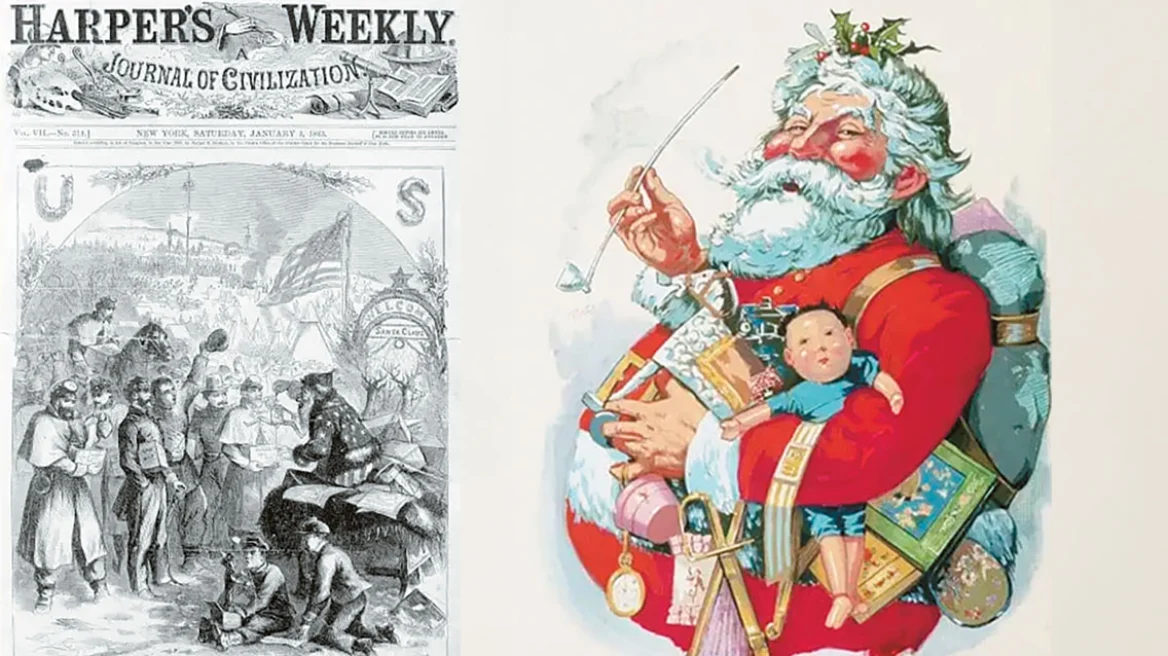
This Saint Basil bears the design signature of the Bavarian-born American great cartoonist Thomas Nast, who is considered the “father” of American political cartooning.
Puppet
Nast designed Santa Claus at just 23 years of age, in 1863. He presented him in the then-popular news magazine Harper’s Weekly. The first image of Santa Claus was that of a Union soldier holding a puppet of Jefferson Davis—the president of the Confederate States that seceded from the USA and formed an independent state during the Civil War—with a noose around its neck. This image of Santa Claus was established worldwide through advertising campaigns by Coca-Cola during the interwar years.
Nast was a multifaceted personality, with significant political and social engagement. Through his cartoons during the American Civil War, he supported the unity of the USA and denounced slavery in areas controlled by the South. Such was the power of his cartoons that Lincoln called him “our best recruiting sergeant.”
He also contributed to the dismantling of a group of corrupt officials of the Democratic Party led by congressman and businessman William Tweed. Additionally, he designed the symbols of the two major US parties: the elephant for the Republicans, whom he supported, and the donkey for the Democrats.
The historical events of January 1
New Year’s Day, as the starting milestone of each year, has been accompanied by major events of historical significance in the past. And this will continue in the future, as the first day of each year is customarily used to mark the beginning of a new period for countries, supranational institutions, and peoples around the world.
In the history of the European Union, for example, January 1 has been associated with the entry into force of the historic Treaty of Rome establishing the European Economic Community (EEC), signed by six states (Luxembourg, Belgium, the Netherlands, Germany, Italy, France), as well as with its successive enlargements, including the accession of Britain, Ireland, Denmark (1973), Greece (1981), Spain, Portugal (1986), Austria, Finland, Sweden (1995), Bulgaria, Romania (2007). It is also associated with the introduction of the euro into circulation and the start of the Eurozone on January 1, 2002. Similarly, in Britain, on the first day of 1788 the first issue of The Times of London was published, while on January 1, 1880, construction of the Panama Canal began based on the plans of Ferdinand de Lesseps; in 1904, the world’s first Highway Code came into force in England; and in 1934, the prison on Alcatraz Island in the USA was inaugurated.
Conversely, entirely by chance, January 1, 1822, was chosen by the First National Assembly of the revolted Greeks to proclaim at Epidaurus the independence of Greece and its political organization, adopting the first Greek Constitution, known as the “Provisional Regime” or “Law of Epidaurus.” On the same day, the blue-and-white flag was established as the official flag of the newly founded Greek state.
Ask me anything
Explore related questions




