





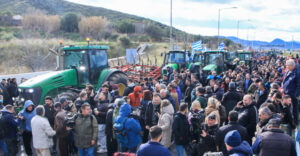
Either on Tuesday morning or at midday, representatives of the country’s farmers’ roadblocks will cross the threshold of the Maximos Mansion to meet Prime Minister Kyriakos Mitsotakis. For the first time after more than 40 days of farmers’ mobilizations, there appears to be light at the end of the tunnel—an outcome that would be beneficial both for the government, which had been accumulating political cost, and for the farmer union leaders, who admittedly had been escalating their actions without a clear prospect.
One day after the announcement of the package of measures for the primary sector, and despite leaks about administrative fines and criminal penalties, the government once again put the prospect of a meeting between the prime minister and the farmers back on the table. The farmers accepted the invitation, undertaking in turn to designate their representatives.
From the outset, Mr. Mitsotakis had made it clear that he would agree to talks only if the farmers’ delegation reflected all roadblocks nationwide. The telephone coordination was handled by Minister of Rural Development Kostas Tsiaras, in consultation with Kyriakos Mitsotakis, while government spokesperson Pavlos Marinakis outlined the framework for a possible meeting: open roads and collective representation. He also clarified—by way of an asterisk—that there is no additional money available and that the government can realistically discuss technical and structural issues concerning the primary sector.
At the same time, the government set aside plans for strong police deterrence, surprising even the farmers themselves. Behind the scenes, however, phones were ringing nonstop in the direction of arranging a meeting.
The strategy
The government is not celebrating this development for two reasons: first, because society has been—and continues to be—burdened by road closures; and second, because the mere fact that the meeting will take place does not automatically mean that the roadblocks will be lifted.
Nevertheless, a senior minister estimates to protothema.gr that “accepting the invitation means that the roadblocks themselves want a solution, since farmer union leaders cannot stay on the streets forever.” This remains to be confirmed in practice, depending also on the spirit of the discussion from the government’s side.
According to one line of information, securing the meeting on the “third and lucky” attempt—after two refusals by the farmers—also constitutes a vindication of the tougher line adopted by the government in recent days, aimed at regaining the initiative. According to other government officials, however, following the announcement of the government’s package of measures, the outcome was simply a matter of time.
Who will attend the meeting
Mr. Mitsotakis has international commitments in the coming days. His trip to Mainz, Germany, to meet Chancellor Merz was cancelled today, while on Monday he will be in Spain with Prime Minister Pedro Sánchez. For this reason, he proposed Tuesday as the most likely day for the meeting.
He will certainly be accompanied by Deputy Prime Minister Kostis Hatzidakis, Minister of Rural Development Kostas Tsiaras, Deputy Finance Minister Thanos Petralias, and possibly Mr. Tsiaras’ deputy ministers, AADE Governor Giorgos Pitsilis, interim OPEKEPE Governor Giannis Kavadás, and ELGA President Andreas Lykourentzos. It remains to be seen whether Giorgos Stassis, CEO of PPC (DEI), will also be invited, as key farmers’ demands are related to electricity—not only its price, but also payments and debt arrangements.
Ask me anything
Explore related questions




